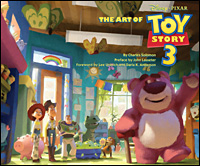
 Released May 21st, 2010
Page count: 176 pages
Size: 9.27” x 11.44”
The Art of Toy Story 3
Written by Charles Solomon
Preface by John Lasseter
Foreword by Lee Unkrich and Darla K. Anderson
Published by Chronicle Books
Distributed by Raincoast
http://www.chroniclebooks.com/
___________________________________________________________________________
The Art of Toy Story 3 Book Review By Erin V.
A lot of this book, especially at the beginning focuses not just on Toy Story 3, but on the first two installments as well and the similarities/comparisons. Unlike I have with other ‘art of’ books, I’m not going to list the section titles here, since they do give away key plot points of the film. I’ll just say that there are eight very informative sections.
Besides being a Pixar fan, I also have an interest in the intricacies pertaining to the behind-the-scenes of filmmaking, which is why I made it a point to read this book from cover to cover. Surprisingly, with the amount of images, reading it off and on it can be done in one-two days. Reading first-hand about a production of such an amazing film really does give a special insight into what works and what doesn’t.
A lot of this book focuses on lighting and colour scripts [palettes]. Considering the time-span between the first two movies and this one, with the technological advances the challenge was, (while adding better animation and more detail), to try to keep it still feeling like the same world. A good way to do this was with colour. By using similar palettes, the audience gets the familiar feeling that connects the films together even as the characters and sets get minor upgrades. A phrase those working on the film repeated to themselves often, was “Believability, not realism.” Sure, technology could allow things to look practically photorealistic, but it wouldn’t be believable in the Toy Story universe. Every decision had to benefit the story to connect with the audience.
I do want to note quickly that a two page colour script from TS1, as well as TS2 is included here, along with a four page (fold out) colour script from TS3. These are very neat all laid out like this to see how the colours change between the high/low emotional points in the story. Going hand in hand, the colour works best when flowing like the writing of a good script does – constantly changing and blending from one scene to the next.
Reading what some of the production people had to say was very interesting, but I won’t give you any more here, since you’ll want to read it for yourself. Basically, image as well as information rich, this is a book to be enjoyed by fans, as well as film students.
___________________________________________________________________________
To find out more about the The Art of Toy Story 3, or other books, visit Raincoast’s website here.
 The Joy of Movies