By John C.
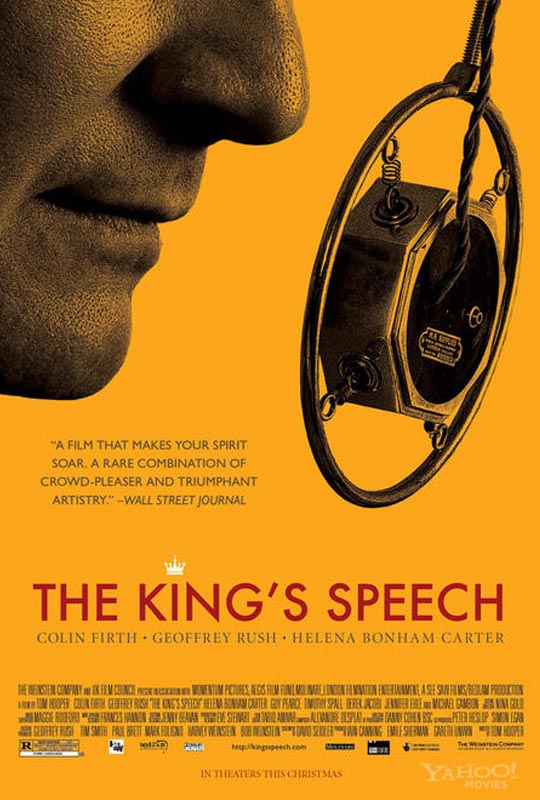 Recent Oscar winners The King’s Speech and Black Swan just can’t seem to shake the controversy. For Best Picture winner The King’s Speech, distributor Harvey Weinstein has ludicrous plans to release an edited version with crucial scenes of swearing taken out, and Natalie Portman’s recent Best Actress win for Black Swan seems to be getting degraded by allegations that she used a stunt double for the many scenes of dancing.
But after an exhausting awards season that finally came to a close just over a month ago, I’m sure I’m not the only one wishing that things could just be left well enough alone. Especially with Black Swan due on DVD tomorrow (check back soon for our rave reviews) and The King’s Speech hitting shelves on April 19th.
On February 7th, I openly disagreed with Harvey Weinstein’s proposal to censor several integral and powerful uses of the “f-word” from The King’s Speech. Oscar-winning lead actor Colin Firth has also spoken out against the decision, as have co-stars Geoffrey Rush and Helena Bonham Carter. But Weinstein has gone through with the edited version, and is planning to release it across the border on 1000 screens come April 1st.
The fact that Oscar-winning director Tom Hooper has also spoken negatively of the new cut just goes to show how disturbingly little control a director has over their own work once it’s in the hands of the distributor. But the real joke is that the plan is to market the period piece as “family entertainment,” and open it against Hop – a movie starring the Easter Bunny.
 Black Swan’s controversy came over the last week in the form of Natalie Portman’s on-screen dancing double, professional ballerina Sarah Lane. Lane has said that she did not receive proper recognition for her work on the movie, and despite Portman’s year-and-a-half of ballet training, she was only responsible for “5 percent” of the full body dancing that we see. Portman’s choreographer and fiancé, Benjamin Millepied, begs to differ saying that she was responsible for “85 percent” of the dancing.
Watching the film, I never presumed that these were all images of Portman actually dancing, but I do believe that she was responsible for more than “5 percent” of what we see on-screen. For me, the fact that she did not do all of her own dancing in no way downgrades her performance or recent Oscar win. In many ways Portman’s extensive ballet training was a form of method acting to get inside the mind and physical exhaustion of a dancer, rather than to perform all of her own stunts.
Maybe Sarah Lane wasn’t given enough credit, but the bottom line is that we wouldn’t even be having this argument had Black Swan been a special effects-heavy picture where stunt doubles are commonly used. Dancing is used metaphorically and supplies the axle on which the film is based, but at its heart Darren Aronofsky’s ballet thriller is a character-driven portrait of Nina Sayers, and her slow descent into madness. Dancing is Nina’s life, it is all she knows. Ballet is what puts so much pressure upon her, but it is also her only escape.
Natalie Portman is the one who has brilliantly brought Nina to life, not just as a dancer but as a tortured soul. It takes an actress of her caliber to slowly and quietly unravel on-screen, as we watch her fall under the possible seduction of both her instructor and her understudy. Portman is the one we are watching as her character is both terrified and helplessly in need of her mother, and it is undeniably her performance as Nina’s fragile mind is dangerously pushed over the edge.
Oscar-winners deservedly garner publicity long after the Academy Awards are announced, but these are two films that have gained a little too much publicity of the negative kind. I just hope that these controversies in no way diminish people’s appreciation of the great films at hand.
 The Joy of Movies