By John Corrado

In his over twenty years as an animator at Pixar, Peter Sohn has directed the short film Partly Cloudy, the feature The Good Dinosaur, and also lent his voice to characters in Ratatouille (Emile), Monsters University (Squishy) and Lightyear (Sox). Sohn is now directing Elemental for the studio, which is set to be released in theatres on June 16th.
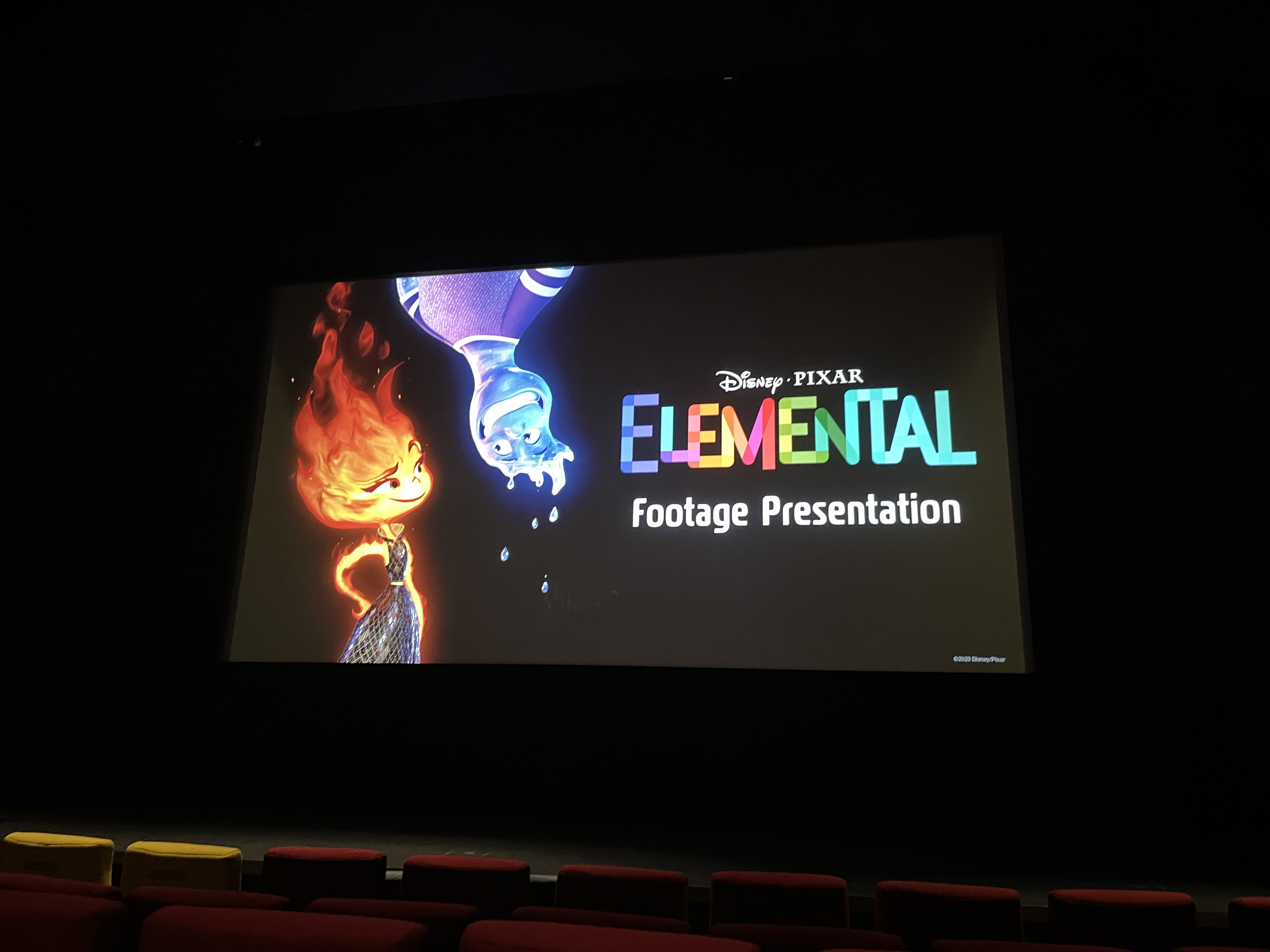
Sohn was in Toronto this morning to unveil exclusive footage from the upcoming film in front of an audience of press at TIFF Bell Lightbox, and I was lucky enough to be in attendance.
We saw four extended clips from the film, which the director noted is about two weeks away from being fully finished. These scenes showed us a good bit of the film’s setting – a place called Element City that is separated into boroughs for its fire, water, land, and air residents – and introduced us to the two main characters; Ember Lumen (Leah Lewis) and Wade Ripple (Mamoudou Athie), the personification of fire and water who meet and fall in love.
The footage was followed by a slideshow presentation with Sohn on-stage highlighting the unique challenges of animating these characters, as well as a Q&A with the director moderated by host Marriska Fernandes. Throughout the event, Sohn spoke candidly about the characters and animation process for the film (which has been seven years in the making), as well as the story, which is deeply personal for Sohn and serves as a tribute to his parents.
Sohn started the Q&A by noting how the film serves as a “thank you” to his mother and father, who both sadly passed away at different points during the production. Sohn revealed that the initial germ of an idea for the film came from being in school and visualizing the periodic table as a grid of apartments, with the different elements having to interact with each other (Sohn joked about platinum and gold having to be next to mercury, and helium way up in the corner).
But he only really found the “heart” of the story when others at the studio – including other first and second generation immigrants – suggested that he base it around the immigrant experience of both his parents, who came to America from Korea in the early-1970s, and opened a store in the Bronx. “I’ve seen this movie so many times,” Sohn began. “So many times you’re watching it, you can lose objectivity and get lost. My north star for this has always been about thanking our parents for their sacrifices, it’s how this idea started,” he remarked.
“I remember going to this event with my parents, it was in the Bronx in New York, and they were like ‘you’re from Pixar, we want to celebrate the arts,’ and I went up on stage and I looked at the crowd and there was this huge, diverse group of people, and my parents were up in the front – these yellow faces up there – and they were crying, and I lost it,” Sohn said.
“I just remember I had a speech I was going to give, and I didn’t give it because I was so overwhelmed by seeing them. And I just thanked them, you know, ‘thank you mom and dad for giving my brother and I a life.’ And I remember someone in the crowd going ‘you better thank them!’ But I came back to Pixar and somebody asked me, how was New York? And I told them the story, and they were like ‘Peter, you have to do that as the movie.’ So that has been the thing that I came back to when I was getting lost during this.”
Sohn talked about how the “opposites attract” story is not only influenced by his parents, but also by his own experience of growing up Korean in New York City, and marrying a “non-Korean” woman. Sohn noted that his grandmother’s dying words were essentially “marry Korean” (which is also alluded to in the film), with this culture clash providing the main inspiration for the film’s central love story between Ember and Wade.
The design of Element City is based on real life New York City, with Sohn explaining how Water Town is sort of like the Upper East Side, and they had fun with design elements for the different areas (such as a cyclone sports stadium). But the biggest challenge of animating the film, Sohn noted, is that every shot is basically an “effect shot” involving fire and water, and these effects also double as characters.
Sohn talked about needing to find the right balance between not making them too realistic or “abstract” so it is hard to connect to them (especially in the case of Wade, who at one point in development he said was completely see through), while also retaining recognizable qualities of their original elements and how they evoke different emotions. The main challenge of the film, as Sohn highlighted throughout his presentation, was to not only design characters based off of these elements, but to get emotive performances through these effects.
“Early on, Ember was more a superhero,” Sohn revealed, “where she was just throwing fire everywhere, but you didn’t feel anything from it. Then there was this one drawing we were playing with of Ember as a candle, and it connected to that sort of naked vulnerability that you can get to when you’re connecting with someone. The tools that they created to have Ember’s fire fluctuate between anger and candlelight is one of the most exciting things because of how it is tied to the performance.”
While Ember presented the challenge of portraying a gaseous character who is fire instead of on fire (“she doesn’t have a skull,” Sohn noted), with Wade it was “difficult to find the wateriness.” Ember has what Sohn characterized as an “upwards, drafting energy” since she is only light, where as Wade is more slippery and much heavier. Sohn also talked about how the inherent conflict between fire and water, which came about through a drawing he did of a fire and water character together that got him thinking about the “symbiotic relationship” between the different elements, helped inform these characters and this world.
Sohn also mentioned how the similarities between the personalities of lead voice actors Lewis and Athie and their characters helped bring Ember and Wade to life, while revealing to a warm reception from the hometown crowd that Canada’s own comedy legend Catherine O’Hara is voicing Wade’s mother, with the director remarking on how much fun it was to have her in the recording studio.
Sohn talked about how Pixar strives to deliver “emotionally truthful performances through animation,” and this film seems to very much follow in that tradition. From the footage we saw, Elemental seems to be quite the visual treat, as well as an impressive technical achievement; Sohn revealed that it took a whopping 151,000 computers to render the film. This is compared to 294 on the original Toy Story in 1995, roughly seven hundred on Monsters, Inc., and nearly a thousand on Finding Nemo, with Sohn showing an onscreen graph to really highlight this massive jump.
Sohn also touched upon the benefits of getting to spend seven years working on and developing the story for Elemental (close to the eight years that the studio spent on developing their modern classics Up and Coco), versus the experience he had taking over directing duties on The Good Dinosaur – a notoriously troubled production – eighteen months before it was released in theatres when the original director got taken off the project.
Finally, Sohn reiterated that Elemental will be released in theatres, despite four Pixar movies in a row being released directly to streaming, saying that they have a theatre at Pixar where they preview all of their work on the big screen, and he loves making movies for that format. “We’re excited for it to go onto streaming plus,” he said, “but for Elemental, it won’t go onto streaming plus right away.
“There will be a bigger window, just because we’re so proud of this film,” Sohn said. But the director still assured us that the lighters are grading it so that it will look great on every format (including iPhones), and he also noted that they really pushed the 3D further out from the screen this time around – instead of just using it for depth – to showcase different, well, elements of this world.
Sohn began the Q&A by telling host Fernandes that he definitely relates more to the water element, and is a lot like Wade in terms of how “emotional” he is. “I wish I was more fire, but I’m a sap,” Sohn said, adding that Wade’s “emotional side” is what he most relates to in the character. And we can already tell that Sohn put a lot of his own heart into this film.
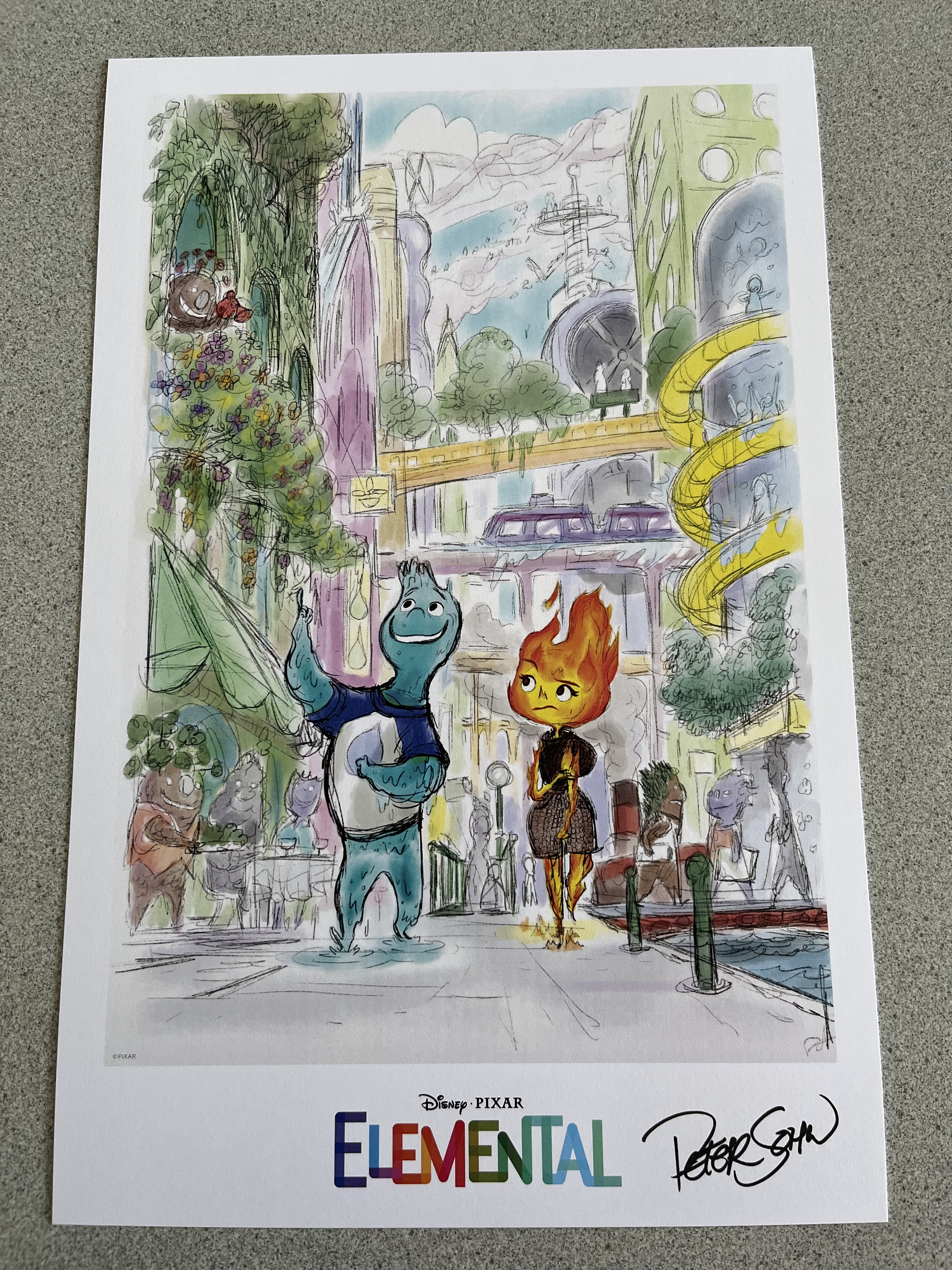
Everyone at the presentation also received a lovely art print signed by Peter Sohn, pictured below.
 The Joy of Movies
wow
LikeLike