By John Corrado
★★★ (out of 4)
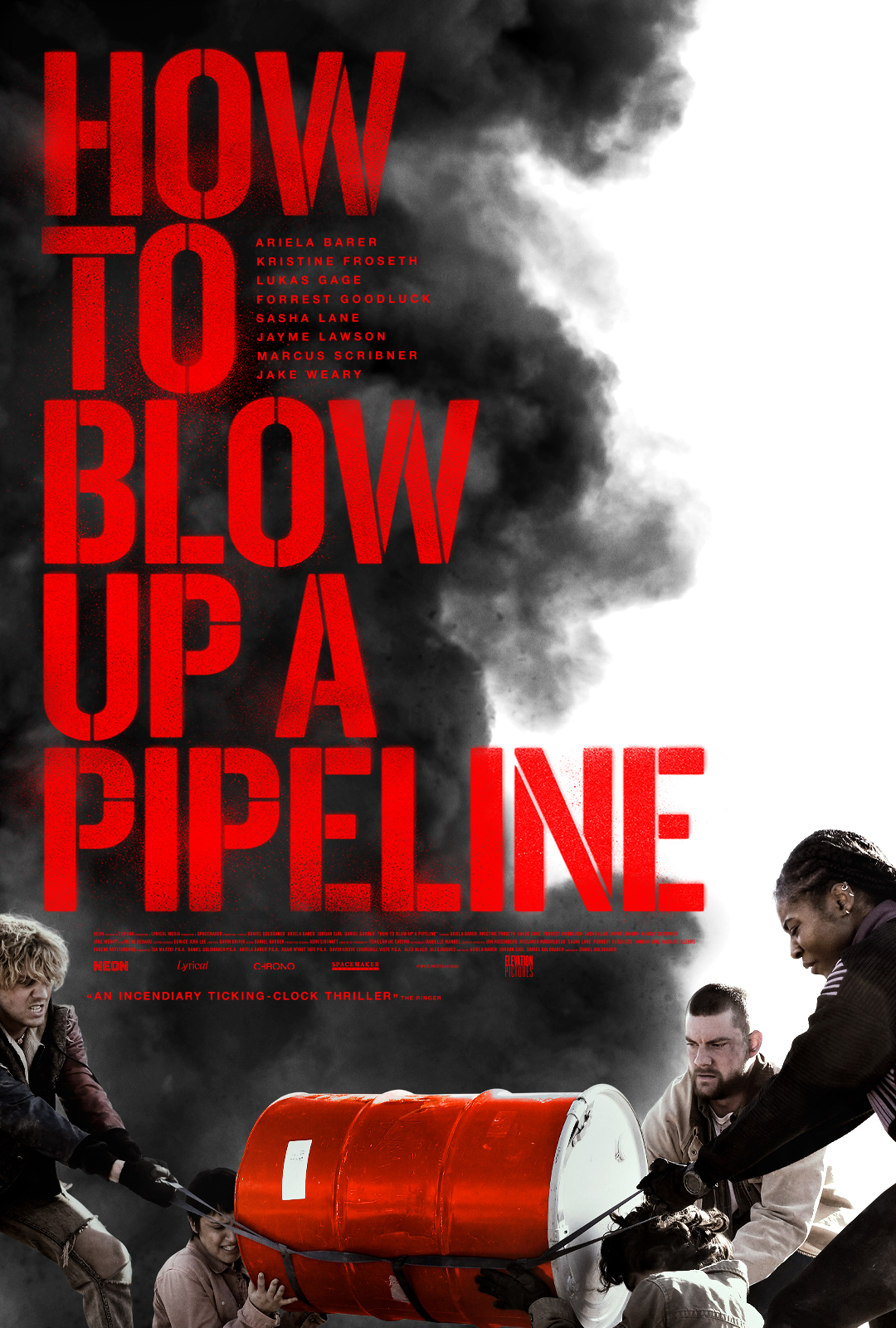 Director Daniel Goldhaber’s provocatively titled second feature How to Blow Up a Pipeline – which has garnered a lot of buzz since it premiered at TIFF last year, and also (unsurprisingly) stirred up controversy – is a tautly paced thriller following a group of eco-terrorists plotting to blow up an oil pipeline in West Texas.
Inspired by Andreas Malm’s non-fiction book of the same name, Goldhaber’s film centres around a group of young adults who see a lack of action around climate change, and decide to take their own drastic measures to send a message.
Two of the main instigators are Theo (Sasha Lane) and Xochitl (Ariel Barer), friends who grew up amidst the refineries of Long Beach, California and have experienced the impacts of climate change first-hand in the highly polluted area.
Xochitl is involved in climate activism at her university, but begins to question if passive measures are leading to real change, and becomes convinced that more extremist actions have become necessary. She assembles a ragtag group, including Theo’s girlfriend Alisha (Jayme Lawson), her friend Shawn (Marcus Scribner), the drifter anarchist couple Rowan (Kristine Froseth) and Logan (Lukas Gage), as well as the live-wire amateur explosives expert Michael (Forrest Goodluck) and the intense Dwayne (Jake Weary).
The characters all have their own motivations for getting involved. For example, Goodluck’s Michael is an aimless, depressed Native kid from North Dakota who picks fights with the white men who come to work in the oil fields, while Weary’s Dwayne is a redneck, gun-toting Texan patriot who is pissed at the government for repossessing his family’s land to build part of the pipeline.
Their goal is not to kill anyone or spill any more oil than would be spilled on a normal day, with part of the plan involving shutting off the flow before detonating the bomb. They simply want to destroy a piece of critical infrastructure to tank the price of oil on the stock market (the film doesn’t get into the idea of strategic oil reserves or how a disruption in domestic oil distribution would lead to increased reliance on foreign oil delivered by rail and ship which is worse for the environment, but I digress).
In bringing Malm’s non-fiction book to the screen, which argued for sabotage as a legitimate form of climate activism, Goldhaber and his co-screenwriters Barer and Jordan Sjol have crafted a fictitious but eerily believable environmental thriller. The film serves less as a literal book adaptation, and more of an exploration of the ideas within it. Malm’s book actually makes a brief onscreen appearance at one point, with a character shown reading it in a bookstore and another remarking that it “doesn’t actually tell you how to do it” (i.e., blow up a pipeline).
The film opens with the team already assembled and the plan already in motion, with Goldhaber employing a fractured narrative that strategically cuts to flashbacks introducing us to each of the characters while they are already in the midst of carrying out their mission. This helps recontextualize some of their reasonings for taking drastic measures as the film goes along, while also building tension through the precise editing by Daniel Garber, including cuts at key moments.
The film can feel heavy-handed at times as it comes down decidedly on the side of radical action, which does strip some necessary nuance from the film. The characters themselves also aren’t really the most sympathetic, with several of them seeming at best unconcerned with potential injuries or collateral damage. One character argues it is poor people who will suffer the most for their actions, while another flippantly counters that it’s better for people to have to pay more for oil “now” than to “not be able to breathe in five years” from climate change.
There is a brief but fascinating conversation about the roles of different revolutionaries throughout history who were considered “terrorists” in their time, dating all the way back to Martin Luther King Jr. and Jesus Christ, with several of the characters arrogantly putting themselves in this group. In this way, the characters come across as overly ideological young activists with a dangerously inflated sense of self-importance, but this is also sort of the point; there is a youthful grandiosity to how they view themselves.
I will admit that I am decidedly against the film’s radical politics. But, as a stylish environmental thriller that plays around with elements of the heist genre, How to Blow Up a Pipeline is a consistently engaging film that shows a lot of promise for Goldhaber as a filmmaker. The film has a scrappy, anarchist bent to it, with Tehillah De Castro’s gritty 16mm cinematography giving it a sort of DIY feel, and Gavin Brivik’s pulsating techno score upping the tension.
 How to Blow Up a Pipeline is now playing exclusively in theatres in limited release. It’s being distributed in Canada by Elevation Pictures.
 The Joy of Movies