By John Corrado
★★★ (out of 4)
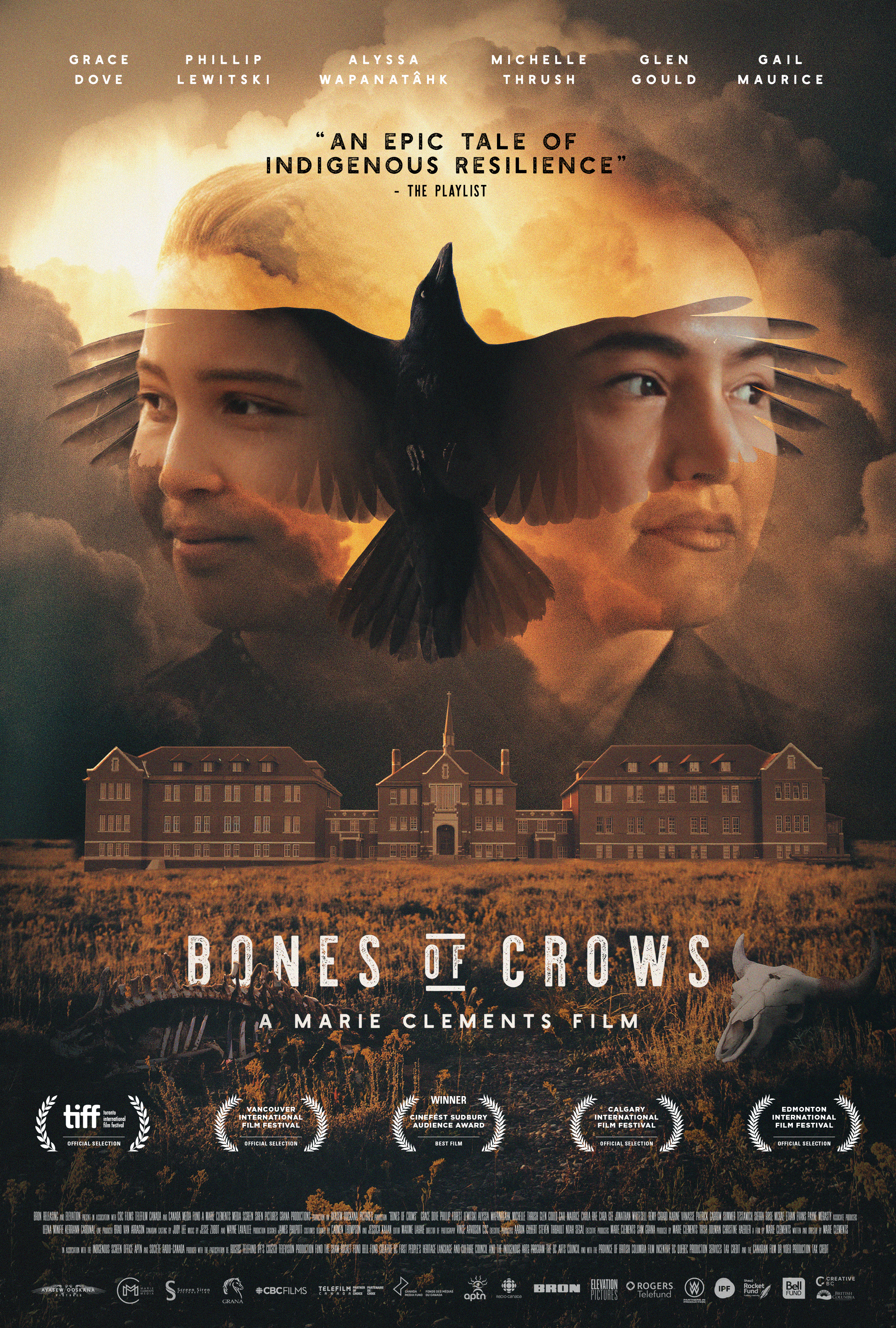 Written and directed by Marie Clements, Bones of Crows is an ambitious Canadian drama that follows the life of a residential school survivor over many years, and the scars that remain from the trauma that she has experienced.
The film spans multiple decades in the life of Aline Spears (played by Grace Dove, with Summer Testawich portraying her as a child in flashbacks and Carla-Rae in flash-forwards), a Cree woman from Manitoba, with the story freely jumping back and forth between different points in time.
We go from 1942 with Aline getting married to Adam (Phillip Lewitski) in Montreal before he ships off to London for the war, to 1932 when she is a student at the residential school and known as a piano prodigy, who is afforded “special privileges” by her piano teacher Thomas (Jonathan Whitesell) and Father Jacobs (Rémy Girard).
These flashbacks, showing how Aline and her two younger siblings were taken from their parents (Glen Gould and Michelle Thrush) and placed in the care of the Catholic Church, provide context for what she is experiencing later in life. Clements is sure to highlight the abject cruelty of these institutions. In one scene, Aline is forced to play piano as Father Jacobs shares a feast with other representatives from the Catholic Church, and brags about keeping the students on a meagre diet of rations to carry out scientific experiments on starvation.
The story itself is a massive undertaking by Clements, as it not only spans nearly a century but also jumps from Manitoba to Montreal, Toronto to London. During the war, Aline is hired as a translator by the Canadian Air Force due to her ability to speak Cree, noting the irony of how the same government that tried to erase her language now views her as an asset for still being able to speak it.
By constantly shifting focus and going back and forth like this, Clements is able to show how traumatic memories continue to linger and resurface, including several moments when scenes bleed into partial flashbacks as the events that characters are experiencing in their present lives trigger something from their past. It’s a tough film, but one with a through-line of resilience, showing the moments of mercy from others that allowed Aline to endure.
There are plans to release an extended version of the movie as a five-part miniseries that will expand the narrative even further. As such, Bones of Crows does at times play like a series that has been truncated into a roughly two hour film, which does strip some development from supporting characters and can make it feel more like a collection of sequences showing the horrors that Aline has experienced. But strong performances and a number of stirring moments save this from being a Heritage Minutes-style history lesson.
In addition to scenes showing the abuse that took place in residential schools (fair warning, the film is disturbing to watch at points), Clements has also crafted a story about survival and resilience in the face of a system that was designed to erase entire cultures. The film is carried by fine performances from its cast, including the three actresses portraying Aline at different points in her life, as Clements conjures some startling and haunting images throughout. The last act brings the story into present day, as the final moments offer a sobering look at the lingering impact of the trauma that survivors and families have endured.

Bones of Crows opens exclusively in theatres on June 2nd. It’s being distributed in Canada by Elevation Pictures.
 The Joy of Movies