By John Corrado
★★★★ (out of 4)
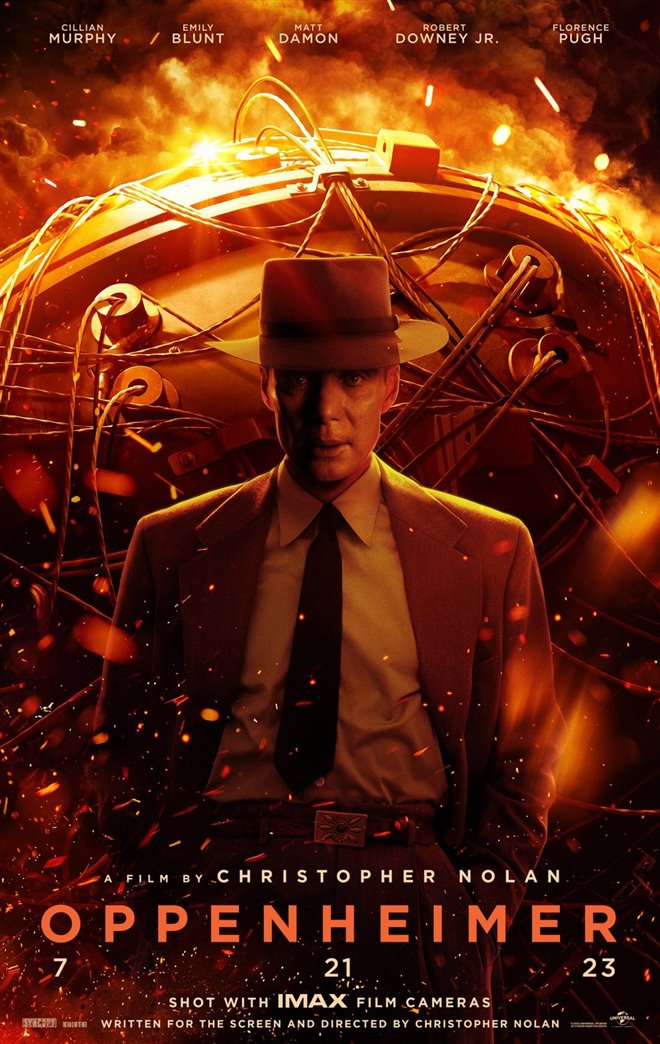 “Now I become death, the destroyer of worlds.”
Taken from Sanskrit, these were the famous words spoken by American physicist J. Robert Oppenheimer following the test of his atomic bomb in the Los Alamos desert, an invention that would be used to take countless lives when it was detonated over Japan.
In Oppenheimer, filmmaker Christopher Nolan dramatizes the story of the famous scientist and his infamous invention. The result is one of the most interesting summer blockbusters in recent memory; a challenging, three-hour long historical drama that doubles as a gripping character study of a genius dealing with the fallout of his creation.
Adapted from the book American Prometheus by Kai Bird and Martin J. Sherwin, Nolan’s film charts Oppenheimer’s race to invent the atomic bomb during World War II, as well as a post-war trial involving interrogations around his involvement with communist politics. In the main timeline, Oppenheimer (played by Irish actor Cillian Murphy) works feverishly on the Manhattan Project (in a town built on Native American land by the US government in Los Alamos to house scientists and their families), to beat the Germans in the creation of a nuclear weapon.
On a personal level, the film shows Oppenheimer’s marriage to Kitty (Emily Blunt) and his affair with Jean Tatlock (Florence Pugh). The secondary timeline focuses on Oppenheimer’s involvement with Lewis Strauss (Robert Downey Jr.), who served on the United States Atomic Energy Commission and is seeking a higher appointment as Secretary of Commerce after the war, but faces a Senate confirmation hearing that is complicated by his ties to the Manhattan Project.
This is weighty, often riveting stuff, brilliantly performed by Murphy and the rest of the staggering ensemble cast. The film features a who’s who of character actors, including Matt Damon as Manhattan Project director General Leslie Groves, and Benny Safdie as Edward Teller, the Hungarian-American physicist working on developing a hydrogen bomb. But Murphy’s main match is Downey Jr., whose Strauss dominates the last act as Oppenheimer’s show trial comes into sharper focus, including moments of verbal fireworks.
Nolan employs an ambitious narrative structure through his adapted screenplay, jumping back and forth in time while shifting between black-and-white and colour (as well as shifting aspect ratios). Despite its demanding running time and fractured narrative structure, the film has a propulsive, almost obsessive drive to it, and it’s a testament to Nolan’s skill (and Jennifer Lame’s editing) that the densely packed story remains pretty easy to follow through its multiple threads.
Nolan’s mastery lies in how he plays around with time and uses sound. One incredible example of this is the Trinity Test sequence, when the atom bomb is first detonated in the middle of the Los Alamos desert, with Nolan building tension and suspense around his stunning recreation of the blast. It’s one of the finest set-pieces that Nolan has ever directed, and will go down as a classic. The film is heightened by Hoyte van Hoytema’s glorious 70mm cinematography (it looks incredible in IMAX, even projected digitally), as well as Ludwig Görranson’s pounding musical score.
Throughout it all, Nolan remains tightly focused on the almost narcissistic perspective of his brilliant but tortured protagonist, with Oppenheimer unfolding like the jittery memories of someone wracked with guilt, realizing the cataclysmic devastation that his invention has caused. The film has received some criticism for not actually showing the bombings in Hiroshima and Nagasaki or the Japanese perspective, though I think this is a fascinating narrative choice that is far more indicative of the chilling indifference of how so many Americans viewed them at the time.
The point of Nolan’s film is in showing Oppenheimer’s individual realization that the nuclear genie can never be put back in the bottle, as he grapples with the looming, existential threat of the destruction of the world. It’s an arc that is played exceptionally well by Murphy, especially in piercing closeups, as Nolan builds to a devastating final scene that puts everything into perspective in a haunting way.

Oppenheimer is now playing exclusively in theatres.
 The Joy of Movies