By John Corrado
★★★½ (out of 4)
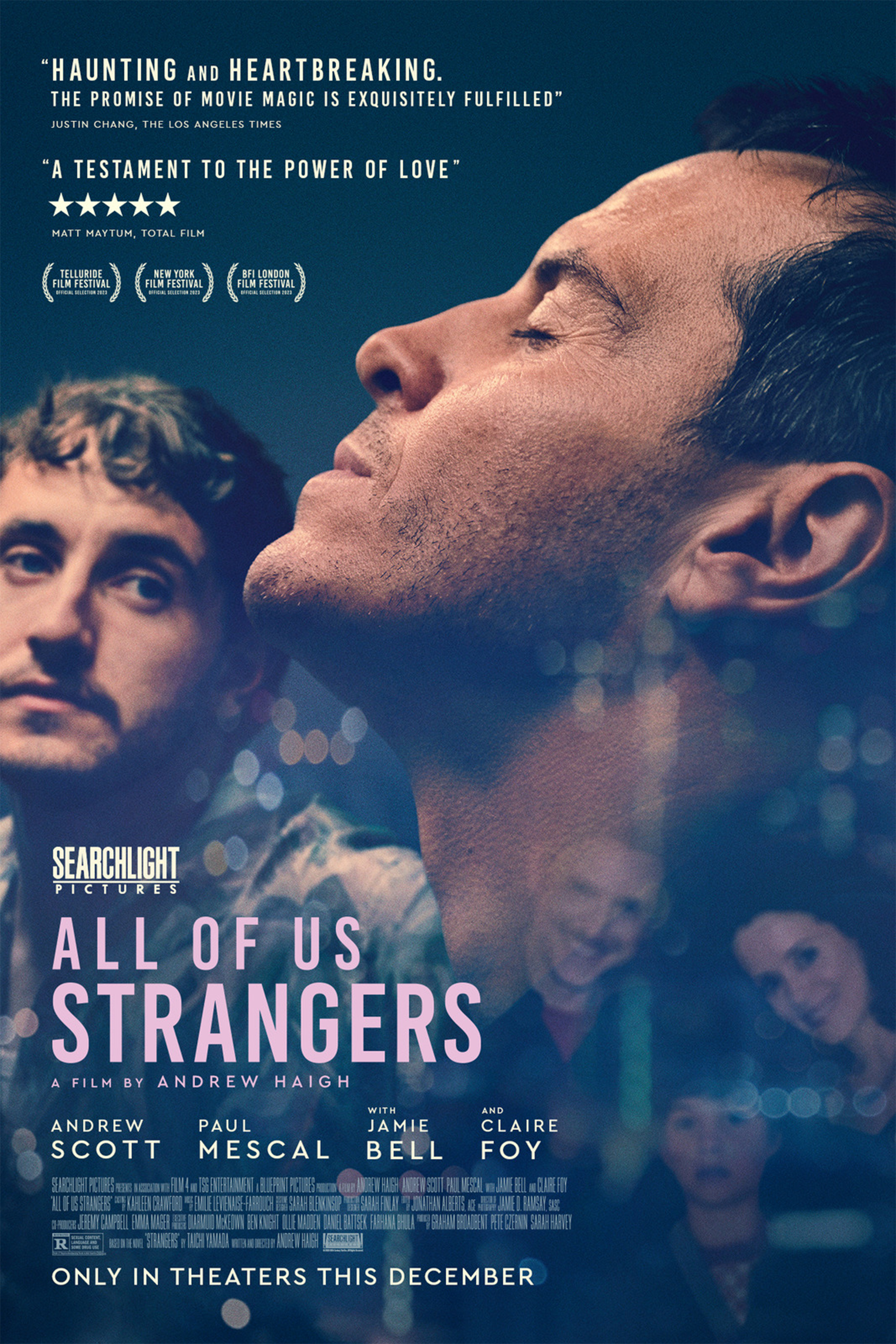 The latest work from writer-director Andrew Haigh, whose 2011 breakout film Weekend remains an essential piece of queer cinema, All of Us Strangers is a tender, dreamlike meditation on grief and loneliness.
Working from the 1987 Japanese novel Strangers by Taichi Yamada, Haigh’s film is a ghost story in both the literal and figurative sense. It’s a story about the cruel passage of time, seen through the eyes of an adult child given the chance to reconnect with his deceased parents.
The film centres around Adam (Andrew Scott), a screenwriter struggling to work on a script about his life. He lives in a nearly empty apartment tower in London, where the only other resident seems to be his neighbour Harry (Paul Mescal), who drunkenly comes to his door one night and propositions him.
Harry seems as lonely and isolated as Adam, perhaps even more so, but is seeking out a connection through him. Adam leaves his apartment to take train rides back to the suburbs where he grew up, and ends up back at his childhood home, where he encounters the ghosts of his mother (Claire Foy) and father (Jamie Bell), who are seemingly the same age as when they died.
The concept of talking to your late parents as if you were a child as an adult could have been used for cheap sentimentalism. But Haigh, a deft observer of human interaction whose previous films have been grounded in naturalism, crafts a devastating work that exists somewhere between dream and memory. There are hints of surrealism at play here, with Jamie D. Ramsay’s cinematography offering ethereal lighting and some fascinating uses of mirrors and reflective glass windows.
The sunlight shining through Adam’s high up apartment windows looks too intense, golden to the point of burning. The near-emptiness of the high rise building also turns it into a sort of liminal space (until they venture out to a nightclub, there don’t even seem to be many people in this world). Even the warm interiors of Adam’s family home, including a childhood bedroom that remains intact with all of his boyhood possessions, feel a little too perfect, as if they exist in a fantasy version of the past.
I haven’t read the original Japanese novel, but Haigh’s biggest interpretation seems to be in turning this into a gay love story. He also finds a fresh, compelling way to explore the “coming out” narrative, with Adam being given the chance to reveal to his late parents – who died when he was an boy – the things they never got to know about him, including his sexuality.
But their responses are measured, with their understanding of what it means to be gay having been frozen in time around the AIDS epidemic. This allows Haigh’s adapted screenplay to explore aspects of queer identity, and the impact that growing up having been told that being gay meant living a life of loneliness or illness had on a generation of men (a perspective not really understood by the younger Harry).
Andrew Scott’s aching performance is what holds the film together. The way the actor holds himself, reduced back to being a child seeking the approval of his parents, is both compelling and moving to watch. He is supported by poignant turns from Mescal, Bell, and Foy. Foy is pitch-perfect as the loving if somewhat icy mother, and Bell brings understated emotion to his portrayal of a father reconciling with not having been more emotionally supportive of his son. Meanwhile, Mescal plays his lost soul love interest as somewhat of a fascinating enigma.
This really is mostly a chamber piece between these four people, with Haigh allowing several haunting conversations to unfold. These exchanges between the characters, who are allowed to reconnect across space and time in a way that lets us suspend all disbelief, offer moments of deep catharsis. The film works on a pure emotional level, while also leaving itself open to some interpretation, in a way that deepens the heartbreaking experience.

All of Us Strangers opens exclusively in theatres in limited release on January 5th.
 The Joy of Movies