By John Corrado
 The feature directorial debut of Canadian filmmaker Meredith Hama-Brown, Seagrass is a patient character drama that captures the slow deterioration of a biracial family unit.
Judith (Ally Maki) is a Japanese-Canadian woman who is experiencing difficulties in her marriage to non-Asian husband Steve (Luke Roberts). These challenges are amplified by Judith’s mother having recently passed away, leaving a void in the family.
The film unfolds while the couple is on a family retreat to the Pacific coast with their two daughters Stephanie (Nyha Huang Breitkreuz) and Emmy (Remy Marthaller), which includes couples counselling sessions meant to smooth over the problems in their marriage.
Drawing from personal experiences, Hama-Brown’s Seagrass is effective at showing the series of cascading factors that contribute to the breakdown of a marriage. It’s in these group therapy sessions that Judith and Steve encounter Pat (Chris Pang) and Carol (Sarah Gadon), another interracial couple. Pat is a charming, confident Asian man, who causes Judith to question her own cultural ties, while his mere presence seems to intimidate Steve.
The film balances this out by also showing things from the perspective of the two daughters. It’s perhaps most impactful in capturing the simple, almost universally relatable moments that leave a big impact on your psyche growing up, such as the casual racism that the kids experience, or Judith getting annoyed by her kids being, well, kids.
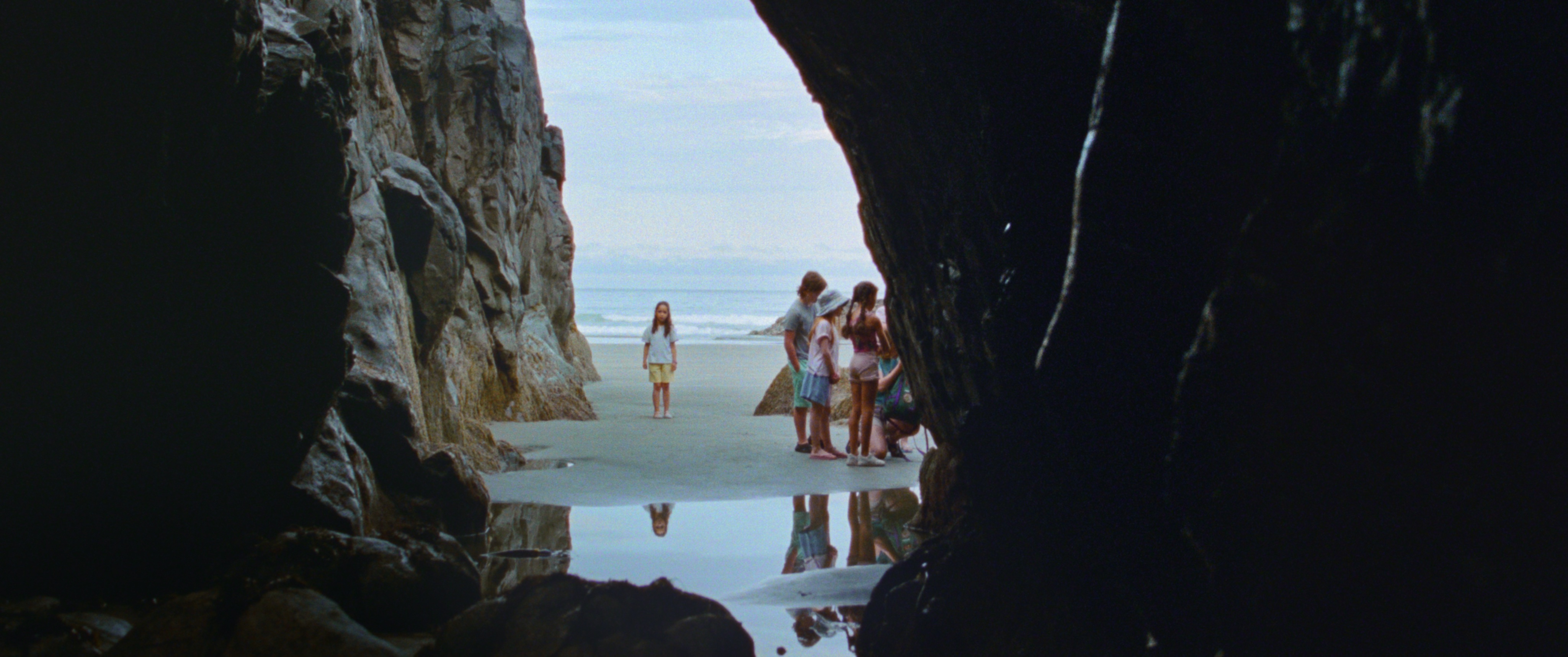
Stephanie is about eleven, and at that age where she is starting to pull away from her six-year-old little sister, yearning to hang out and test the boundaries with other adolescents. Meanwhile, Emmy is lonely and struggles to make friends, leaving her to explore the house and island where they are staying on her own, feeling the presence of her late grandmother. Through this, Hama-Brown deftly works in some vaguely supernatural undertones, with the foreboding presence of a cave that the other kids tell Emmy can bring back ghosts of the dead, if you go inside and think about them.
The cinematography by Norm Li (The Body Remembers When the World Broke Open, Something You Said Last Night) offers the perspective of a floating, watchful eye through sequences where the camera tilts and pans as if on a boat gently swaying side by side. Li also captures the majesty of the surroundings in widescreen shots of the landscape, with the film’s soft pastel colours giving a lush beauty to it.
It’s a film of small observations that lead to a few quiet revelations, particularly in how Judith views her relationship. Hama-Brown takes an observational approach, building to a climactic crescendo followed by a simple but no less impactful final moment that allows her uniformly well-acted film to linger.
Film Rating: ★★★ (out of 4)
Seagrass opens exclusively in theatres in limited release on February 23rd, including TIFF Lightbox in Toronto. It’s being distributed in Canada by Game Theory Films.
 The Joy of Movies