By John Corrado
Napoleon is Nominated for Best Production Design, Best Costume Design and Best Visual Effects at the 96th Academy Awards
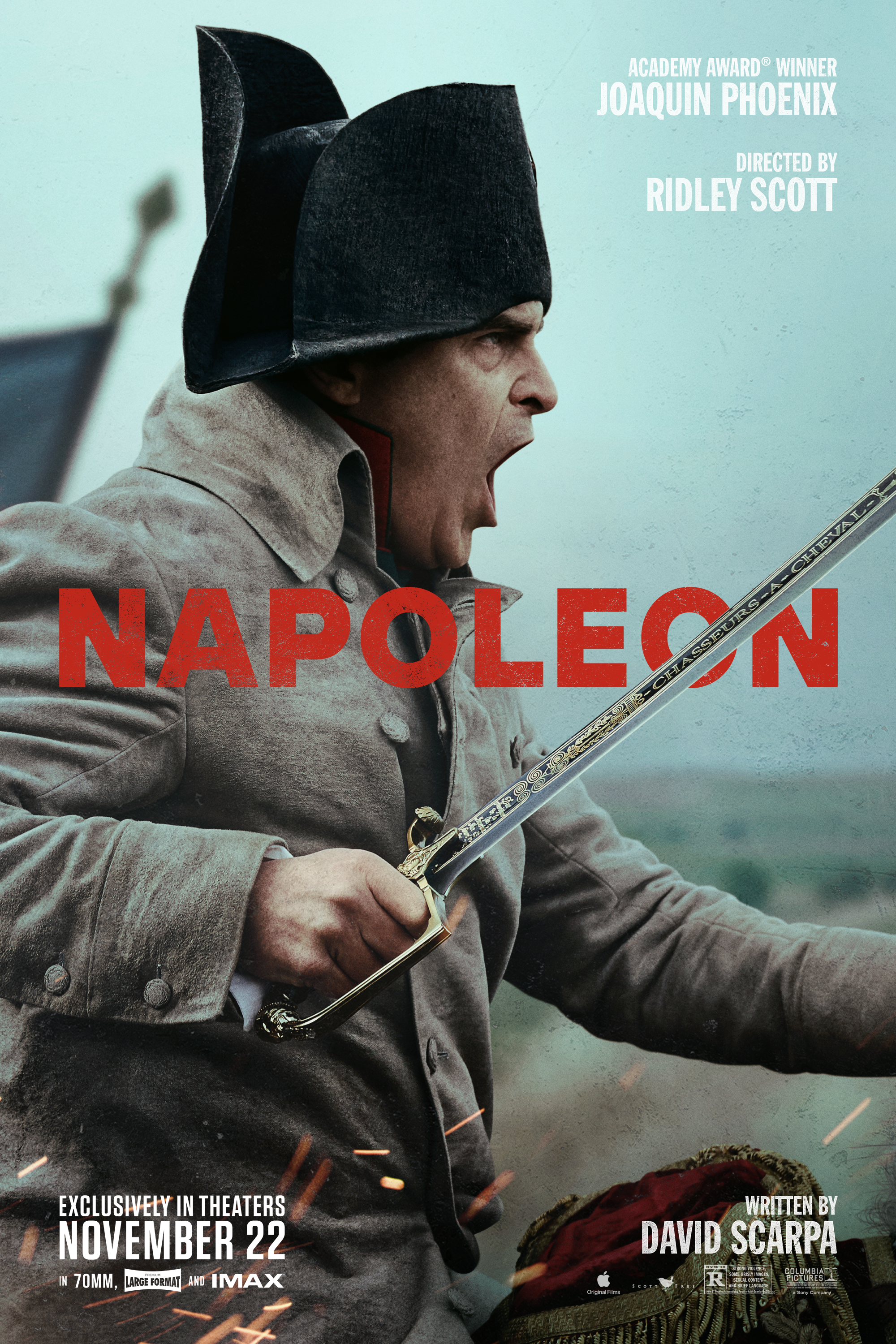 Throughout his long career as a director, Ridley Scott has been no stranger to big budget filmmaking and risk-taking, and his latest film Napoleon – the result of a complicated, months-long production – is an example of both.
Scott’s Napoleon is a sweeping yet eccentric portrait of French Emperor Napoleon Bonaparte, that eschews hagiography of its subject for a portrayal that at times borders on satire. The result is a film that is perhaps more entertaining than expected, with an element of camp to it that will either work for you or seem insultingly ahistorical.
Joaquin Phoenix stars in the titular role of Napoleon Bonaparte, noticeably offering his own unique take on the historic figure. The film opens with him as a young army officer in 1793 in the midst of the French Revolution, observing the public beheading of Marie Antoinette.
From here, the film charts his rise to general and French Emperor after stealing the crown, offering a sort of “greatest hits” of his military achievements along the way. But the main focus is on his pursuit of widow Josephine de Beauharnais (Vanessa Kirby), who becomes his first wife, and their struggles to conceive an heir.
And herein lies the most controversial aspect of Napoleon; the film not only portrays him as a brilliant military strategist, but also as a petulant, socially awkward man consumed with trying to prove himself and keep his wife. In other words, Phoenix’s Napoleon is essentially a pathetic simp around Josephine, who stamps his foot and grunts when he wants sex. It’s as much an interrogation of the idea of a Napoleonic complex and where it came from, as much as it is a portrait of the man himself.
Phoenix is one of our most fascinating actors, willing to take risks in his almost idiosyncratic portrayals of complex characters (there are moments where his portrayal of Napoleon recalls his Oscar-winning take on The Joker, like a mad dash away from guards). Phoenix’s Napoleon behaves erratically at times, but the actor adds something interesting to the interpretation. His appearance even resembles an old portrait, his mouth in a near-permanent frown.
Aside from its focus on domestic melodrama and marital strife, Scott’s Napoleon also delivers the massive battle scenes that we want from this type of movie. The film’s most visually striking sequence (and surely the one that got it the Visual Effects Oscar nomination) is the Battle of Austerlitz, when Napoleon and his army push back against Russian and Austrian forces over a frozen lake. Cannonballs shatter the ice, causing men and horses to fall in, the camera capturing this from below the surface, in a series of visceral images.
The cinematography by Dariusz Wolski presents images that recall old paintings, capturing the opulent production design in glorious wide shots. Despite its lengthy 158 minute running time, the film moves at a surprisingly quick clip. But the narrative can feel a little bumpy, with constant jumps ahead in time – which require subtitles telling us what year we are in in order to keep up – that make parts of Napoleon’s life feel glossed over.
There is a reported four-hour director’s cut of the film that will likely help flesh out more aspects of the story and characters. As it stands, the theatrical (and streaming) cut of Napoleon works as a flawed but largely entertaining historical drama with a decidedly idiosyncratic portrayal at its centre.
Film Rating: ★★★ (out of 4)

Napoleon is now available to stream exclusively on Apple TV+.
 The Joy of Movies