By John Corrado
 Alex Garland’s Civil War, the filmmaker’s visceral near-future portrait of an America on the brink, doesn’t divide things into Red States and Blue States. In fact, the story’s imagined alliance between California and Texas doesn’t even make much sense along current political lines.
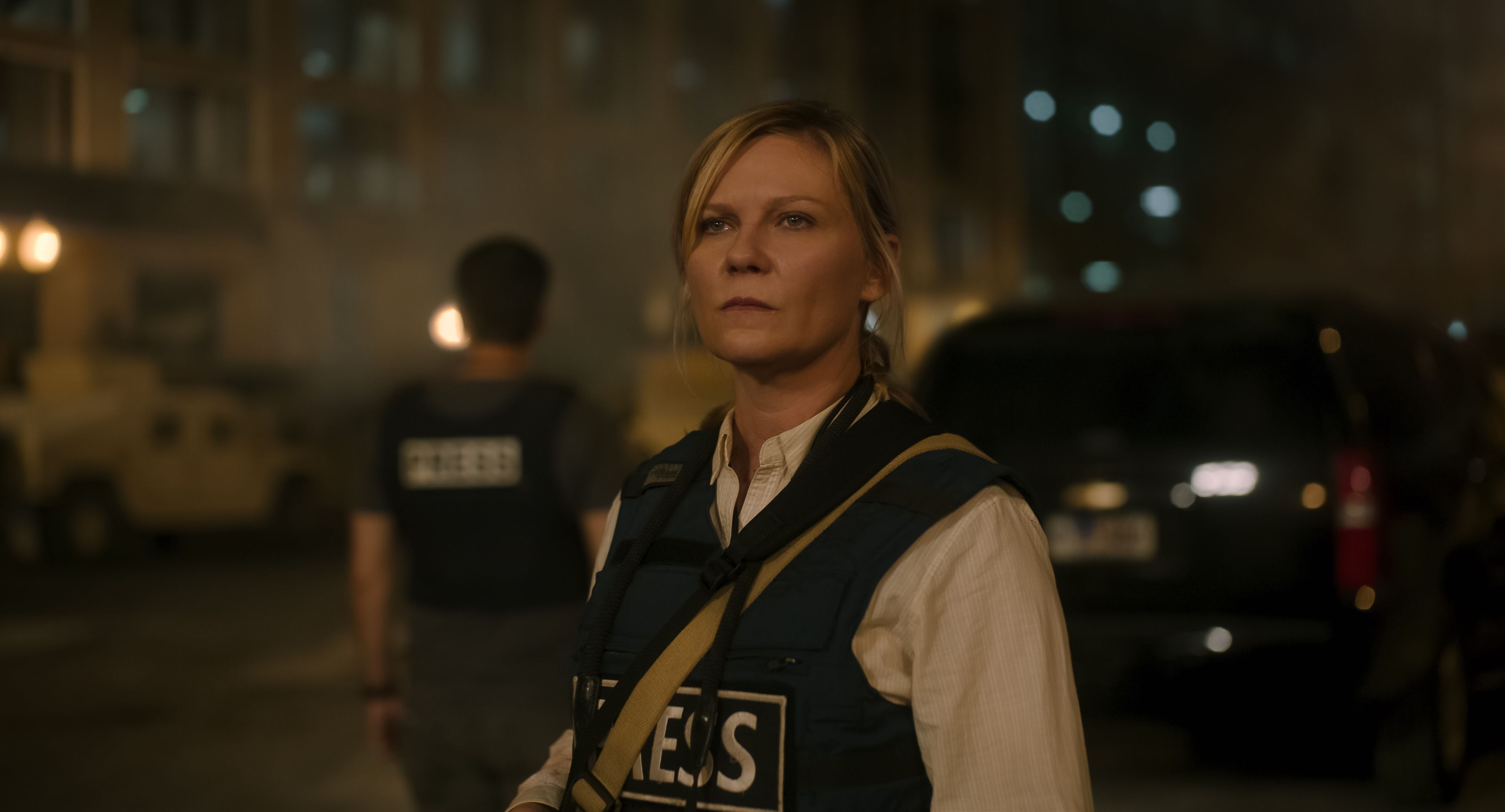
But this neutral stance is also what makes the A24 film such a taut, intense ride. It plays like an apocalyptic road trip movie that shows the country breaking apart not from the viewpoint of politicians or rebel leaders, but rather from the strictly apolitical perspective of journalists and war photographers, who see it as their duty to simply document the carnage on the ground.
Garland’s film is set in an America that has been divided into four warring factions; the Western Forces of Texas and California, the Florida Alliance, the New People’s Army, and the Loyalist States including Washington, D.C.
Lee Smith (Kirsten Dunst) is a hardened war photographer, travelling with her journalist colleague Joel (Wagner Moura) from New York to Washington. The Western Forces are trying to make their way to D.C. to capture the White House. Lee and Joel want to be there to document the takeover, and hopefully snag an interview with the American president (played by Nick Offerman), who has declared war on the rebels during his third term in office.
They are joined by Sammy (Stephen McKinley Henderson), a veteran New York Times journalist, and Jessie (Cailee Spaeny), an aspiring war photographer who admires Lee and gets herself invited along to watch her hero at work. A mentor-mentee relationship reluctantly forms, but Lee is determined to not give her an easy ride, wanting to challenge Jessie every step of the way.
Lee tells Jessie that she is not there to ask questions, but simply to take photos and let others ask questions later. This apolitical stance will frustrate some, but it’s also what makes Civil War a far more interesting and nuanced work. Whether people view the Western Forces moving towards Washington to take down the American president as the “good guys” will speak more to the individual viewer; because Garland doesn’t tell us what side to be on.
It’s never entirely clear which sides make up these alliances. There are some clues as to what each side represents, but it’s not completely spelled out (an “antifa massacre” is referenced, but it’s unclear if this was an attack on members of the left-wing radical group, or one carried out by them). We are presented with no real side to be on, just a gritty portrait of war as hell, with people killing and being killed on both sides.
Beyond simply not falling into the Red State/Blue State divide, Garland’s apolitical approach is also meant to challenge viewers in their own beliefs. This isn’t a simple “orange man bad” screed as some might take it as (Offerman’s president could be a stand-in for Trump, though also appears to be a little Gavin Newsom), but more a look at what a civil war would actually look like on the ground. We simply watch as the characters travel through a series of dystopian hellscapes, where streets are guarded by snipers on rooftops and people fight over dwindling resources.
Dunst does an excellent job of carrying the film with her guarded portrayal of a war photographer who has become necessarily detached from what she is shooting, her performance suggesting years of walled off trauma from things she has seen. As Lee’s younger, more idealistic counterpart, Spaeny builds upon the immense promise that she showed in Sofia Coppola’s Priscilla. She delivers a completely different type of performance as a young activist-type becoming shell-shocked as she discovers that the world is much darker than she could have imagined.
Meanwhile, Jesse Plemons (Dunst’s real life partner) makes the most of his limited screen time with a chilling performance as a soldier they encounter, in one of the film’s most suspenseful scenes. Garland has a way of crafting these tense, visceral set-pieces filled with harrowing images (the film looks great in IMAX), including freeze frames of the photographs being taken in the middle of the carnage. The visuals are matched by immersive sound design, like the eery use of background Christmas music during an unsettling sequence in an abandoned theme park.
This is in some ways Garland’s most narratively straight-forward film as a director following sci-fi mind-benders Men, Annihilation and Ex Machina, and his screenplay does feature a few slightly questionable character choices. But the purposefully episodic, point A-to-B plot is thorny in other ways, with its as-it-happens look at the country imploding from the inside. Garland presents a gripping, provocative vision of a divided America that builds with steadily increasing suspense towards a relentless, brilliantly staged finale, which culminates in a chilling final shot.
Film Rating: ★★★½ (out of 4)
Civil War opens exclusively in theatres on April 12th. It’s being distributed in Canada by Elevation Pictures.
 The Joy of Movies