By John Corrado
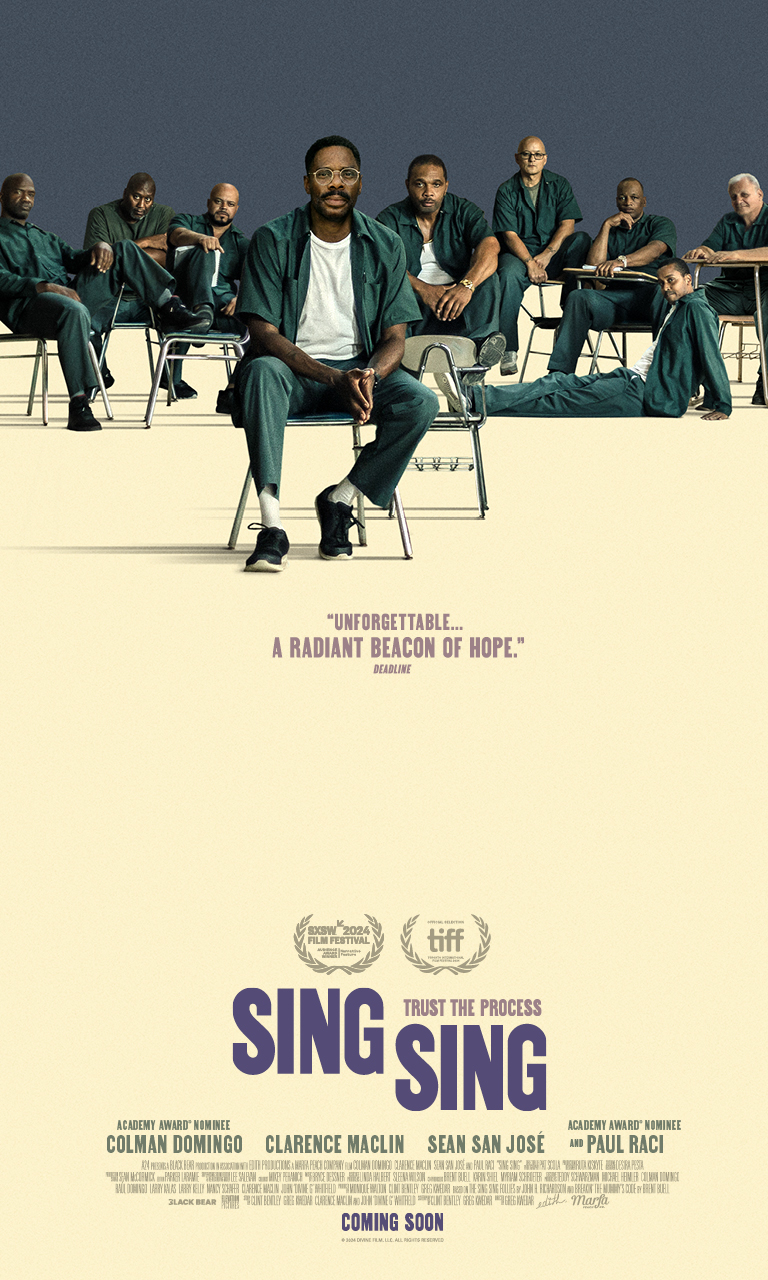 The title of Sing Sing refers to the Sing Sing Correctional Facility in New York, located on the Hudson River. But the film’s title, with its evocation of music and singing, also serves as a jubilant nod to the spirited performances being staged by the men within the maximum security prison.
It’s a juxtaposition that is fully highlighted in director and co-writer Greg Kwedar’s film, a based-on-a-true-story drama set inside the titular prison that manages to be gritty, moving, and uplifting.
The film is based around the real life Rehabilitation Through the Arts program that began at Sing Sing, where inmates work together to put on a play for the rest of the prison population. But the real stroke of genius behind the film lies in the choice to cast formerly incarcerated actors in most of the supporting roles, playing versions of themselves.
The program is designed to help these prisoners channel and control their emotions through the performing arts, and learn to work together through a series of covertly therapeutic acting exercises, run by theatre director and group leader Brent Buell (played by Paul Raci). One of the founding members is Divine G (played by Colman Domingo), who was wrongfully convicted, and maintains his innocence.
The film begins with the acting troupe having just finished doing a Shakespeare production, and finding actors for their next play. Divine G recruits Divine Eye (former inmate Clarence Maclin), a rough, stand-offish drug dealer with a natural inclination for performing, who he thinks can bring new energy to their ensemble. Drawing upon moments from his own life, the real Maclin brings both live-wire energy and layers of depth to this performance.
The men vote for their next play to be a comedy, and decide to embark on staging an original; behold Breakin’ the Mummy’s Curse, a time-travelling comedy with musical elements that features Egyptians, gladiators, cowboys, and Hamlet. It’s the “To Be or Not to Be” soliloquy that becomes one of the key moments for them to get right. Divine G naturally wants the Hamlet role, but so does Divine Eye, leading to some early friction between them.
As strange as it sounds for a film set inside a prison, Sing Sing also offers those moments of joyful “let’s put on a show” energy that will be relatable to anyone in the performing arts. This just makes the harsh reminders of their incarceration, from looking at the outside world through bars or having soul-baring late night conversations between the walls of their cells, hit even harder.
Domingo is in many ways the anchor holding it all together, delivering a beautiful and shattering lead performance that allows his character to be both tough and emotionally vulnerable. In one scene, Raci’s character says that anger is “easy” for actors to perform, but “hurt” is the hardest emotion to portray. It’s these subtle moments of hurt that play off Domingo’s face in key moments that make his performance so powerful to watch. He is backed up by excellent supporting work from Maclin and the rest of the ensemble cast, many of them acting professionally for the first time.
The decision to cast the actual men in these roles adds a real layer of authenticity to the film. Aside from actors Domingo, Raci and Sean San José (who plays Divine G’s friend and confidante Mike Mike), the supporting cast is mostly made up of former prisoners from Sing Sing, who were involved in the real production of Breakin’ the Mummy’s Curse. Kwedar even allows them the freedom to improvise some of their dialogue, including in deeply moving scenes when they are asked to reflect on moments from their lives during acting exercises. It makes the emotional impact of these scenes even more profound.
The film unfolds with almost documentary realism, as it allows its cast of incarcerated men putting on a play to be vulnerable with each other. This is enhanced by Pat Scola’s mostly handheld cinematography, intimately capturing the group sessions as his camera freely moves around to highlight the different actors. The movie was also shot on 16mm, which lends the film a grittier aesthetic and gives a sort of rough beauty to the images.
In the virtual Q&A after the screening I attended, Kwedar remarked that there is really no comparison to this film strictly within the “prison genre,” and it actually shares more in common with One Flew Over the Cuckoo’s Nest. I was reminded of that film while watching Sing Sing; both films are about men who know they are trapped, but are nonetheless trying to fly (while there is no direct comparison to a Nurse Ratched watching over them, that role goes to the system itself).
Another important fact that Kwedar shared in the Q&A is that, in general, the recidivism rate for former prisoners tends to be about sixty percent, while that number drops to just three percent for alumni of the RTA program. It’s a compelling statistic, and one that underpins a powerful cinematic experience. We are watching a group of men yearning for freedom, with their art, even for fleeting moments, being what can set them free.
Film Rating: ★★★½ (out of 4)

Sing Sing opens exclusively in theatres in limited release on August 2nd, including at TIFF Lightbox in Toronto. It’s being distributed in Canada by Elevation Pictures.
 The Joy of Movies