
By John Corrado
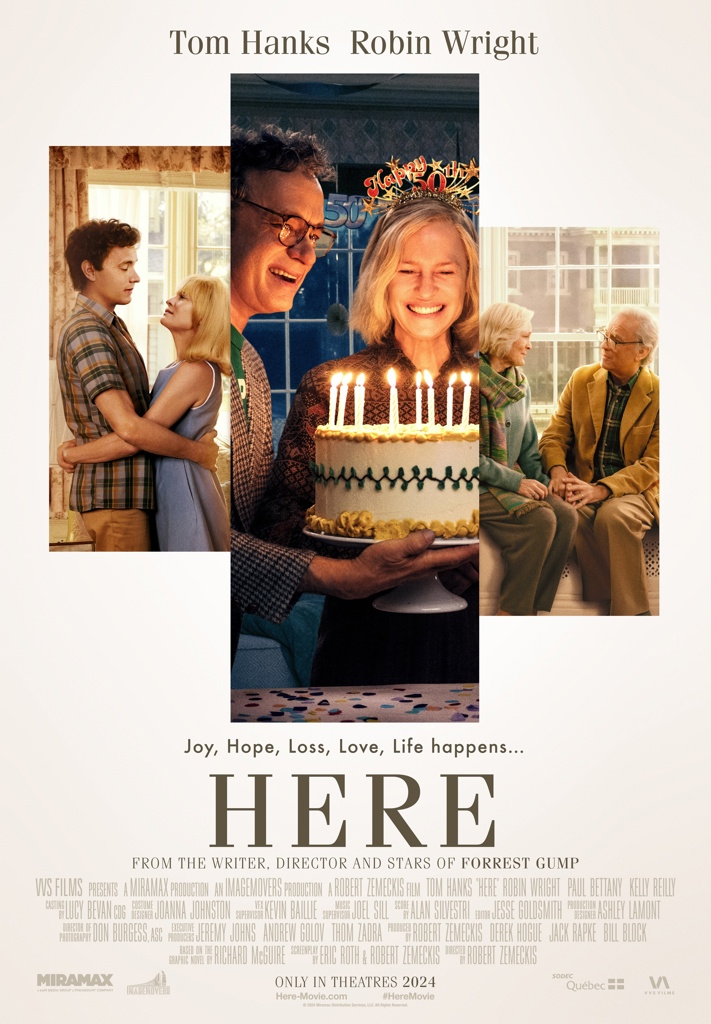
Thirty years after Forrest Gump, director Robert Zemeckis reunites with stars Tom Hanks and Robin Wright as well as screenwriter Eric Roth for the ambitious drama Here.
An adaptation of the 2014 graphic novel by Richard McGuire, Here is built around the conceit of watching life unfold in a single location across millions of years, from dinosaurs to present day. Zemeckis achieves this by keeping the camera locked off in one static shot, with overlaid panels to show different moments and help transition between scenes.
The film simply lets us we watch various life moments that all happen in the same space, across centuries. It doesn’t always work as a narrative piece or as a technological experiment. But Here has enough engaging moments across its sweeping scope, and enough invention in its construction, to be worth seeing.
It opens with a montage that spans from dinosaurs roaming the earth, to Native Americans hunting on the land, and finally the foundation being laid for a house. The narrative unfolds around the families who will come to occupy this house over the years, including shell-shocked veteran Al Young (Paul Bettany), who purchases the home with his wife Rose (Kelly Reilly) after WWII. Their son Richard (Hanks) becomes the focal point, with his own partner Margaret (Wright) eventually moving in.
Hanks and Wright are digitally “de-aged” to play these characters from eighteen onwards, teenage sweethearts who end up tied to the house through an unexpected pregnancy. We keep cutting back to previous owners; the inventor (David Fynn) and his model girlfriend (Ophelia Lovibond), the wife (Michelle Dockery) who worries about her pilot husband (Gwilym Lee). There is an undercurrent of American history to it as well, with a historical house across the street that can be seen through the window.
As he has done multiple times in his career, the film finds Zemeckis tinkering around with cutting edge technology, in this case “de-aging” the actors through an AI process that happened live on-set. This fairly convincing if still not-quite-there technology will be one of the most divisive aspects of the film, giving the actors a smoothed over, almost waxy look at times that takes some getting used to. The film also arrives twenty years after Zemeckis revolutionized motion-capture with The Polar Express (another collaboration with Hanks, in which the actor played multiple roles).
It’s a consistently interesting viewing experience, at least for the ways that Zemeckis commits to keeping the action all within the single frame, even if not every element works. Some of the fractured narrative’s various threads and storylines do feel underdeveloped, particularly the present day scenes with modern couple Devon (David Beckman) and Helen (Nikki Amuka-Bird). At times the single location also makes it feel like we are watching a filmed stage play, including some more theatrical acting choices.
You can tell that this is as much an experiment in visual storytelling as it is a standard narrative drama. Zemeckis finds some clever ways to open up the space, through reflections or a folding table that extends into the frame during Thanksgiving scenes. The film uses dissolves, fade-throughs, and different panels appearing within the frame to transition between scenes. It’s all a wide shot. For the characters to appear in closeup, they must walk towards the camera. It’s also rooted around being a Christmas movie, a fully decorated tree appearing in the centre of the frame at various points to show another year has passed.
While Zemeckis utilizes the latest technology to “de-age” his actors, and the entire film is built around the high concept premise of all unfolding in a single frame, there is an earnestness to his heart-on-sleeve storytelling that feels old fashioned. The film has most of an impact when it stays focused on Hanks and Wright, who do a nice job of depicting an evolving love story between two people as milestones are reached and dreams are dashed. There is probably a darker, more cynical read of the material about showing domesticity as a sort of prison.
Despite its use of the latest cinematic tricks, Here is a film classically designed to tug on the heartstrings (some would even say “cloying”). But there is something moving at the centre of it about the passage of time, distilling years and years into moments that go by too quickly, and it does get us thinking about our connections to physical spaces, and the memories that houses hold. It’s set to a lovely score by Alan Silvestri, who excels at delivering this sort of grand, sweeping orchestral work to heighten the emotion of a scene, in a similar vein to his work on Forrest Gump. It’s worth seeing, at least for the uniqueness of the theatrical experience.
Film Rating: ★★★ (out of 4)

Here opens exclusively in theatres on November 1st. It’s being distributed in Canada by VVS Films.
 The Joy of Movies