
By John Corrado
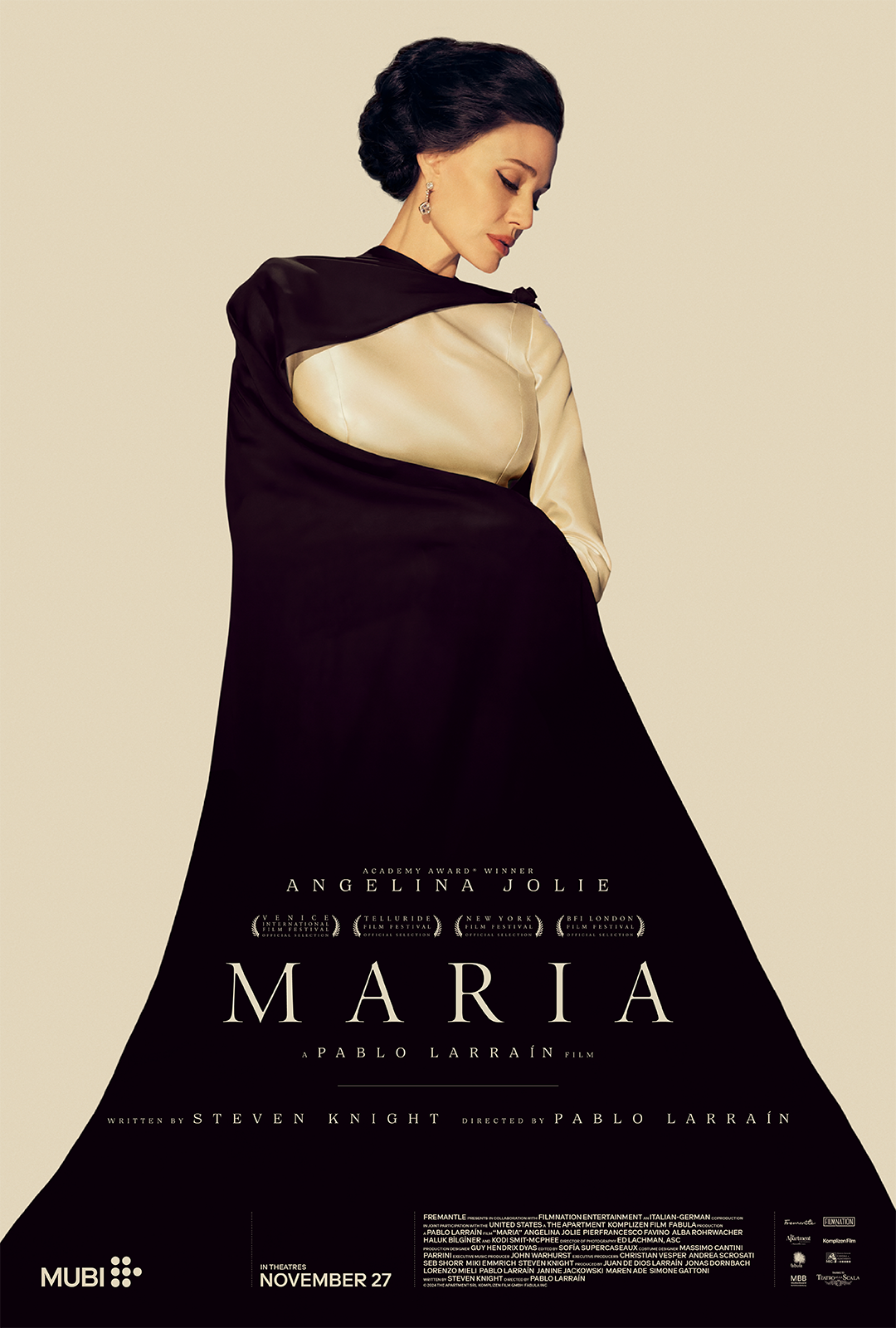
The third entry in Pablo Larraín’s unofficial trilogy depicting the interior lives of famous women (following the one-two punch of Jackie and Spencer), Maria is the Chilean filmmaker’s portrait of the Italian opera singer Maria Callas.
Larraín aims to do for Callas what he did for Jacqueline Kennedy and Princess Diana in his previous films, which boasted career-best performances from Natalie Portman and Kristen Stewart, respectively.
Angelina Jolie takes on the role of Callas, with the film set in the final days of her life in 1977, as she is literally trying to regain her voice. It’s a fitting metaphor for the film’s portrayal of Callas, who by this point has isolated herself in her Paris apartment, with her butler (Pierfrancesco Favino) and housekeeper (Alba Rohrwacher) as her closest confidantes.
If the previous two films in Larraín’s trilogy were about stripping away the veneer of these historic figures to show the complex women underneath at very specific moments in time, Maria does lack some of the same insight or intrigue in its portrayal of Callas. Despite the more wispy, dreamlike tone of the piece at times, this is also the most conventional of the three films on a narrative level.
The film finds Callas being questioned by a young interviewer (Kodi Smit-McPhee) who is profiling her, and fantasizing about her past romance with Aristotle Onassis (Haluk Bilginer). Through this interview conceit and heavy use of flashbacks, the screenplay by Steven Knight (Spencer) features a more typical biopic structure in its depiction of a dying diva in her final days.
But, if Maria falls a bit flatter on a dramatic level than Jackie and Spencer, Larraín’s work as a stylist remains strong. The filmmaker adopts a somewhat heightened visual style as he blends in fantastical touches and even high camp elements, and it’s in these more operatic flourishes when the technical aspects of Maria are really able to shine. This is a beautiful looking film that captures the rich aesthetic of the 1970s, through the lavish costumes designed by Massimo Cantini Parrini, and Edward Lachman’s gorgeous cinematography.
Lachman, who also shot El Conde for Larraín and is best known as the go-to cinematographer of Todd Haynes on films like Carol, switches between opulent colour, black-and-white flashbacks, and moments meant to mimic sepia-toned home movies. His images and compositions are often striking; whether he’s capturing Jolie’s Callas dramatically commanding the stage, or walking the sun-dappled streets of Paris in the early autumn, Lachman crafts one visually sumptuous sequence after another.
It’s not as transformative as the work that Portman or Stewart were doing, but Jolie is very good in the role of Callas. Jolie innately understands things like the spotlight and media scrutiny, and she is able to infuse her portrayal of Callas with a tragic quality. In some of her strongest moments, she shows the opera singer trying to navigate fame and privacy as paparazzi try to capture her in her lowest moments, more interested in the sensationalism of a potential downfall. Jolie partially does her own singing, with the voice of the real Callas blending in.
Like so many third instalments, Maria is a slight step down from its two predecessors. It doesn’t have the same immediate impact as Jackie and Spencer. But Larraín remains an accomplished filmmaker. It’s a good movie with a good performance, that is worth seeing for the visual splendour on display.
Film Rating: ★★★ (out of 4)
Maria opens in select theatres in Canada on November 27th, including TIFF Lightbox in Toronto. It will be available to stream exclusively on MUBI in Canada as of December 11th.
 The Joy of Movies