
By John Corrado
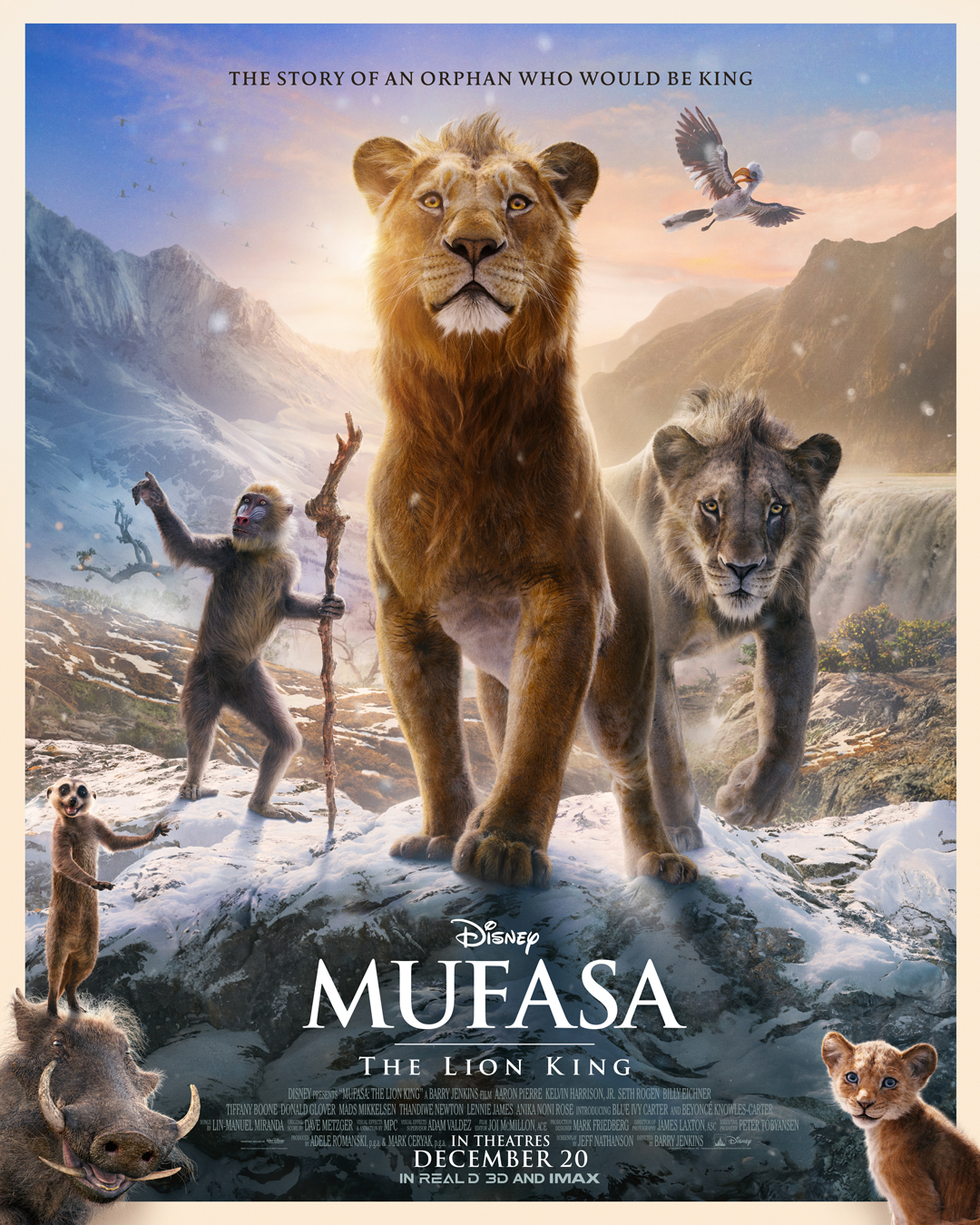 The most surprising thing about Mufasa: The Lion King, which serves as both a prequel and sequel to Disney’s 2019 “live action” remake of their 1994 animated classic The Lion King, is that it’s directed by Barry Jenkins.
Jenkins is best known for the Oscar-winning dramas Moonlight and If Beale Street Could Talk, so to see him now playing around in this entirely digital world of big budget studio filmmaking is somewhat unexpected.
But, by reuniting with some of his usual crew including cinematographer James Laxton and composer Nicolas Britell (who composed the score alongside Dave Metzger), Jenkins does elevate the IP-driven material slightly.
The result is a good enough prequel to a remake that nobody really asked for (but one that still grossed a billion dollars). This is similarly a film that we didn’t really need, but it’s diverting and entertaining enough in its efforts to expand the franchise. The film explores the fated relationship between a young Mufasa (Aaron Pierre) and his adopted brother Taka (Kelvin Harrison Jr.), before he became Scar, and Jenkins does manage to find some dramatic weight in this sibling origin story.
The whole thing is presented as a story within a story, that mandrill Rafiki (John Kani) is telling to new cub Kiara (Blue Ivy Carter), the daughter of Simba (Donald Glover) and Nala (Beyoncé), about how her grandfather became king of the Pride Lands. Meerkat Timon (Billy Eichner) and warthog Pumbaa (Seth Rogan) are on babysitting duty while Kiara’s parents are away.
They provide the comic relief, while Rafiki spins the dramatic tale of Mufasa’s childhood as an orphaned lion cub (voiced by Braelyn Rankins), who gets adopted into royalty when he is rescued by the young Taka (voiced by Theo Somolu). Taka is the son of Eshe (Thandiwe Newton) and Obasi (Lennie James), and next in line for the throne.
The flashbacks provide the actual meat of the story, while the rest is just a framing a device. The Timon and Pumbaa stuff is there to entertain the young ones, but their constant interruptions can feel like a distraction. The self-referential humour also doesn’t really fit (they reference the Broadway play, and joke about not having the right clearances for “Hakuna Matata”).
This framing device often breaks the flow, and adds to the narrative unevenness of Mufasa: The Lion King overall. The film also feels too long at about two hours, and falls into the prequel trap of answering questions that we probably didn’t need answered. Despite a few new twists and added elements, we also know pretty much exactly where this story is going, with a lot of heavy foreshadowing.
But, if it’s largely thematic material that was covered in the original, there is still something here about how Taka came to betray his brother, that makes us somewhat understand why Jenkins was drawn to a Mufasa and Scar origin story (aside from the obviousness of the money). Jeff Nathanson’s screenplay does find moments of resonance in presenting a sibling dynamic that goes from playful competition to bitter rivalry. The dramatic moments when we sense the betrayal happening are some of the strongest in the film, and Jenkins clearly recognizes that in how he presents them.
The visuals are sweeping at times (especially on a giant IMAX screen), with Jenkins and Laxton letting loose with the digital cinematography. Their camera flies through the Savannah landscapes, before settling on closeups, and the effect can be dazzling. While this film and its predecessor are presented as being live action, they are in reality near-photorealistic CG creations. The visuals do appear brighter here than in the 2019 version, and the animals themselves are also slightly more anthropomorphized, which allows their faces to be a bit more emotive (a common criticism of the previous one).
The new songs by Lin-Manuel Miranda are catchy enough in the movie, though “I Always Wanted a Brother” is much stronger lyrically than villain song “Bye Bye,” sung by new antagonist Kiros (Mads Mikkelsen), leading a pack of white lions who are seen as outsiders. If Mufasa: The Lion King is an uneven film, especially within Jenkins’ own growing filmography, there are still enough elements here that make it worth seeing. It will especially entertain families over the holidays.
Film Rating: ★★½ (out of 4)

Mufasa: The Lion King opens exclusively in theatres on December 20th.
 The Joy of Movies