By John Corrado
It’s the final day of 2024, which means that another year has come to an end. The preambles to these lists are always hard to write, so I’m going to keep this one short. I saw a lot of movies in 2024, and liked quite a few of them. It’s been assessed by some as being a “weak” year for film, but there were plenty of gems, even if you needed to know where to look for them.
That said, several of the movies on my list were box office behemoths (like Dune: Part Two and Inside Out 2) or surprise hits (like Challengers and The Substance). As always, these rankings are personal in terms of representing my favourite movies of the year. Though I do believe that all of these films have incredible artistic merit as well. So here are my best films of 2024, starting with honourable mentions and followed by my top ten.
Honourable Mentions:
#25: Furiosa: A Mad Max Saga; #24: A Different Man; #23: Babygirl; #22: Longlegs; #21: Civil War; #20: My Old Ass; #19: Nickel Boys; #18: Conclave; #17: Sing Sing; #16: Queer; #15: Saturday Night; #14: Better Man; #13: Nosferatu; #12: Wicked; #11: A Complete Unknown
#10: Memoir of a Snail

This is always one of the hardest slots to fill, but this small gem from Australian animator Adam Elliot deserves recognition. Fifteen years ago, Elliot made the stop-motion feature Mary and Max, which remains among the best cinematic depictions of both autism and unlikely friendship. Elliot now returns with Memoir of a Snail, which serves as a companion piece of sorts. This film also focuses on characters who aren’t neurotypical, in this case a lonely snail hoarder (voiced by Sarah Snook) looking back on her life. But it’s their unique ways of viewing the world – and how Elliot captures it through his greyscale claymation – that make these films so impactful. Elliot is once again using animation to explore the human experience. The story deals with heavy themes, but also allows for some profound glimmers of hope. (Full Review)
#9: Dune: Part Two
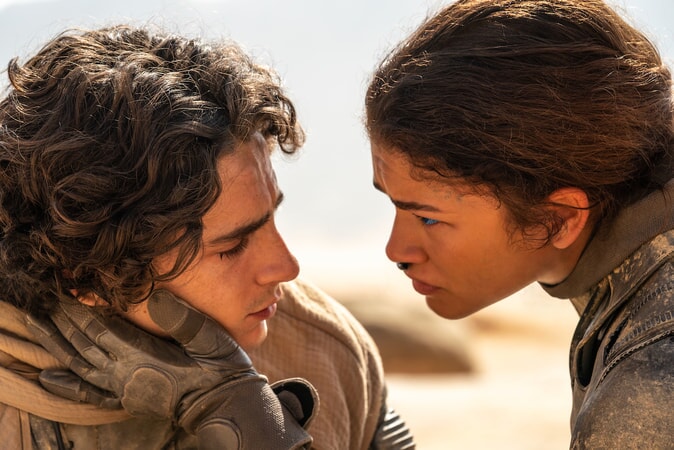
I liked Denis Villeneuve’s Dune quite a bit in 2021. But Dune: Part Two, his adaptation of the second half of Frank Herbert’s sci-fi novel that was split in two, elevates it completely. This film expands the story of Paul Atreides (Timothée Chalamet) and his rise to become a warrior and leader, while deepening the love story between him and Chani (Zendaya), and heightening the religious themes as well. It does what all great sequels should do by enriching the first film. It’s also just a spectacularly well-crafted piece of grand scale moviemaking, from Greig Fraser’s cinematography to Hans Zimmer’s score. Chalamet also deserves major credit for not only pulling off this role but also for his portrayal of Bob Dylan in A Complete Unknown, both stellar turns from one of our best young actors. (Full Review)
#8: Challengers
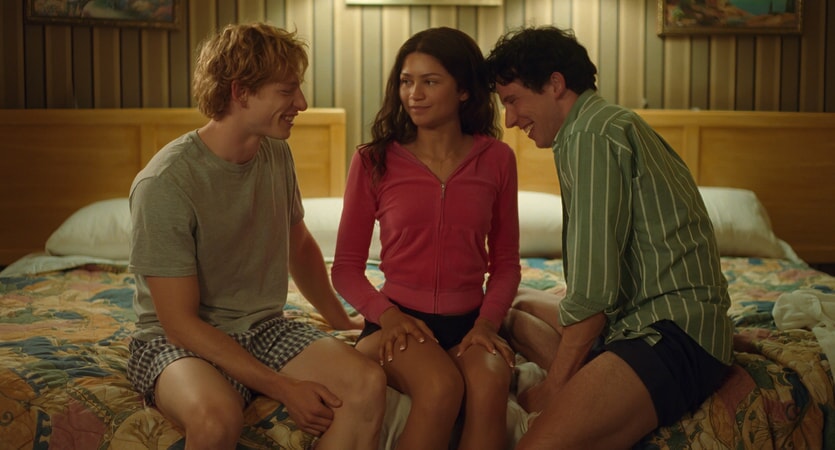
Luca Guadagnino’s first of two movies released this year (the other being Queer, which made my honourable mentions), Challengers is, on the surface at least, a tennis movie. But it’s also about relationships, power dynamics, and people being played off each other, and that’s where the sharp screenplay by Justin Kuritzkes (who also adapted Queer) really excels. It’s in the dynamics of leads Zendaya, Josh O’Connor and Mike Faist that the film finds its electricity. The cinematography by Sayombhu Mukdeeprom (who also shot Queer and Trap this year) only adds to the excitement – at times the camera becomes the ball – with a mesmerizing score by Trent Reznor and Atticus Ross pumping behind it all. It’s electric, sexually charged filmmaking. (Full Review)
#7: The Substance
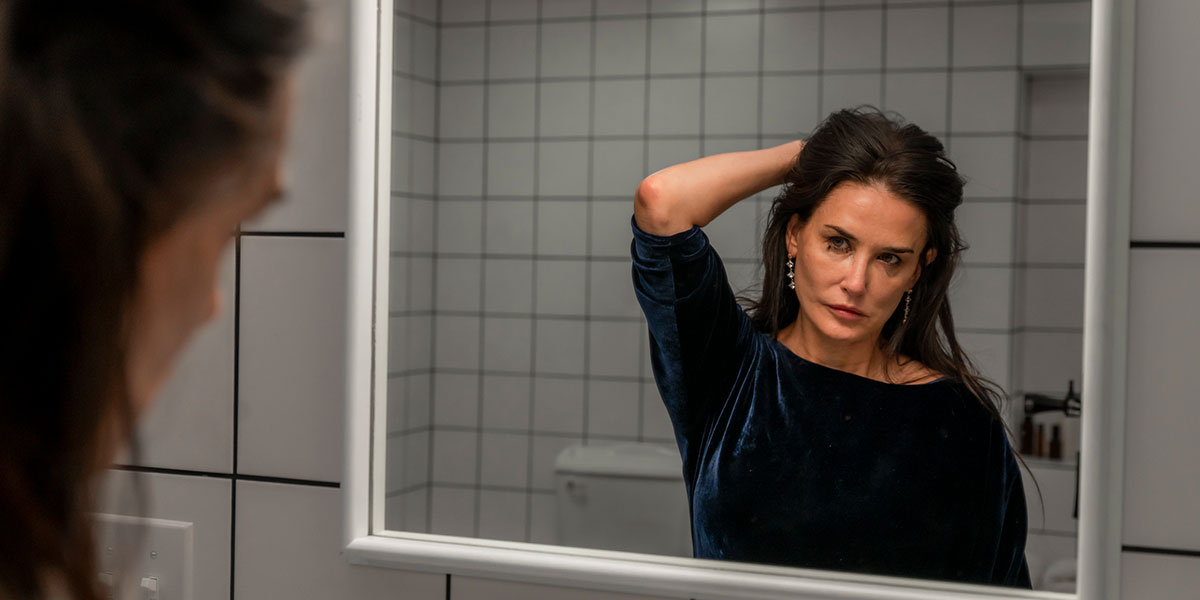
Coralie Fargeat’s body horror satire The Substance is a film that does a brilliant job of efficiently setting up its premise (we don’t need any backstory about what “the substance” is or who invented it), and just running with it. Demi Moore and Margaret Qualley mesmerize in a great dual performance, as Fargeat skillfully builds to one of the most insane finales in recent memory. It just keeps going and topping itself in grossness, absurdity, and intensity, to the point where we can’t look away. I saw the film at a morning press screening two weeks before TIFF, and had such a great time that I went again during the festival just to experience it with the Midnight Madness crowd. It rocked both times I saw it. An instant genre classic. (Full Review)
#6: A Real Pain

Jesse Eisenberg directed, wrote, and stars in A Real Pain, the story of two cousins reconnecting with their familial past during a Holocaust tour through Poland. Eisenberg plays one of the cousins, and Kieran Culkin is the other, giving possibly the greatest supporting performance of the year. Culkin is a mesmerizing ball of energy, but it’s the stunning monologue that Eisenberg delivers partway through that brilliantly reshapes how we view his character and their dynamic together. It’s a film that finds humour in uncomfortable situations, but with a deep well of emotion running underneath it as well, exploring how different people react to trauma – both recent, and in the past. I couldn’t stop thinking about this one for days and weeks after seeing it. (Full Review)
#5: Megalopolis

The inclusion of Francis Ford Coppola’s Megalopolis on my list, especially this high, will surely be one of the most controversial placements. But The Godfather filmmaker’s ambitious late-career epic, set in the fictitious city New Rome, simply worked for me; from its vision of the future as he imagined it over four decades ago when first writing the script, to its elements of operatic drama and theatrical camp. It’s clear that Coppola sees himself in Adam Driver’s misunderstood genius Cesar Catilina. These director-as-protagonist comparisons carry through to how Coppola had to self-finance this $120 million passion project (by selling off shares in his winery), with many scoffing at his ambition.
The result is a massive, VFX-heavy film that is also rooted in heart-on-sleeve sincerity and profound optimism for the future. It’s this utterly sincere quality that has perhaps caused Coppola’s latest to be misunderstood by so many audiences and critics. Yes, Coppola has made a hopeful film, and one that resonated with me deeply. It’s also a work of pure cinema, with images that I won’t soon forget (like the Méliès-inspired shot of a cloud hand grabbing the moon, or a sweeping romantic moment on steal construction beams suspended high in the sky). Time, stop. (Full Review)
#4: The Wild Robot

DreamWorks Animation’s The Wild Robot is an exciting, gorgeously animated adventure. But this tale of stranded robot Roz (Lupita Nyong’o) becoming the surrogate mother to an orphaned gosling is also an incredibly moving story about motherhood, and finding your purpose through being a caregiver. Like many of the best animated movies, it’s a film that basically anyone can watch and take something away from. When I saw The Wild Robot at TIFF with a packed audience of adults and kids, everyone around me was equally enraptured, all laughing at the same moments and tearing up at the same parts as well. This is in the upper tier of DreamWorks with How to Train Your Dragon and Puss in Boots: The Last Wish, and that soaring “Kiss the Sky” sequence is one of the best scenes of the year. (Full Review)
#3: Anora

Sean Baker has emerged as one of the most vital voices in American independent cinema over the past decade. He’s been on a hot streak that started with iPhone-shot Tangerine in 2015, and carried through The Florida Project (my number one movie of 2017) and Red Rocket (arguably the best movie made about the first Trump Era). As I’ve said before, Baker makes films about America’s “forgotten people” (i.e., sex workers, those living in poverty), and his films work because of the compassion that he has for his characters, as sidelined, marginalized, or underprivileged as they may be.
In this case, it’s a Brooklyn stripper named Ani (Mikey Madison) who falls for the twinkish son of a Russian oligarch (Mark Eidelstein), and, well, gets taken for a ride. We are on that ride right along with her, in what I’ve described as Pretty Woman meets After Hours, as Baker takes the typical rom-com setup and turns it on its head with madcap intensity. Madison delivers one of the great performances of the year as Ani, who is as strong-willed as they come, but also just a girl who falls in love. In many ways, Anora feels like a thrilling culmination of Baker’s works, and not just for winning him the coveted Palme d’Or. I can’t wait to see what he does next. (Full Review)
#2: The Brutalist

Much ink has been spilled about Brady Corbet’s third film The Brutalist, a three-and-a-half-hour period piece that he shot on VistaVision and made for under ten million dollars. This ambition on the face of it is highly impressive, even more so because of how the film delivers on every possible front. Unfolding in two halves broken up by a fifteen minute intermission, it’s a story of greed, warring ambitions, and the immigrant experience, that provides one of the most unforgettable cinematic experiences of the year.
When the lights come up at the end of this saga about Hungarian-Jewish architect László Tóth (Adrien Brody), we feel we have witnessed something monumental. First and foremost, Corbet’s film is anchored by brilliant performances; Brody as the architect who comes to America after the war, Guy Pearce as the man who hires him to complete a project, and Felicty Jones as Tóth’s wife. Then there is Lol Crawley’s stunning cinematography, and Daniel Blumberg’s gripping score.
In my review during TIFF, I remarked how it felt like the great American novel being played out onscreen, due to the richness of how the characters and story are allowed to develop over the course of the film’s mammoth running time. The complex partnership between these two men is what underpins the grand vision of Corbet’s film. It’s really a throwback to great films of the 1970s like The Godfather and The Deer Hunter, sprawling portraits of America as a whole told through dramatic character studies. A staggering work. (Full Review)
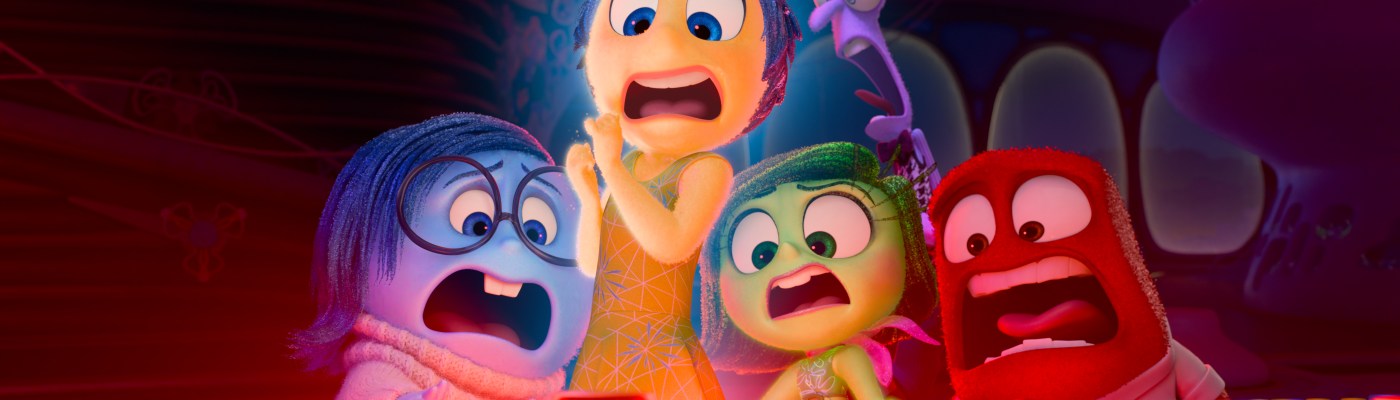
#1: Inside Out 2

One of the age old questions in film criticism is about judging the objective versus the subjective when grading a movie. This is the case with my number one and number two films this year. You could make a strong case that The Brutalist is the best movie of the year (objectively). But my favourite movie of 2024 was Inside Out 2 (subjectively). As a massive fan of the first film, which was my number one movie of 2015, Inside Out 2 delivered everything I could have wanted in a sequel, while also being a pretty great coming-of-age movie in its own right.
The Pixar sequel beautifully expands the world inside Riley’s mind through the introduction of new emotion Anxiety (Maya Hawke), a natural foil to Joy (Amy Poehler). But Anxiety crucially isn’t really a villain; she also wants to do what’s best for Riley, but just doesn’t quite know how. It all builds to that incredible sequence, stunningly realized onecreen. The genius of these films is in how they show the rich interior lives of the emotions themselves, namely Joy coming to terms with her girl getting older (Joy’s piercing recognition that maybe you feel less joy as you grow up is this generation’s equivalent of “when you grow up, your heart dies” from The Breakfast Club).
A key theme of these films is also about how we process memories, and how “core memories” are essential to building our sense of self, imaginatively and creatively explored here by director Kelsey Mann and his team of genius animators. The first movie came out at a very formative time for me, and my memories of it are intertwined with what I was doing that summer, so this sequel naturally had a lot to live up to in terms of my own expectations. And it hit me hard both times I saw it in the theatre. So, yeah, for all of these reasons, Inside Out 2 was my favourite movie of 2024. (Full Review)
 The Joy of Movies