
By John Corrado
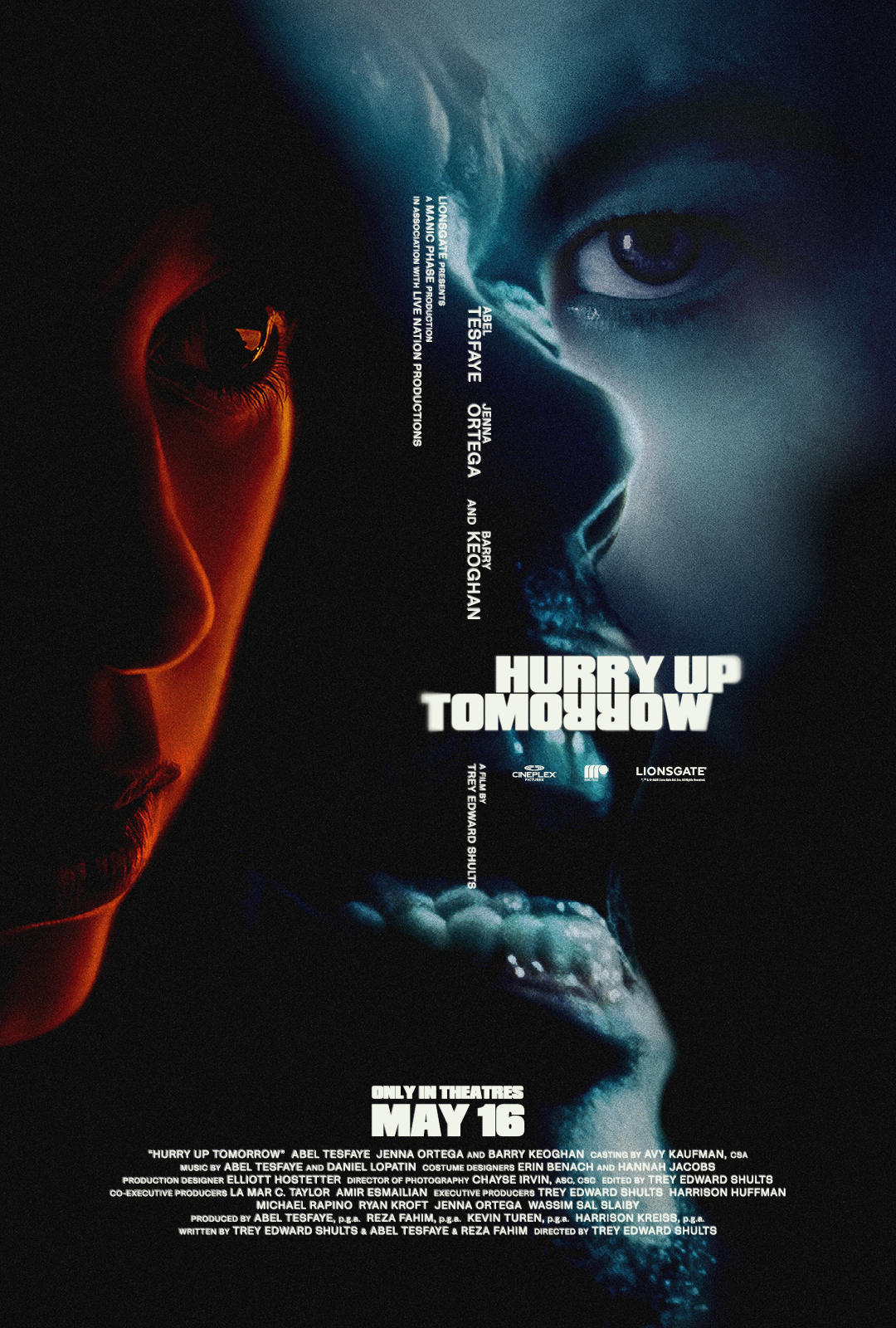 Abel Tesfaye (aka The Weeknd) is undoubtedly a Canadian success story, rising from Scarborough to become one of the biggest pop stars on the planet. Tesfaye, who branched out into acting on the HBO series The Idol, now stars as a version of himself in Hurry Up Tomorrow, which serves as a visual companion piece to his album of the same name.
But this misguided, over-stylized vanity project from director Trey Edward Shults (Waves, It Comes at Night) does nothing for his music or career. The film is convinced that it’s deep, but the whole thing feels empty and barely surface level. It plays like what people on TikTok think is an “Art Film.”
In the strictest sense, Hurry Up Tomorrow – which Tesfaye also co-wrote and produced – is a mix of semi-autobiographical confessional and attempt at surreal psychological thriller. But it’s mostly a slog; an underwritten, tonally confused collection of scenes that barely function as a movie.
The paper thin plot follows a performer named Abel who starts to lose his voice due to stress during a world tour, while his manager and friend, Lee (Barry Keoghan), tries to keep him going. Abel has turned to booze and drugs to get over an ex-girlfriend (voice of Riley Keough) who dumped him. He repeatedly listens to the voice message she left him about how she felt used by him. We also follow a “troubled” young woman named Anima (Jenna Ortega), an obsessive fan who is on the run after setting a fire, and meets up with him after a concert.
I like The Weeknd’s music. But Tesfaye isn’t a good enough actor to sell any of this, from his pensive stares into the camera to comically overacted freak outs. The film opens with a closeup on his face, his lips going “brrr” as a vocal warmup, in a moment that borders on parody. Tesfaye mainly struggles to portray the interiority of his character in an interesting way, something that a more skilled actor would have focused on.
Tesfaye’s shortcomings as an actor are even more apparent in scenes alongside Ortega and Keoghan. That said, Ortega doesn’t fare much better, and is stuck playing a barely fleshed out character. Anima is the disturbed™ version of a manic pixie dream girl. The film has little interest in why she is troubled, with her existing solely to help Abel discover things about himself. This leaves Keoghan as probably the best part of the film, but he is absent for much of it.
This is hardly the first film to deal with the idea of a performer facing burnout on tour, or the first to show the emptiness of a hedonistic lifestyle built on sex, drugs, and rock ‘n’ roll. But Hurry Up Tomorrow has nothing new to offer, outside of essentially presenting The Weeknd as an insufferable narcissist. The cardinal sin of Hurry Up Tomorrow is that it thinks it is profound, but the themes that it explores, and the commentary it offers, are barely surface deep.
In one sequence, Ortega’s character dances wildly to The Weeknd’s songs, explaining the lyrics to him in the most basic way possible. You see, beneath the infectious beat of “Blinding Lights,” the song is actually about loneliness and emptiness, she explains. Yes, there is a darker undertone to “Blinding Lights” (and the entire album, After Hours, that it originates from). But we don’t need the film to tell us this. It’s a case of an artist trying to over-explain themselves in a way that actually reflects worse on their art.
There is a feeling throughout Hurry Up Tomorrow that Tesfaye is patting himself on the back for how “clever” and “introspective” he is being, while saying little that we couldn’t conclude from his music. If anything, the way he spells things out feels painfully obvious. The film is also a major disappointment from Shults, who, in his previous film Waves, displayed a command of craft that actually served the story. Shults employs many of the same stylistic touches here, including changing aspect ratios, but the aesthetic itself is not enough to save the film from its amateurish writing, lack of compelling character development, and narrative shortcomings.
That said, the cinematography by Chayse Irvin, shooting on 35mm film, does look cool at times, and the film shows some promise with an early concert scene that makes use of the strobing lights and 360-degree spinning camera. But these stylistic flourishes are in favour of poorly written characters and a non-existent story. If anything, it shows that Hurry Up Tomorrow likely would’ve worked better as a concert film or extended music video (the music itself is obviously good), instead of the hackneyed attempt at brooding character drama and psychological thriller that it becomes.
After the largely formless, meandering first half, the film eventually becomes a way for Tesfaye to explore some sort of perverted fantasy of a fan forcing him to atone for his sins. Namely his reliance on co-dependent relationships, and using women to fill the void within himself. There is potentially something to be said for a major pop star portraying an unvarnished version of themselves. But Hurry Up Tomorrow can’t get past its own navel-gazing, and there is no real glue holding any of this together. As such, it’s more self-promotion than self-examination.
Film Rating: ★½ (out of 4)

 The Joy of Movies