
By John Corrado
 In their debut feature Sorry, Baby, writer-director-star Eva Victor blends elements of comedy and drama to craft a unique, emotionally resonant portrait of a traumatic incident and its aftermath.
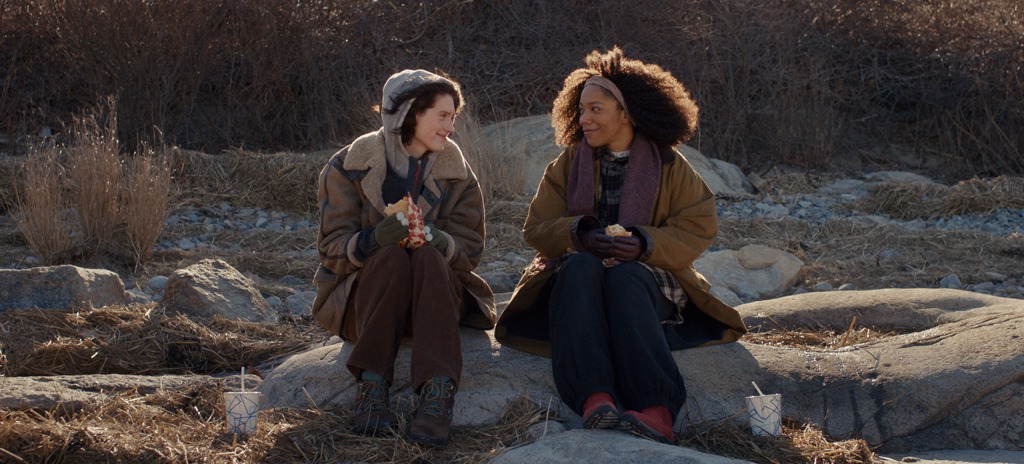
Victor stars in the film as Agnes, a college literary professor living alone in small town Massachusetts. When the film opens, Agnes’ friend Lydie (Naomi Ackie) is coming to visit. It’s been a little while since they’ve seen each other, and like a lot of adult friendships, Lydie is moving into a different life stage.
Agnes, on the other hand, despite moving forward in her career, has been held back by something that happened to her. Agnes refers to it as “the bad thing,” and Victor’s semi-autobiographical screenplay goes back in time to reveal what she experienced.
The film’s episodic, out of order narrative (complete with descriptive chapter titles) serves a deeper purpose; Victor is showing how trauma happens in the middle of life, and becomes something that you have to awkwardly carry around moving forward. It’s heavy material, but Victor handles it with a deft touch, that allows for surprising moments of humour as well.
As a post-#MeToo drama, Sorry, Baby does away with sensationalism, and avoids any hint of exploitation by smartly not showing the assault itself. Victor’s film is instead focused on the confusion and conflicting feelings that Agnes is left to carry around and process on her own. Victor is exploring the ripple effects of “the bad thing” that hang over her like a dark cloud, leaving her second-guessing and unsure of herself.
It’s a film about the uncomfortable silences and interactions with people who don’t quite know how to respond after something happens that fundamentally changes relationships. Furthermore, Victor’s film plays with a very unique tone. The dialogue is at times intentionally stilted, and punctuated by awkward comedy. But this is the tone that Victor is going for; someone trying to laugh through pain, or brush it off as no big deal, but not really fooling anyone.
Victor captures these nuances through their performance as well, shifting between heart-wrenching dramatic scenes and moments of physical comedy. They share a natural dynamic with Ackie, who fully embodies the role of the affirming best friend. John Carroll Lynch also leaves an impact despite his limited screen time. The cinematography by Mia Cioffi Henry uses wide shots to capture the isolation of Agnes’ New England house, but also the possible serenity that the setting offers.
Almost miraculously, Victor’s film is also about life finding a way in the midst of trauma. Like the glimmers of light provided by a tentative relationship with a male neighbour (nicely played by a very good Lucas Hedges), or finding a stray kitten to adopt. It’s about the support of a friend who will do anything for you, the process of healing and getting comfortable with things again at your own pace, and the promises made to others to not let “the bad thing” happen to them.
Film Rating: ★★★½ (out of 4)
 The Joy of Movies