By John Corrado
 Watching Eddington, the new movie from writer-director Ari Aster, it’s hard not to think about how much we still haven’t processed from the year 2020, even though it was (shockingly) five years ago now.
Aster’s film is set in May of 2020, to be precise, at the height of mask mandates, lockdowns, COVID hysteria, and the start of the BLM riots. If this sounds intentionally divisive, and ripe for controversy, that’s because it is; Aster has crafted a blistering political satire turned neo-Western that throws a molotov cocktail at all the absurdities of 2020, pointing out hypocrisies on both sides.
It’s a lot to take in, and will be polarizing because of it. But, if you can get on its wavelength, Eddington is another thought-provoking and mostly compelling work from Aster, who has already proven himself to be a director unafraid of delivering polarizing films. While his first two movies, the elevated horror films Hereditary and Midsommar, weren’t entirely mainstream, they were adjacent enough to it to gain him widespread acclaim.
But he pivoted sharply with his third film Beau is Afraid, a blackly comic, arthouse exploration of anxiety and parental trauma, delivered as a quixotic, three-hour dream odyssey. If Beau left his more casual fans scratching their heads, for others (including myself) it was a rich experience that had plenty to celebrate and chew over, even if it was hard to entirely “get” everything it was trying to say (at least on initial viewing).
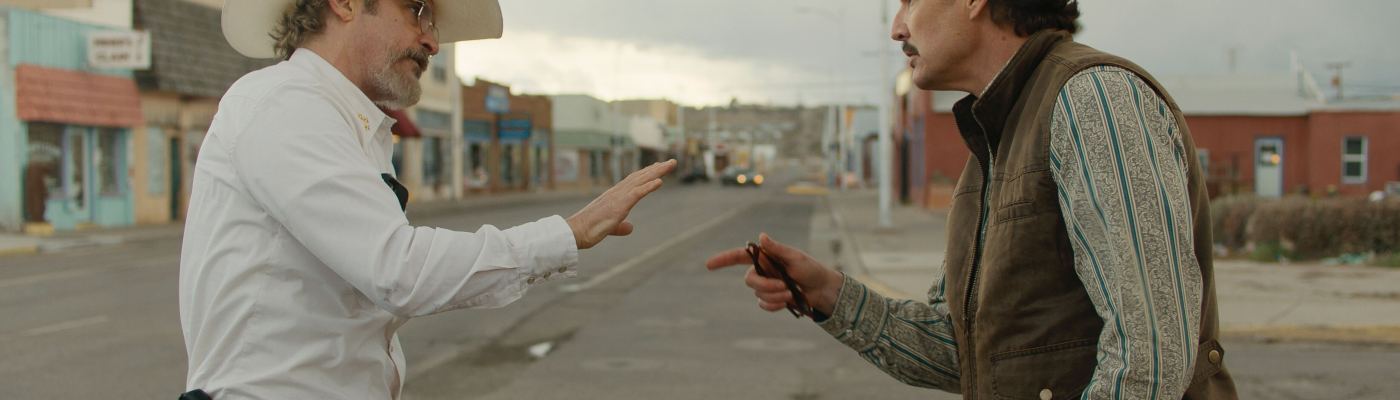
Aster’s latest continues in this vein, even reuniting him with his Beau star Joaquin Phoenix. But, if Eddington appears outwardly more accessible than Beau is Afraid, the two-and-a-half-hour film will likely prove even more divisive due to its provocative subject matter. Phoenix plays Joe Cross, the local sheriff of Eddington, a small town in New Mexico. The film opens with him being admonished by other officers for not wearing his mask while alone in his squad car, and everything sort of snowballs from there.
A long-standing rivalry is reignited between Joe and local mayor Ted Garcia (Pedro Pascal), who is enforcing all of the mandates imposed by the state’s governor, while not entirely adhering to the rules himself. He’s also up for re-election. When Joe intervenes on behalf of an elderly man being kicked out of the grocery store for not wearing a mask, the incident provokes him to run for mayor against the incumbent.
Phoenix excels at playing these sorts of slightly offbeat characters, his Joe Cross a man on the verge of snapping that the actor is able to fully and convincingly embody. The cast also includes Emma Stone as Joe’s increasingly withdrawn wife Louise, and Deirdre O’Connell as her conspiracy-minded mother Dawn (the “mommy issues” of Aster’s previous films have not gone away here). Austin Butler also appears as Vernon Jefferson Peak, the leader of an online cult that Louise follows. If Stone and Butler feel slightly underused, their presences also add a certain gravitas to the film.
For the first stretch of Aster’s film, Eddington plays as highly entertaining satire. Joe begins to run a haphazard mayoral campaign out of the sheriff’s office, with his deputies Guy (Luke Grimes) and Michael (Michael Ward) reassigned as his campaign team. The former is white, while the latter is Black. These are details that do not seem to matter much until the death of George Floyd ignites racial justice protests in the town, mostly led by white teenagers.
Yes, Aster does go there, which will be one of the most contentious aspects of the film. But, by referencing actual events from this moment in time, Aster’s film successfully manages to exist both in the real world and in its own slightly heightened reality. If 2020 was a cultural and social tipping point, Aster uses it as the grounded backdrop for a descent into madness that captures the feeling of living through it all over again. We don’t know how bad things will get until they do, and by then there is no going back from it.
At first, Eddington identifies hypocrisies in a somewhat playful and sardonically funny way, such as the “six feet” rule for social distancing that Joe capitalizes on during an early encounter with his opponent. Aster doesn’t seem interested in offering a one-sided political screed, but rather skewering everybody. It’s the South Park approach, if you will. There was absurdity in the mask mandates and how they were haphazardly enforced, as well as in the largely performative virtue signalling of white people posting black squares on Instagram to show “racial solidarity” following the police-involved death of Floyd.
This “both sides” approach might feel like a bit of a cop out to some, but it turns Eddington into a sort of political Rorschach test. Some of the political commentary feels particularly biting and astute. For example, one of the BLM protesters who gets involved is your prototypical young white guy who starts spouting far-left, social justice talking points about “abolishing whiteness” just so he can get the attention of a girl.
Aster also capitalizes on the confusion in the early days of the pandemic, with a lot of public health responses being made up on the spot. The more liberty-minded (or “based”) reading of the film would be how the mandates had ripple effects even more harmful to society in the long run. There was a lot of gaslighting from the mainstream media and politicians, which in turn led some very online types to go even deeper down conspiracy-driven rabbit holes, leading to increased paranoia and distrust in all institutions. Aster is interested in the endpoint of where that can lead.
Watching Eddington feels like falling back into that abyss, before it reaches a tipping point that will lose some viewers. If the film starts as a bit of a lark, it gets increasingly bleak partway through, and becomes terrifying. The suffocating nature of the film’s last hour plays out with nihilistically comic, Coen Brothers intensity. Aster is using the real backdrop of 2020 to amplify a powder keg situation of his own design, one that, while more thriller than horror, feels characteristically in line with the nightmare visions of his previous three films.
Furthermore, the specificities of the titular town feel so well-realized, with Aster embracing the milieu of this time and place. Every element feels carefully crafted. Despite the film’s modern setting, Aster develops the visual aesthetic of a classic Western, working with master cinematographer Darius Khondji for the first time.
If this is Aster in burn the house down mode, he delivers a searing piece of work that is designed to evoke strong reactions across the aisle with its time capsule portrait of 2020. What you take away from it might depend on the viewer, but is there really any other way to capture the feeling of living through a year as strange as that one?

 The Joy of Movies