By John Corrado
 Weapons, the ambitious new horror movie from director Zach Cregger who burst onto the scene with Barbarian in 2022, opens with a killer hook. One night, at 2:17am, seventeen kids all woke up, got out of bed, walked out their front doors, and disappeared.
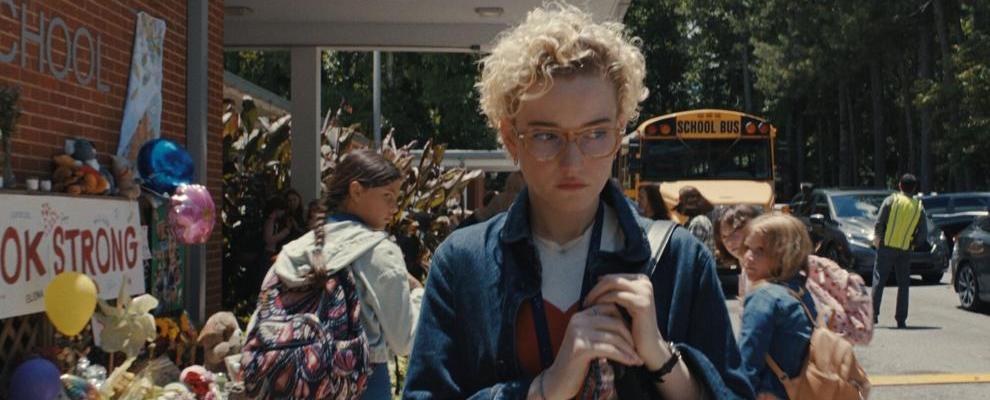
At the start of the film, we see haunting images of the children running into the night, never to be seen again. A child’s voiceover explains how the kids were all in the classroom of teacher Justine Gandy (Julia Garner), with all but one of her kids disappearing.
And so begins this latest from Cregger, an intriguing and unsettling horror-mystery that unfolds with a compelling, inventively structured story told from multiple perspectives. If Barbarian revealed Cregger’s penchant for blending genres and delivering unexpected twists, this is him delivering another piece of wild ride cinema, mixing elements of psychological thriller, dark comedy, and urban legend.
The disappearances have rocked the tight-knit town of Maybrook, Pennsylvania. It’s the sort of town that seems stuck in the 1980s, but this story is set in modern day, with Ring doorbells and security cameras having captured the kids running off into the night. The one boy who didn’t vanish, Alex Lilly (Cary Christopher), has been questioned constantly since the disappearance of the other kids.
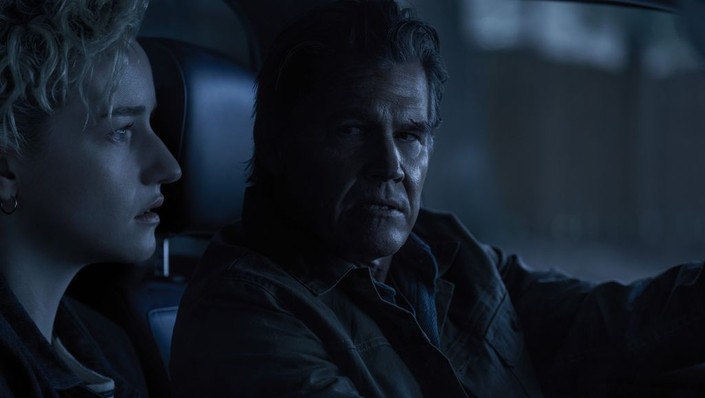
At a tense town hall meeting, fingers are pointed at Mrs. Gandy, and she is confronted by Archer Graff (Josh Brolin), the father of one of the missing kids. From these threads, Cregger weaves his diabolical web. The film’s point of view keeps switching. Just as one chapter builds to a possible climax, the focus shifts, bringing in the perspectives of other characters; the school principal (Benedict Wong), a young cop (Alden Ehrenreich), a homeless drug addict (Austin Abrams).
Cregger, who pre-Barbarian was primarily known for his humorous work as part of the comedy troupe Whitest Kids U Know, continues to prove himself as a skillful horror filmmaker. There is a lot going on in Weapons (with comparisons to be made to films like Prisoners and Longlegs), but Cregger is successful at mixing it all into his own distinct, creepy, and very entertaining package. The film also looks incredible, with cinematographer Larkin Seiple (who also lensed Swiss Army Man and Everything Everywhere All at Once for The Daniels) crafting a dark, atmospheric environment in every scene.
The actors are all doing strong character work that further immerses us in this world, and makes the stakes feel higher and more personal. Garner is terrific as the teacher who clearly cares about these kids, but has her own personal demons, including heavy drinking. Brolin is a strong presence as a grieving dad. Abrams steals scenes in a role that toes the line between comic relief and something more tragic. Then there’s Amy Madigan, who compels, confounds and mesmerizes with her bizarro supporting role.
Each character’s story reveals a bit more of the central mystery. In many ways, every chapter is its own tangent, but they all circle back to the same place; those missing kids, and how they vanished. In an example of the film’s ambitions, Cregger has said that this narrative structure was inspired by Magnolia, Paul Thomas Anderson’s sprawling, multi-character drama that had its own symbolic, unexplained events reoccurring throughout.
What does it all add up to? Well, that’s sort of the point. That bad things can happen without clear explanations. In this way, Cregger somewhat bucks a modern trend within the horror genre to actually be about something else by offering a clearly defined message or theme (not that this is always a bad thing). But sometimes evil can’t be explained, and not all horror needs to be elevated, is what Cregger seems to be trying to say.
There has been much debate already if Cregger is crafting a stealth allegory for school shootings, which, to be fair, is a somewhat plausible reading of the film. The themes of inaction, the inability of a community to protect its children, and passing the blame on to an easy scapegoat (in this case, the teacher) are all there. But it’s also not entirely clear that is the case (for what it’s worth, the director hasn’t confirmed these interpretations in interviews). Cregger doesn’t offer easy answers about what it all means or is supposed to represent, intentionally so.
This is not to say that Weapons doesn’t explore the collective impact that a tragic event has on everyone in a community, because that is a core thematic element. But the nagging feeling of unanswered questions, and struggling to find a reason for why something tragic happened, might be more his point. Cregger wrote the script in the wake of his friend and fellow Whitest Kids U Know cast member Trevor Moore’s shocking death in 2021. Which an online search reveals happened around 2:30am on August 7th (the day of the film’s early previews), when he stumbled off a balcony.
The fact that Cregger doesn’t overtly explain his film’s more elusive, surrealistic touches (one haunting dream image in particular lingers in the mind without being elaborated upon) actually makes it stronger and more intriguing. It’s more compulsively watchable this way. Moreover, Cregger is going for something with the feel of a folktale that becomes part of local community lore, details getting muddied as kids repeat the tale. It feels like a story being passed down and retold. A child’s suburban nightmare from the 1980s being played out on screen.
What the film ultimately says will be debated about, but it builds to a killer punchline. Cregger begins with suffocating dread; children have disappeared, and nobody knows where they are. But he builds to something that is wildly entertaining in a way that feels a bit subversive, without undercutting the disturbing nature of the subject matter itself. The film’s bonkers finale, meant to elicit any range of shocks, thrills, pitch black comedy, and “wtf did I just watch?” reactions, is staged with the skill and confidence of a director in control of his craft. It had me hooked from start to finish.
 The Joy of Movies