
By John Corrado
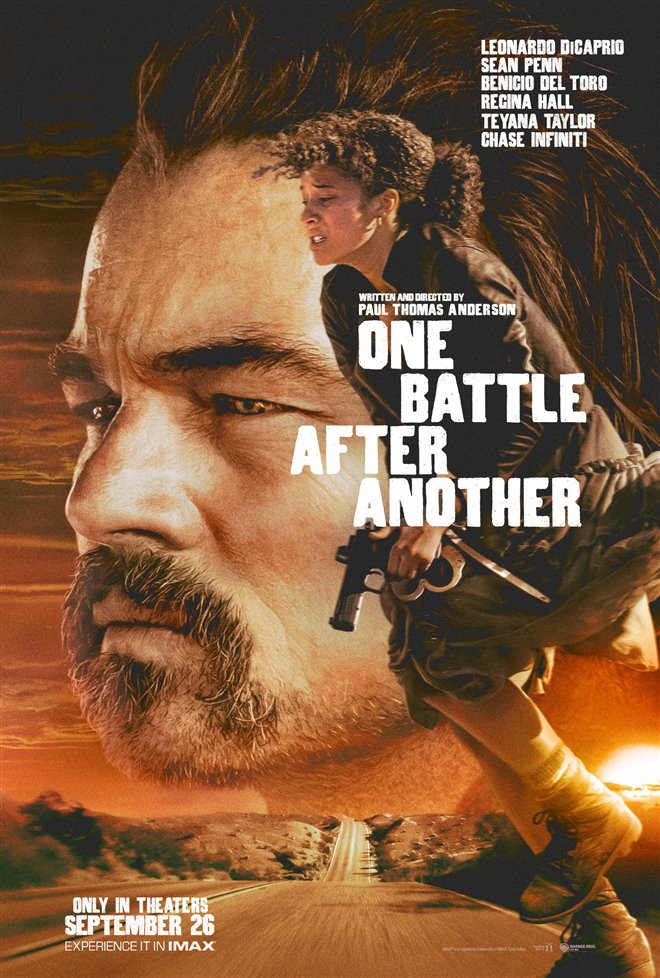 The runtime for Paul Thomas Anderson’s One Battle After Another is 162 minutes. The length of the movie is surely one of the least pertinent things about it, but it’s worth mentioning because of how kinetic the film feels. Nearly two hours in, I was surprised there was less than an hour left.
Anderson’s latest, a mix of dark comedy, political thriller and chase movie, has a propulsion to it that keeps us watching. Despite running nearly three hours, this film moves, elevated greatly by Jonny Greenwood’s superb jazz score.
The story is loosely based on Thomas Pynchon’s Vineland. This isn’t Anderson’s first Pynchon adaptation either, with him also tackling the author’s work in his 2014 stoner noir Inherent Vice (perhaps the director’s most underrated work). It’s set in a version of America that could be past, present or future, ruled by a totalitarian regime that is rounding up migrants and political dissidents.
Leonardo DiCaprio stars as Bob Ferguson (or “Ghetto Pat”), a former member of a revolutionary left-wing militia group called the French 75, along with his pregnant girlfriend Perfidia (Teyana Taylor). The film’s first act focuses on the group’s acts of political terrorism in pursuit of social change, including “liberating” migrant detention centres, with Bob serving as their explosives expert. They are constantly being pursued by Captain Steven J. Lockjaw (Sean Penn), a militant with white supremacist leanings and a secret Black girl fetish.
That was sixteen years ago. Bob is now a paranoid recluse raising his teenaged daughter, Willa (Chase Infiniti), alone in Baktan Cross, a sanctuary city for illegal immigrants. When Willa goes missing, he ventures out to find her, which means a trek across this dangerous territory. Benicio Del Toro is Sensei Sergeo, an almost mythic figure who helps him along the way, and Regina Hall is Deandra, another former member of the French 75.
Despite being our heroes, the characters aren’t particularly likeable in the first act as they carry out a number of bombings, and the overarching politics can feel a bit surface deep. On a more cynical level, though, the film is also showing that these revolutionaries failed. DiCaprio’s character is a washed up, alcoholic drug user who fried his brain with substances. The most noble thing he is doing now is trying to save his daughter.
DiCaprio is excellent in the role, delivering a pitch-perfect portrayal of a faded hippie revolutionary merged with The Dude from The Big Lebowski. What actually drags him out of neutral is that he will do anything to protect his daughter. As the daughter, Infiniti is able to hold her own alongside DiCaprio and Penn, developing a natural rapport with the former and going toe-to-toe with the latter in a series of tense scenes.
As Lockjaw, Penn finds that perfect balance between unnerving but also magnetic. We don’t sympathize with him, but also can’t stop watching him. There is a controlled intensity to every movement and facial tic. But Penn also adds a somewhat sad, pathetic quality to the portrayal, through Lockjaw’s desperation to be included as part of a hilariously portrayed white supremacist secret society. It’s gripping supporting work, and could very well get the actor his third Oscar.
This feels like Anderson’s most accessible (dare I say “mainstream”) work yet, while also full of his own idiosyncrasies. It takes the skills of a master to pull this off, to know he is necessarily playing to a wider audience – the $150 million budget and backing of major studio Warner Bros. practically require him to do so – while also imbuing the film with his own personal touches.
PTA melds elements of dark comedy bordering on all out satire, without jeopardizing the underlying tension of the film, or the deeper emotion of it as a father-daughter story. He finds his own rhythm that doesn’t need to be conventional, at times feeling more like freeform jazz. It’s also hard to overstate just how much Greenwood’s score elevates the film. There are entire sections where the pacing feels completely driven by his music.
I don’t think One Battle After Another is PTA’s best movie. How can it be in a filmography that already includes There Will Be Blood and The Master, let alone Magnolia and Phantom Thread? But it is very good, with some genuinely exceptional filmmaking craft on display. That Anderson shot it in VistaVision shows his commitment to keeping cinema alive
The set-pieces that make up One Battle After Another – and give the film its title – are thrilling to watch; like a citywide siege complete with rogue skateboarders, or a car chase along a desert highway, the camera rolling up and down with the rises and falls of the road. Each one of these sequences is expertly paced in a way that really helps that running time fly by, which is a feat unto itself. It’s a pretty magnificent piece of entertainment.
Film Rating: ★★★½ (out of 4)

One Battle After Another is now playing exclusively in theatres.
 The Joy of Movies