
By John Corrado
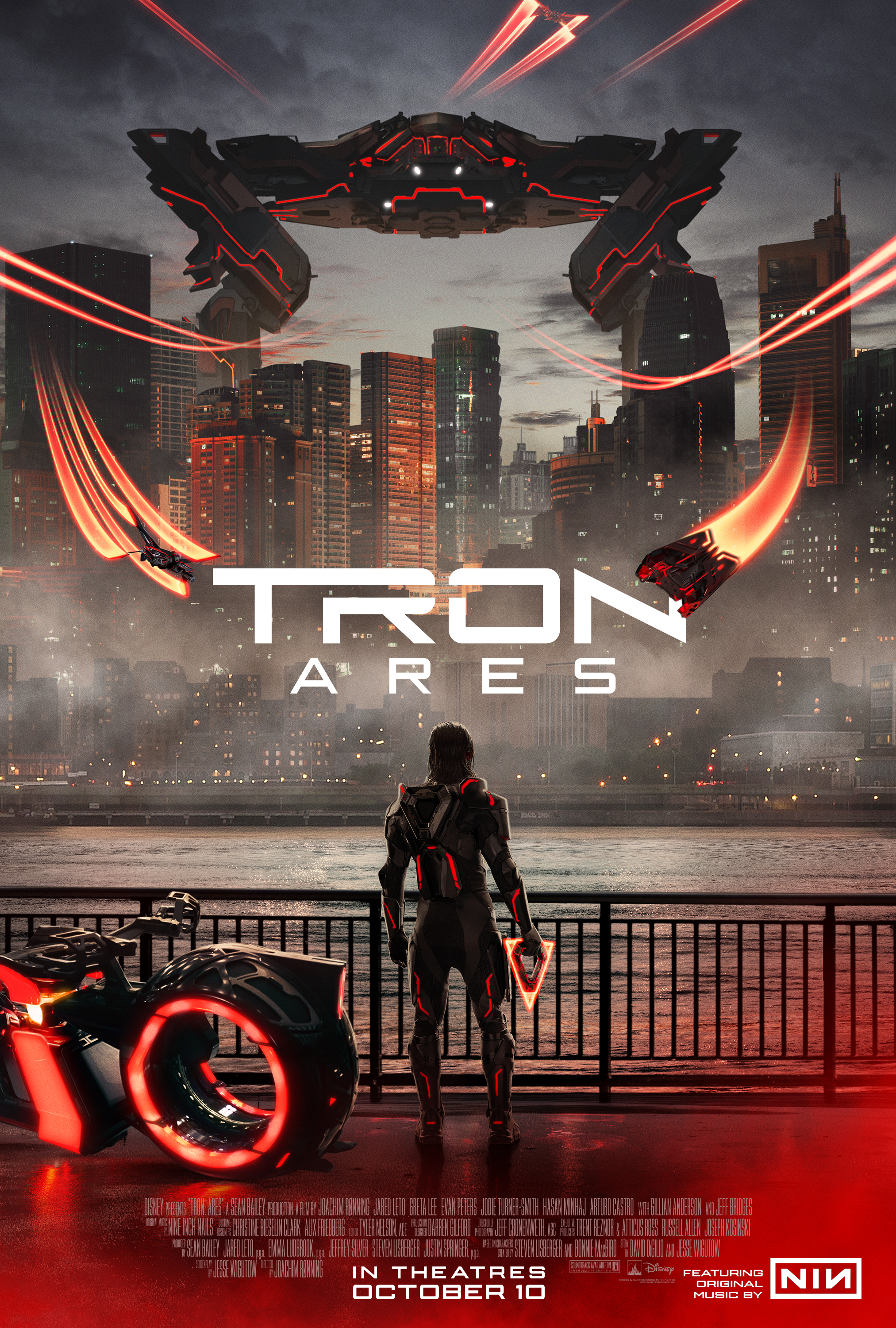 It’s been fifteen years since the release of director Joseph Kosinki’s Tron: Legacy, a belated follow up to Disney’s 1982 film Tron.
This stretch of time between Kosinski’s 2010 film and the new third instalment, Tron: Ares, means that Ares itself feels like a legacy sequel meant to resurrect older IP, in much the same way that Legacy did back in 2010.
The original Tron was an early computer-age vision that gained a cult following over the years, with enough advancements in technology and visual effects by the time 2010 rolled around to justify a follow up. The result was a visually dazzling film (released during the 3D boom, no less) that featured a still-iconic Daft Punk soundtrack.
Well, Daft Punk has since broken up, and Kosinski moved on to make another legacy sequel with Top Gun: Maverick (and this year’s blockbuster F1). Taking their places on Ares are Nine Inch Nails, officially “reuniting” to do the score for this film, and Norwegian director Joachim Rønning, who has become a Disney franchise regular with previous sequels Pirates of the Caribbean: Dead Men Tell No Tales and Maleficent: Mistress of Evil.
We’ve also had enough leaps in technology in the past decade-and-a-half for this sequel to somewhat invert the original premise of getting sucked into a computer program, with a story about rogue AI getting brought into the real world. As a visual and sonic experience, Tron: Ares generally delivers. But it doesn’t reach the highs of Tron: Legacy, and struggles to find a balance between being for the fans of the previous two films, while also trying to be more of a reboot that works for audiences who aren’t as familiar with them.
While it draws on the original IP, this is essentially a story about the leaders of two rival tech companies. Eve Kim (Greta Lee), who took over as the CEO of ENCOM, and Julian Dillinger (Evan Peters), who has been made CEO of Dillinger Systems by his mom Elisabeth (Gillian Anderson). The two companies both have the ability to 3D print organic matter using lasers. The problem is that anything they print disintegrates after 29 minutes.
They are in search of something called the permanence code, a bit of programming that will allow these digital creations to last in the real world. Dillinger wants to use the technology for weapons manufacturing, unveiling the creation of a 3D-printed tank and a super-soldier in the form of Ares (Jared Leto), a sentient, AI being that they are able to endlessly regenerate. Kim has more altruistic goals. Leto’s Ares wants to become human the more time he spends in our world.
The real world stuff is less interesting. The writing is high on exposition and very on the nose, with human characters that are never as interesting or compelling as they could be. Leto and Peters also feel somewhat miscast in these roles. Lee fares better, but the script is below her capabilities. There are enough nods to Kevin Flynn (Jeff Bridges), and many Easter Eggs scattered throughout, to connect back to the previous films. But Ares also doesn’t fully satisfy as a direct sequel to Tron: Legacy, leaving some loose ends in terms of those characters. Kosinski’s visual style is also missed, with Rønning bringing a more generic look to parts of the film.
It’s when we go back into the Grid that the film pops off. Ironically, Tron: Ares is at its best as a laser light show, set to that seat-shaking NIN score. Trent Reznor and Atticus Ross also serve as executive producers on the film, which sometimes works best as essentially a visual album. Their pounding synth music provides a fitting backdrop for the action set-pieces, including a Lightcycle chase through city streets that get reimagined as the Grid, with red light trails left behind by the glowing bikes that cut cop cars in half.
This stuff is all visually cool, and make a compelling enough case for Tron: Ares to be seen in a theatre, especially on a giant IMAX screen. It’s worth it for the audiovisual experience. Even if we leave the film somewhat longing for the missed opportunity of the third instalment that Kosinski never got to make.
Film Rating: ★★½ (out of 4)

 The Joy of Movies