
By John Corrado
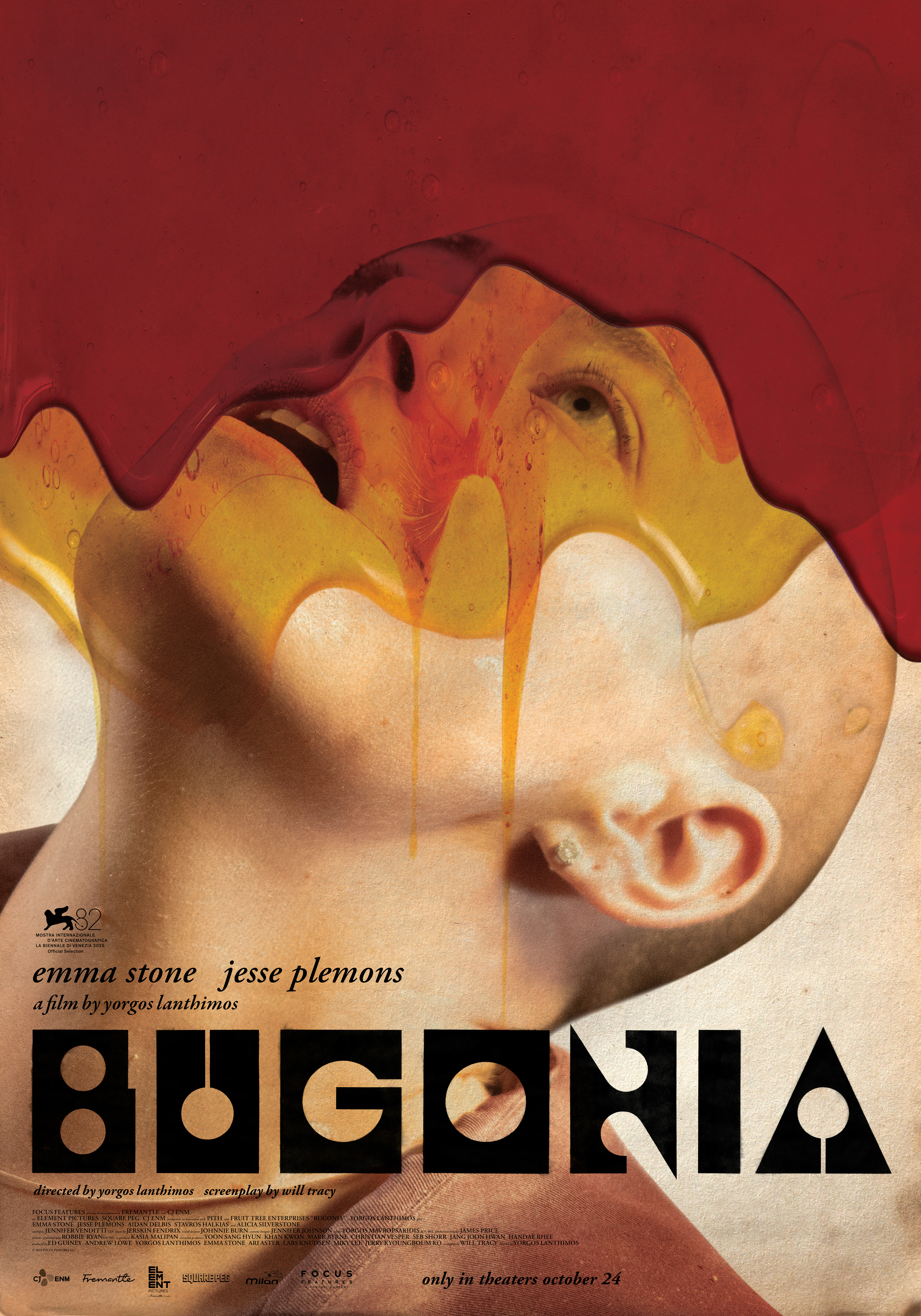 Bugonia is the latest film from Greek director Yorgos Lanthimos, who has been on a hot streak with recent Oscar heavyweights The Favorite and Poor Things, as well as last year’s anthology film Kinds of Kindness.
The common denominator between these films is Emma Stone, who also appears in Lanthimos’ latest, playing a CEO who is kidnapped – and has her head shaved – by two conspiracy theorists who believe she is an alien. Yes, you read that right.
A remake of the 2003 Korean film Save the Green Planet!, which has been updated and Americanized by screenwriter Will Tracy (The Menu), Bugonia is a conspiracy-driven film that exists somewhere between dark comedy, satire, and thriller. It’s not quite sci-fi and not quite horror, but has elements of both. The film is disturbing, yes, but also blackly funny. It’s a balance that Lanthimos knows how to pull off.
Jesse Plemons, who also anchored the triptych storytelling of Kinds of Kindness, stars in the film as Teddy. Teddy is a conspiracy-obsessed loner who is convinced that Michelle Fuller (Stone), the high-powered CEO of a biomedical company, is secretly an alien leader – from the Andromeda species, to be precise – who is intent on destroying Earth. How does he know? Well, he has done plenty of research on the internet, and all the signs are there.
Teddy believes that they only have a few days to convince her to renegotiate with her alien overlords, and stop the imminent destruction of our planet. Teddy is taking advantage of his developmentally disabled cousin Don (Aidan Delbis) to go along with his plan, which involves snatching Michelle from outside her mansion, and holding her hostage in the basement of their rundown house. The men even chemically castrate themselves so they won’t be “tempted” by her female body.
The film becomes game of cat and mouse between Teddy and Michelle, as she plays mind games with him trying to broker her freedom, with Don being used as a bit of a pawn by both of them. It’s a very contained film in this way, but intentionally so, with Lanthimos building off the fascinating dynamic between these three complex characters.
Where Poor Things had a clearly sympathetic lead for us to root for, this film does not. This makes Bugonia more challenging to watch, but also allows it to be a rich experience in its own right, that keeps us dissecting the motivations and beliefs of its characters. As much as Lanthimos is holding the genre balance in check, none of this would work without the performances of Plemons, Stone and Delbis. This is essentially a chamber piece, carried by these three actors.
Plemons fully buries himself in the role of Teddy; long, stringy hair, a different speech cadence, eyes that suggest he is living in an alternate reality. It’s fascinating work that goes beyond just being a stereotype of the basement-dwelling conspiracy theorist, but is a believable and disturbing portrayal of someone with mental illness who got sucked down a rabbit hole and genuinely believes what he does. It’s one of his finest performances.
Stone, an endlessly watchable actress, also brings complexity to her portrayal of a posh elitist trying to talk her way out of this situation, and justify herself in the process. Her work here is in a different register from her previous Lanthimos collaborations. There is a slippery quality to her portrayal; she’s being victimized, yes, but also condescends to Teddy and Don. Michelle’s attempts to reason with Teddy through dialogue, while essentially talking down to him, often inflame him more, offering a compelling snapshot of how crisis negotiation can fall apart.
The other performer here who holds it together is Delbis, a young actor on the autism spectrum, authentically portraying a character with an intellectual disability. Delbis has to navigate a complex role as Don, who ends up being unwitting intermediary between Teddy and Michelle, and it feels like a major breakout role.
If the film doesn’t have the expansive world-building of Poor Things, with its fantastical backdrops and sense of scope, the visual aesthetic of Bugonia is still pretty striking in its own right. This is a much more grounded affair, but the impressive production design of Teddy’s cluttered home and grungy basement show a level of attention to detail.
Lanthimos also uses it to show the stark contrast between Teddy’s drab but lived-in home and Michelle’s cold, sterile house and office, with an early montage that finds editor Yorgos Mavropsaridis cutting back and forth between their daily routines. It’s all captured by cinematographer Robbie Ryan, who lets the actors fill the frame in closeups. The score by Jerskin Fendrix provides near-operatic accompaniment.
These are all frequent Lanthimos collaborators, and their contributions allow Bugonia to recognizably fit in with his previous few works, even if it doesn’t quite reach the level of The Favorite or Poor Things. It’s also not entirely clear what Lanthimos is trying to say, especially with a last act curveball that threatens to throw it off track, and leads to some muddled messaging when it comes to the social commentary of it all.
If Bugonia seems outwardly more accessible than some of Lanthimos’ previous works, it might end up being one of his most polarizing. There is a meanness to parts of it that feels quite cynical, and can keep us at somewhat of an emotional distance, perhaps intentionally so. But Lanthimos still builds to a haunting, strangely powerful sequence that shows a clear command of his craft, and the careful genre balance that he is able to pull off. It’s an interesting addition to his body of work, with a trio of compelling performances at the centre of it.
Film Rating: ★★★ (out of 4)

 The Joy of Movies