By John Corrado
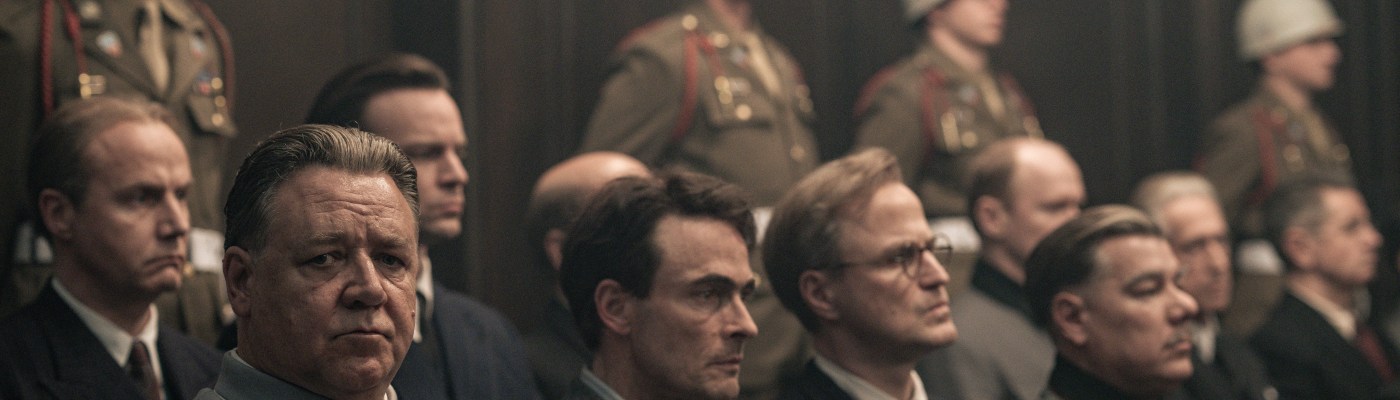
 In Nuremberg, director James Vanderbilt dramatizes the Nuremberg trials, when members of the Nazi high command were arrested and put on trial for crimes against humanity in the wake of World War II. The result is a rock solid old school historical drama that works surprisingly well on every level.
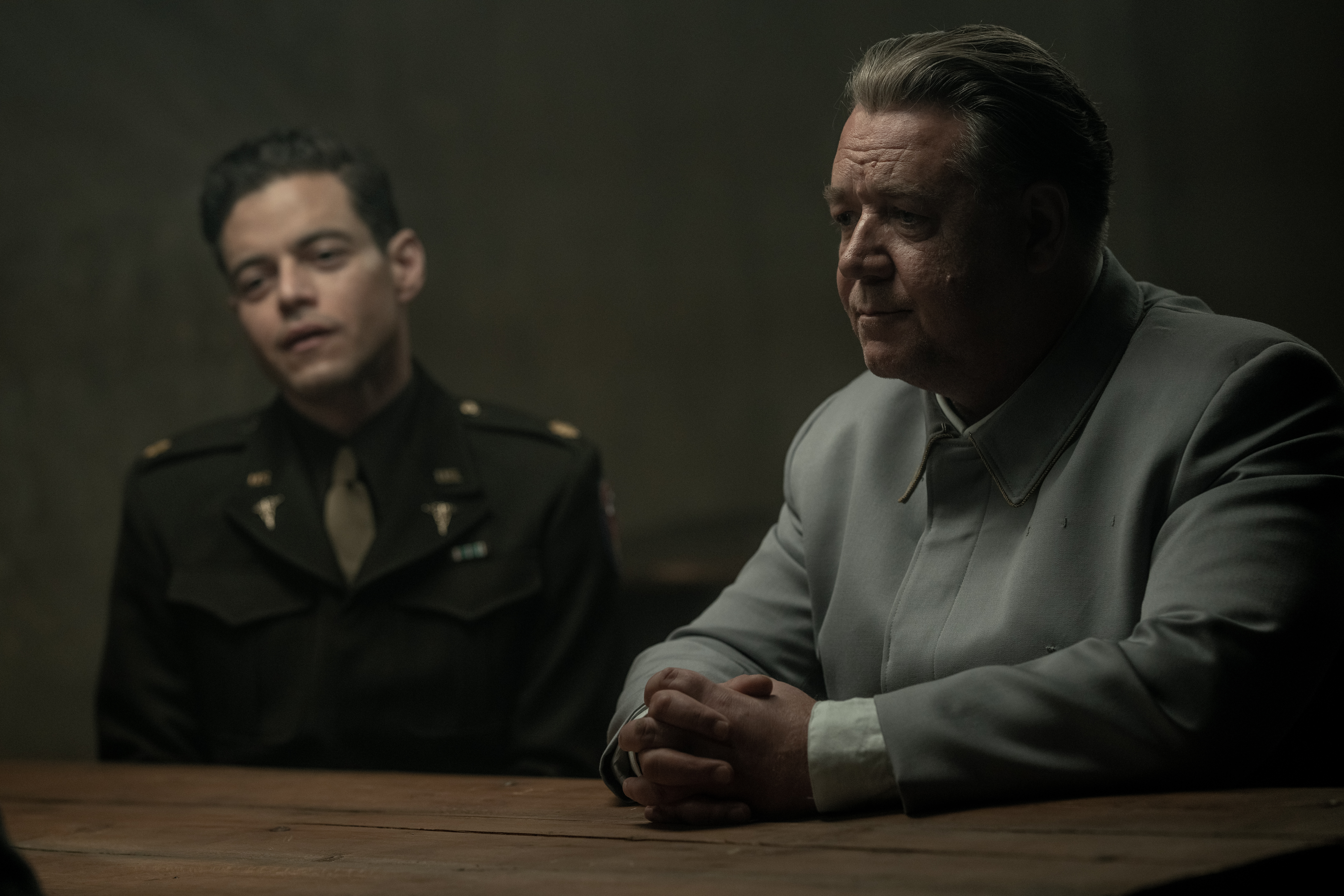
Rami Malek stars in the film as Douglas Kelley, an American psychiatrist who is brought in to determine if Hermann Göring (Russell Crowe), the most powerful figure in the Third Reich following Hitler’s suicide, is fit to stand trial. Sgt. Howie Triest (Leo Woodall) will be his German translator.
We follow preparations for the trial itself, which is being overseen by American prosecutor Robert H. Jackson (Michael Shannon), who must first get approval from other nations to convince the American government to hold them. Jackson, and his British counterpart David Maxwell Fyfe (a sublime Richard E. Grant), feel a responsibility to bring the Nazis to justice, lest their crimes go unpunished and they are able to rebuild their fallen empire.
But it’s the sessions between Kelly and Göring that provide the basis for Vanderbilt’s film, which is based on Jack El-Hai’s 2013 book The Nazi and the Psychiatrist. In exploring the more complicated aspects of the relationship between Kelley and Göring, Nuremberg is able to balance being a mix of courtroom drama and psychological character study. Kelley begins meeting with Göring in his cell in the German jail where the prisoners are being held, chosen for its close proximity to the bombed out courtroom that is being rebuilt for the trial.
Göring is a narcissistic sociopath who claims ignorance over the mass slaughter of Jewish people that happened in the Nazi concentration camps. The goal of the trial is to get him to admit to his complicity in the millions of deaths, which he reasonably would have known about as a high ranking official. It begins a psychological game, with Kelley trying to figure out a way to use Göring’s own need to validate himself against him.
Vanderbilt’s film at times feels like a two-hander between the two men. Their sessions turn into an odd sort of friendship, yet Kelley is also betraying the trust that he has built up with his patient to feed information to Jackson that will help him convict Göring. What’s fascinating about the film is that it shows how Göring is able to charm even Kelley at first, and this is what terrifies him. If Göring is not convicted, he will continue to propagandize for the Third Reich, and downplay Nazi war crimes.
What is perhaps most impressive about Vanderbilt’s film, beyond the obvious historical weight and importance of the events it is dramatizing, is just how well it plays as a movie. The cinematography by Dariusz Wolski has a classic feel to it. Editor Tom Eagles (who received an Oscar nomination for his work on Jojo Rabbit) keeps it ticking along, cutting between scenes with a forward momentum that makes the 148 minute running time fly by.
The film is very well paced despite running nearly two-and-a-half-hours, and is extremely engaging throughout with the amount of information and characters it packs in. Vanderbilt’s screenplay is filled with dialogue that both feeds necessary information and often crackles, underscoring it with scenes that deepen the emotional weight of the material.
It also serves an acting masterclass, with excellent performances from the entire ensemble cast, which is headlined mostly by previous Oscar nominees and winners. Malek plays Kelley as a charismatic figure who is increasingly consumed by what he is doing and his connection to Göring, desperate to understand how the seemingly charming and even sympathetic man in front of him could be complicit in such evil.
On the other side of it is Crowe, who is fascinating to watch as Göring, choosing to underplay him instead of portraying him as a cartoon villain. In moments when Malek goes bigger, Crowe responds with a restrained facial expression. He brings a magnetism to the portrayal. It’s a far more chilling approach, that underscores how the film wants us to grapple with man’s true capacity for evil.
Shannon plays Jackson as a noble man who understands the importance of not losing this trial, while also having his own ambitions of wanting to be on the US Supreme Court. One of the actor’s finest scenes is a beautifully written speech that he has about the necessity of these trials to ensure the Nazis are remembered as being on the wrong side of history (“there will be no statues,” he says).
The other standout is Woodall, who is a solid presence throughout, and delivers an emotionally compelling monologue partway through that in many ways becomes the film’s beating heart. It’s a genuinely moving moment that underpins Vanderbilt’s entire approach, never once diminishing the moral implications of this trial, or the horrors and atrocities committed by the Nazis.
In fact, the emotional gut-punch of how the film weaves in the realities of what took place in the concentration camps, showing them as something unspeakably evil carried out by real people, is what makes Nuremberg so powerful and necessary. Especially at a time of increased antisemitism and Holocaust revisionism (if not outright denialism) entering the mainstream in a disturbing new way.
It would be easy to heap praise upon the film by simply saying they don’t make ‘em like they used to, but they really don’t make ‘em like they used to. This is the best sort of historical prestige drama that we could hope to get in a post-Oppenheimer landscape, calling to mind Steven Spielberg’s Lincoln in its scope and propulsive ability to condense key moments from history into compelling cinematic drama.
Film Rating: ★★★½ (out of 4)
 The Joy of Movies