
By John Corrado
 James Cameron returns to the world of Avatar in Avatar: Fire and Ash, the third film in his sci-fi saga that began all the way back in 2009. And this latest instalment essentially delivers more of what fans of the first two want, with Cameron giving us another immersive, visually dazzling trip to Pandora, that is made to be seen in IMAX 3D.
To say that Avatar: Fire and Ash basically offers more of the same is not to damn it with faint praise, but rather to say that it’s hard to imagine anyone who liked the first two films feeling much differently about this one.
Narratively, Fire and Ash very much serves as a direct continuation of 2022 sequel The Way of Water (the two films were even shot back-to-back). Sure, the screenplay itself doesn’t always live up to the cutting edge visuals, and it once again falters with some genuinely cheesy dialogue. But this is all par for the course in Cameron’s universe at this point, so best not to dwell on it and just go along for the ride.
All told, the Titanic and Terminator filmmaker has already spent about two decades of his life on this multi-billion dollar franchise, and the anticipated box office success of this one will likely (hopefully) herald at least two more. So it’s a case of just letting him cook at this point, as Cameron whisks us away once again to this planet of ten foot tall blue people with tails.
The film begins with Jake Sully (Sam Worthington), his wife Neytiri (Zoe Saldaña), and the rest of their Na’vi family, grieving the death of their son Neteyam in different ways. They face ongoing attacks from the “Sky People” (or humans) who want their resources, and are still being hunted by Colonel Miles Quaritch (Stephen Lang), who is out for revenge against Jake. The story involves the emergence of the planet’s Mangkwan tribe, or the Ash people, and their villainess leader Varang (Oona Chaplin).
There are also subplots involving Jake and Neytiri’s adopted kids Kiri (Sigourney Weaver) and human boy Spider (Jack Champion), the pregnant Ronal (Kate Winslet) from the planet’s reef people, and the continuing adventures of whale-like creature Payakan, who were all introduced to us in The Way of Water. There is a heavy spiritual component to this as well, as characters grapple with their connections to the deity Eywa.
Where The Way of Water felt pretty straightforward, this one is a lot busier. The plot itself is far more overstuffed than its predecessor, and there is so much going on that it can feel bloated, especially at over three hours (it clocks in at 197 minutes, to be precise). This film is long, and you can feel it. In fact, the whole thing can be somewhat exhausting at times, and it can be hard to keep up with all of the various subplots and moving pieces. But the character dynamics, performances, and spectacular visuals keep us mostly engaged throughout.
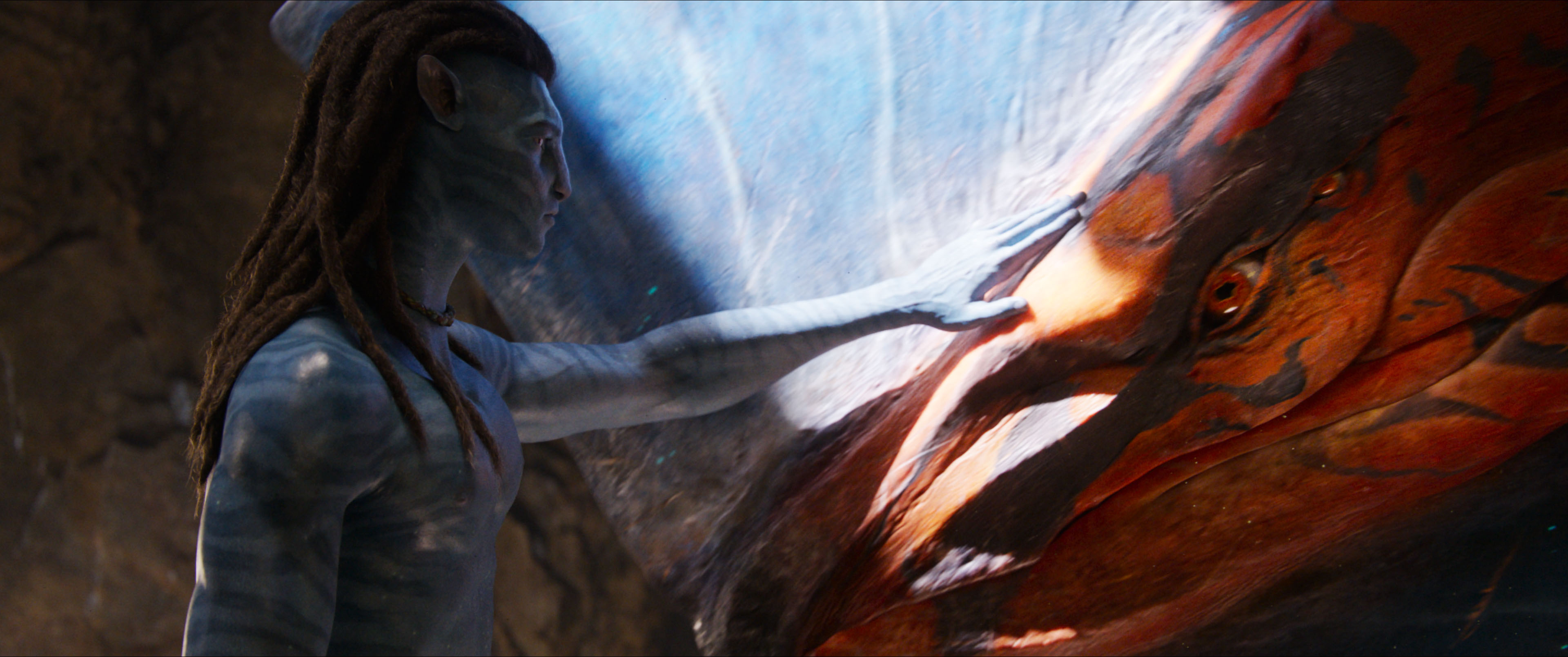
First and foremost, Avatar: Fire and Ash works as another massive blockbuster that is made specifically for the big screen. The visuals are once again fully immersive, especially in 3D on a giant IMAX screen. If 3D largely fell out of favour over the past decade because it mostly felt like a gimmick, Avatar: Fire and Ash reminds us how effective it can be when done well. It adds real depth to the film, allowing characters to appear in the foreground and background, with the fiery embers surrounding the Ash people floating off the screen.
As much as these are narrative films, they are also showcases for advancements in technology and visual effects. Cameron builds off the underwater motion capture technology that literally had to be invented in between the first two films for The Way of Water. The filmmaker is also once again playing around with higher frame rates, presenting action scenes at 48 frames per second. The ultra smooth look of the HFR sequences does make other scenes appear to sputter a bit as it switches back to a regular frame rate, which can be tiring on the eyes.
But, aside from all this digital trickery on display, Cameron is also just a really skilled blockbuster filmmaker, who is still capable of staging thrilling set-pieces. He is able to draw tension out of putting his characters in perilous situations, and building suspense around seeing how they will get out. It’s something that he famously did in Titanic, as well as in the last act of The Way of Water, and does again here.
When you leave the theatre after those nearly three-and-a-half-hours are up, you feel like you have been transported to a different world. It can be exhausting, sure, and the story feels overly sprawling at times. But this sense of full immersion is Cameron’s goal. Long live the theatrical experience!
Film Rating: ★★★ (out of 4)
 The Joy of Movies