By John Corrado
★★★½ (out of 4)
 The latest from Japanese master Hayao Miyazaki, The Boy and the Heron (which had its North American premiere as the opening night film at TIFF) is an enchanting, gorgeously animated fantasy about life and death.
The film is Miyazaki’s first since The Wind Rises a decade ago, which was initially intended as his final film before retirement, and it’s a welcome return that ranks among his best.
Set during the World War II in 1943, the plot centres around Mahito Maki (voiced by Soma Santoka), a 12-year-old boy who gets moved to the Japanese countryside with his father (Takuya Kimura), after his mother is killed in a hospital fire in Tokyo.
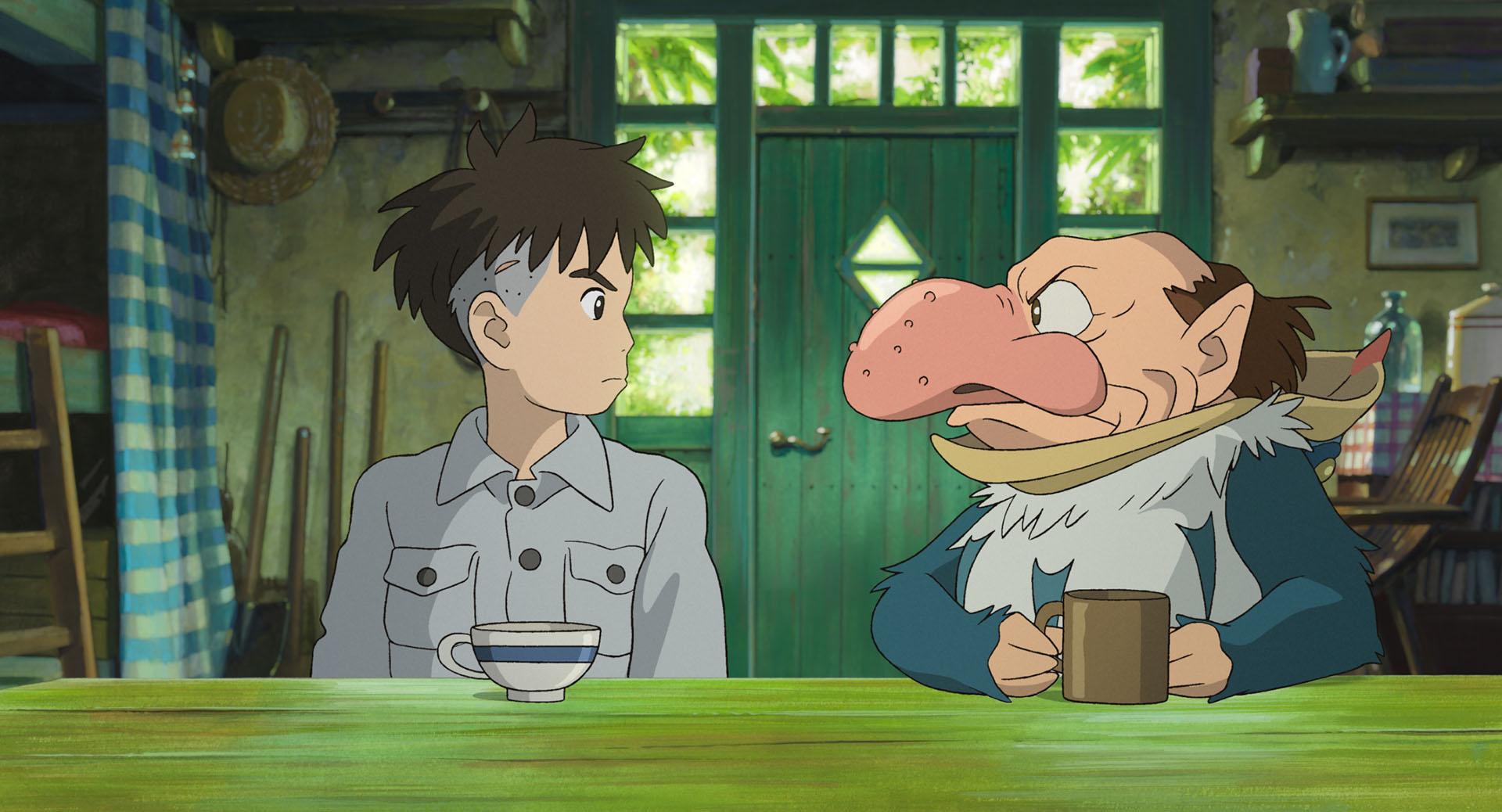
It’s here that he meets a talking grey heron (Masaki Suda), a wonderfully grotesque creature who draws him into a fantastical world where his mother may still be alive. This is when the film starts to soar, as Mahito enters into various fantasy realms that range from nightmarish to beautiful, meeting a variety of creatures that range from cute (the warawara) to oddly terrifying (like a flock of giant parakeets).
Fashioned as the loosest of adaptations of Genzaburo Yoshino’s 1937 coming-of-age novel How Do You Live?, which serves as a plot point rather than the plot itself, The Boy and the Heron is instead entirely its own thing. There is a characteristic playfulness to the way that Miyazaki fleshes out this universe and keeps introducing new ideas, building worlds within worlds. But it’s grounded in a story about trying to find meaning amidst war and death, with Miyazaki’s screenplay drawing upon elements of his own childhood.
The film is almost unclassifiable, with a story that becomes difficult to describe, but works on a level of pure feeling (I was quite moved by it during the 9 AM press screening at TIFF). Characteristic of Studio Ghibli, the film features beautiful hand-drawn animation, with some of the most whimsical and striking images we will see this year. At his best, Miyazaki has always found that balance between weirdness, humour and emotion. But now time is catching up to him, and out of necessity everything is starting to feel like a possible final statement.
What The Boy and the Heron becomes is a powerful fable about the choice of whether or not to keep going in a burned out world. This is a densely packed film that practically begs for another viewing to pick up on all of its symbolism and meaning. It’s entertaining, beguiling, and moving, set to a sweeping score by composer Joe Hisaishi. If this does end up being Hayao Miyazaki’s final film (though it’s now looking like that won’t be the case), it’s a very fitting swan song for him to go out on.
The film is being released both in its original Japanese version with subtitles (which is the version I saw for review), and an English dub featuring an all-star voice cast that includes Luca Padovan as the boy, Robert Pattinson as the heron, and Christian Bale as the father.
The Boy and the Heron opens exclusively in theatres and IMAX on December 8th.
 The Joy of Movies