By John Corrado
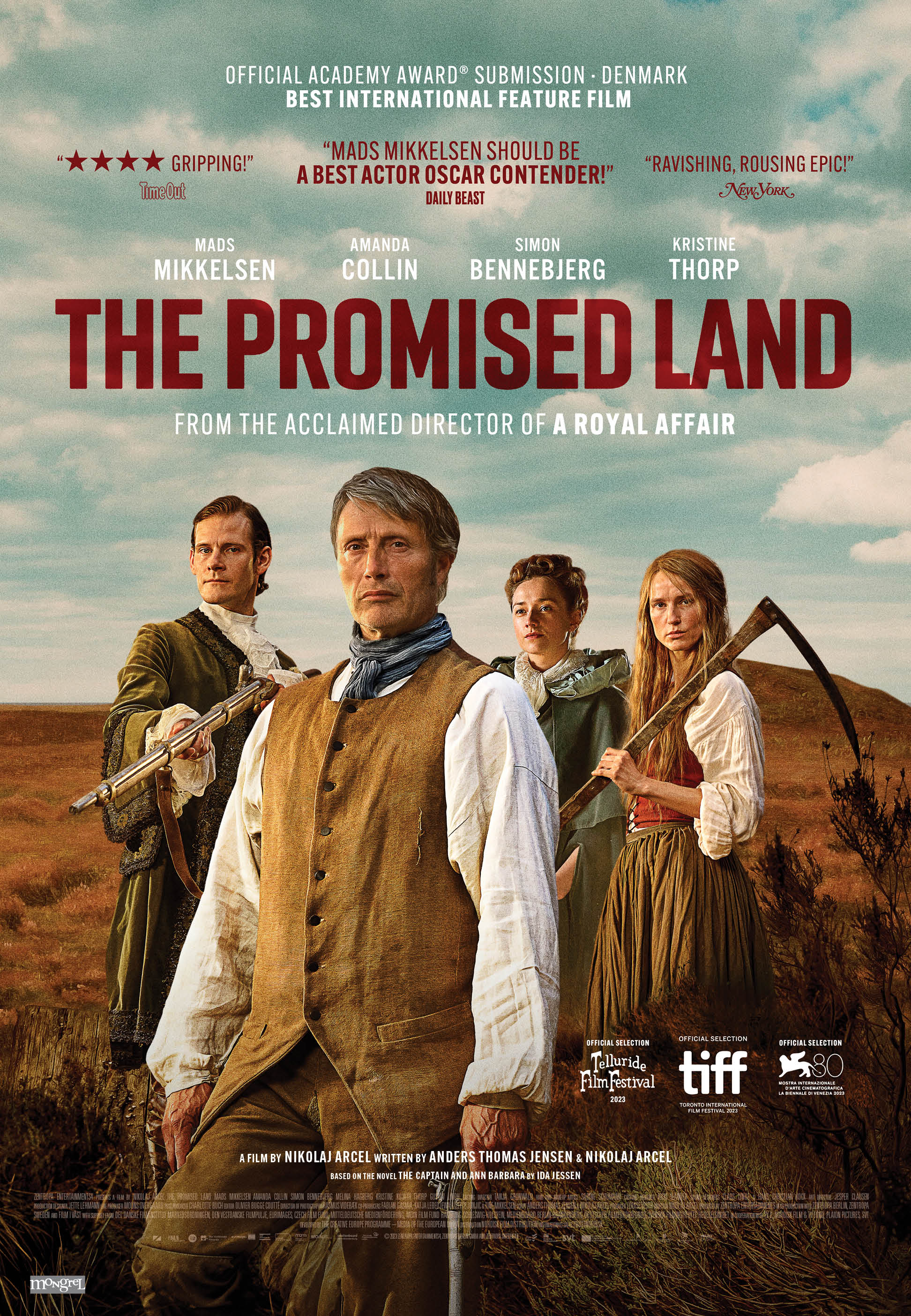 The Promised Land is a historical drama set in Denmark in the mid-1700s, with director Nikolaj Arcel spinning a near-epic tale out of a humble man trying to carve out his own piece of the land while going up against an arrogant nobleman.
The protagonist is Captain Ludvig Kahlen (Mads Mikkelsen), who has retired from service in the German Army, and wants to use his military pension to cultivate the Jutland heath, land that has been deemed infertile for growing crops.
Ludvig is given permission by the Danish Kingdom to build a farm on the land, seeking the noble title that will come if he is successful in growing a crop. But he has limited access to settlers to work on the land, instead relying on the help of a young priest (Gustav Lindh) who brings him Johannes Eriksen (Morten Hee Andersen) and his wife Ann Barbara (Amanda Collin).
Johannes and Ann Barbara are tenant farmers who have run away from Frederik De Schinkel (Simon Bennebjerg), the villainous landowner who wants a monopoly on the area and becomes determined to drive Ludvig out. Ludvig is also faced with a band of outcasts from the nearby woods, including a young Romani girl named Anmai Mus (Melina Hagberg), who initially comes to his farm to steal.
Arcel’s film, which was adapted from Danish author Ida Jessen’s book The Captain and Ann Barbara, understands the laborious process of trying to till this land, while also framing it as a grand rivalry between the haves and the have-nots. The conflict between Kahlen and De Schinkel becomes more dramatic as it goes along, with the rivalry between the two men turning increasingly violent.
But the film still finds ways to ground itself in being a slice-of-life drama following the daily struggles faced by settlers and land cultivators in 18th Century Denmark, giving equal weight to little moments like the miracle of a sprout popping up from the ground, or the natural devastation of a hailstorm. The adapted screenplay, co-written by Arcel and Anders Thomas Jensen, offers an impressive balancing of tones, with the film never fully tipping over into romance, melodrama or revenge fantasy, despite blending elements of all three.
At the centre of all this is Mikkelsen, who delivers a quietly intense performance as Ludvig. He is at times rough and ruthless, but also starts to soften up in the presence of Ann Barbara and the runaway child. Meanwhile, Bennebjerg’s portrayal of De Schinkel borders between chilling and camp, turning him into an almost monstrous buffoon whose cruelty knows no bounds.
Dan Romer’s music provides sweeping accompaniment. The striking cinematography by Rasmus Videbæk captures the rugged beauty of this land, including shots of the scenery drenched in heavy fog, with interiors illuminated by candlelight in a way that recalls Barry Lyndon. This is all to say that The Promised Land feels like a piece of sturdy, classic moviemaking.
Film Rating: ★★★ (out of 4)

The Promised Land opens in theatres in limited release on February 9th in Toronto (at Scotiabank Theatre) and Vancouver, before expanding to Montreal and Ottawa on February 16th and other cities in the coming weeks. It’s being distributed in Canada by Mongrel Media.
 The Joy of Movies