By John Corrado
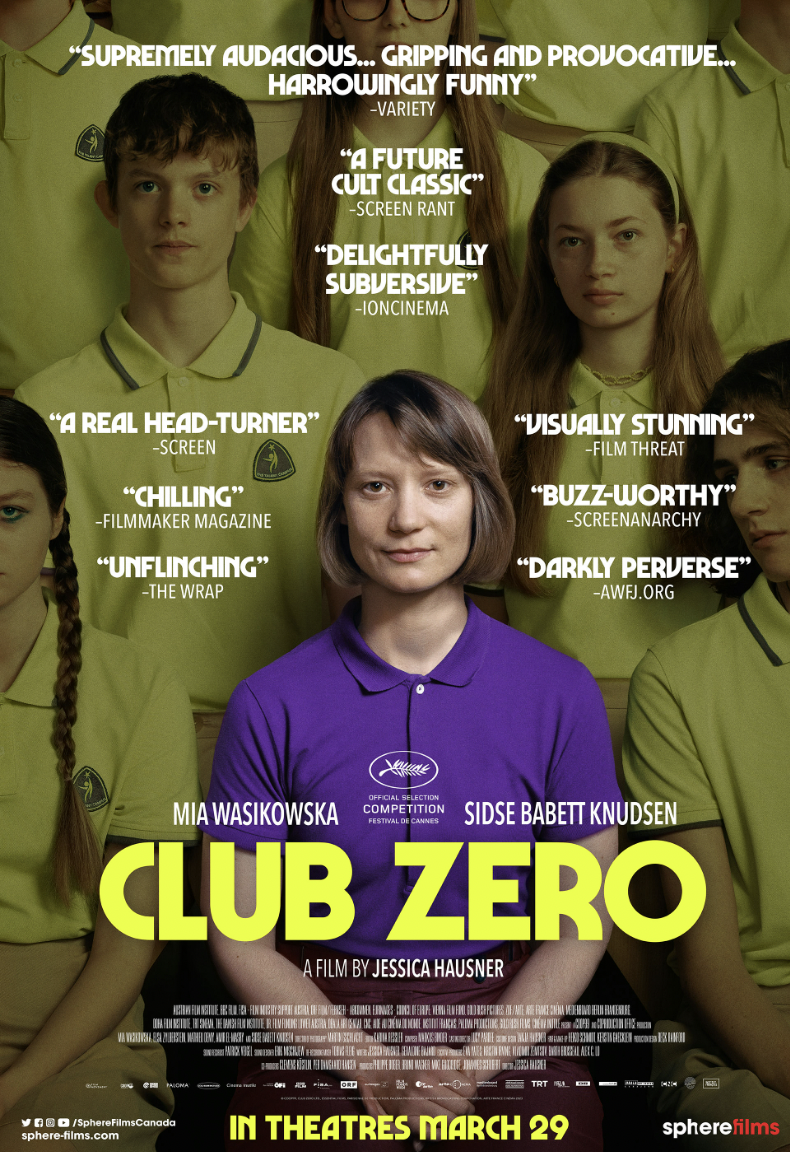 A group of students fall under the sway of their new teacher Miss Novak (Mia Wasikowska) in Club Zero, Austrian director Jessica Hausner’s offbeat and unsettling satire of cliques, social pressure, and radical movements.
Miss Novak arrives as the new teacher at the Talent Campus, an international private school where she is brought on to teach a class in “conscious eating.” The practice begins with encouraging students to limit portions and eat slowly to concentrate on every bite.
But Miss Novak soon introduces her small group of young acolytes to the secret club that gives the film it’s title; an elusive group of “true believers” who don’t eat anything at all, believing that the need for food is merely a social construct. You just “need to have faith,” she assures the students.
Miss Novak selects a small group of students who are most susceptible to her ideas, providing them with her special “fasting tea” and making them feel special by being brought under her wing. While the more traditional body image reasonings for eating disorders serve as motivation for some, for others their embrace of conscious eating is rooted in a concern for the environment (it’s a cheap shot, perhaps, but Greta Thunberg would fit right in here).
For example, Ragna (Florence Baker) is already self-conscious about her body and wants to get better on the trampoline, and Elsa (Ksenia Devriendt) is a bulimic who sees this as a more socially acceptable way to control her food intake. Meanwhile, Helen (Gwen Currant) is there purely for environmental reasons, wanting to control what she eats for the sake of the planet. Fred (Luke Barker) is a dancer who feels that by not eating he can stay rake-thin and keep his diabetes in check, while Ben (Samuel D. Anderson) simply needs the grade from the class.
These students develop a cult-like following around the teacher, who sells “conscious eating” to them as a way to not only stay healthy but also to protest capitalism and rise above consumerist attitudes around food. On a more symbolic level, Club Zero serves as a satirical look at how easy it is for young people to fall under the sway of radical, extremist movements and become completely brainwashed into belief systems and ideologies counter to the ones they were raised in.
Aside from one incredibly gross scene that plays for shock value, this is the driest of satires. Hausner establishes an off-kilter atmosphere that is unsettling but also sardonic. It’s a tonal balance that is hard to say if it completely works, because her film is so focused on being its own thing. The film is often effective at putting us under its strange spell, but aspects of Hausner and co-writer Géraldine Bajard’s screenplay also feel a bit too opaque, with certain spiritual ideas not being fully fleshed out.
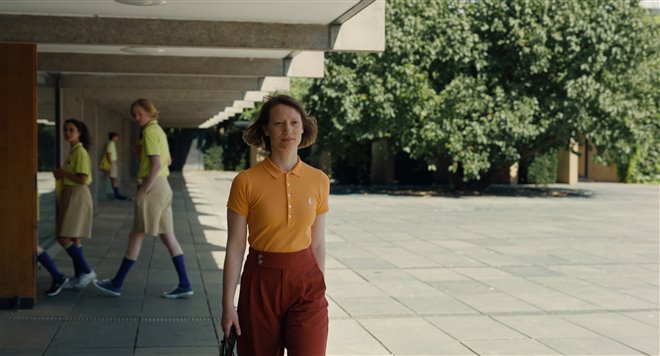
Hausner is going for a somewhat dreamlike tone at times, heightened by Markus Binder’s percussive score, Miss Novak’s bizarre chanting, and an extended sequence set to Mahalia Jackson’s “Silent Night, Holy Night.” Martin Gschlacht’s cinematography frames things in wide shots, often with a lot of empty space in the frame. It’s centred around Wasikowska’s highly measured performance as Miss Novak, who comes across as the calmest of cult leaders, and watching the students fall under her spell is a unique if unnerving viewing experience.
Film Rating: ★★½ (out of 4)
Club Zero opens exclusively in theatres in limited release on March 29th. It’s being distributed in Canada by Sphere Films.
 The Joy of Movies