By John Corrado
 How the heck do you even begin to approach making a sequel to the 2019 smash hit Joker?
You know, the R-rated comic book villain origin story from the director of Old School and The Hangover, that was inspired by the films of Martin Scorsese, somehow won the Golden Lion at Venice, went on to gross a billion dollars, and then finally won two Oscars, including Best Actor for Joaquin Phoenix’s transformative role?
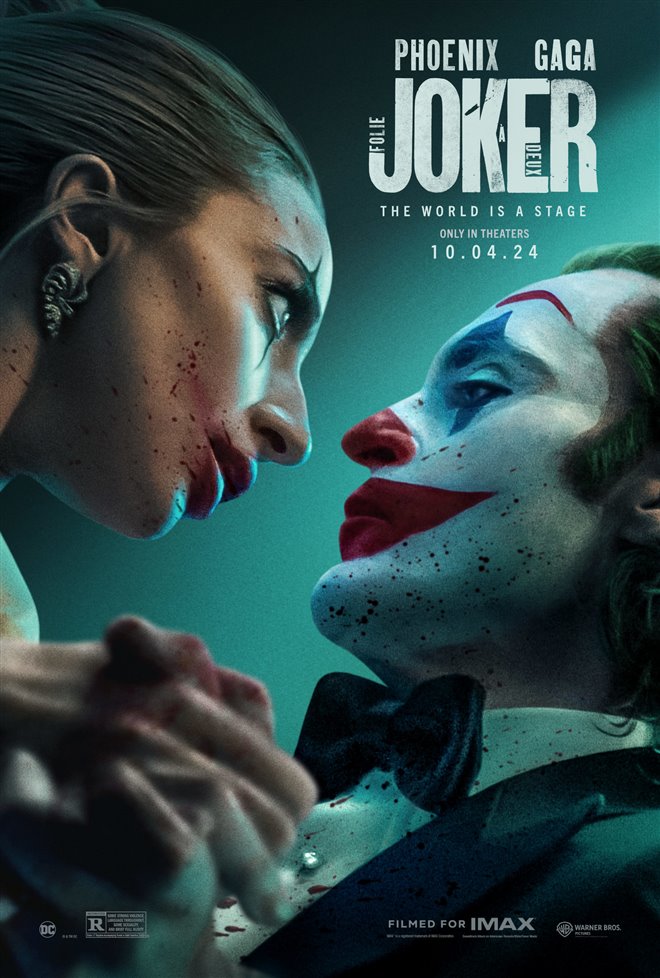
The conventional wisdom would be to simply copy what worked about the first film, but director Todd Phillips has decidedly not taken that path with Joker: Folie à Deux. This sequel is instead pitched as a jukebox musical starring Lady Gaga, that essentially mixes dreamlike production numbers with courtroom drama.
It’s a wild swing-for-the-fences for a studio picture, especially within the usually safe confines of comic book movie IP. In fact, Folie à Deux is so dead-set against delivering what fans expect, that it almost feels like Phillips is trolling; trolling the studio heads who forced him to make a sequel, by taking their nearly $200 million blank cheque and coming back with something this intentionally divisive, and maybe even trolling the fans who idolized the first movie.
This is not to say that Folie à Deux is some sort of misunderstood masterpiece. It is flawed. But it is also interesting; yes, far more so than your typical studio cash-grab. If the first movie was Phillips riffing on Scorsese’s Taxi Driver and The King of Comedy (quite successfully, in my opinion), this is him crafting elaborate homage to Scorsese’s New York, New York and Francis Ford Coppola’s One From the Heart; both ambitious studio musicals that were also notorious box office flops in their day.
The first Joker was a powder keg, a lightning-in-a-bottle sort of film. Set in a Gotham City modelled after New York in the 1980s, it tapped into something in the zeitgeist with its simmering, disturbing portrait of loneliness and mental illness against the backdrop of a crumbling society. In many ways, Folie à Deux is preoccupied with trying to figure out why the first film struck such a chord, with Phillips still working through the answers in his head five years later. If the first film felt hazy and intentionally ambiguous, this one doesn’t shy away from open exposition.
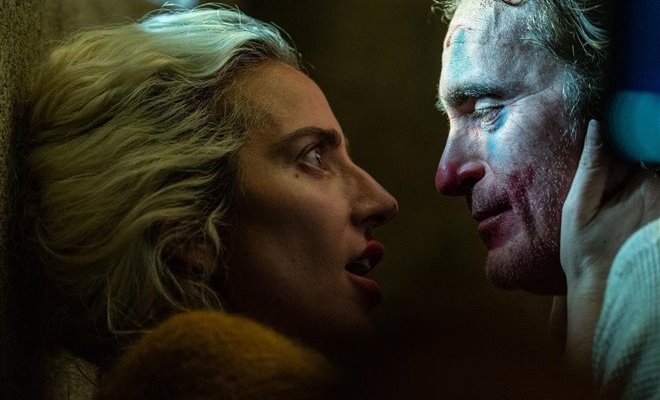
The film opens with failed comedian Arthur Fleck (Phoenix) now imprisoned at Arkham State Hospital, for killing five people and inciting a riot of his followers as Joker. It’s here that he meets and falls in love with fellow patient Harley “Lee” Quinzel (Gaga), a disturbed young woman facing her own mental health challenges, who also happens to be an obsessive fan of Fleck’s violent clown persona (the term Folie à Deux itself refers to a shared delusion). The two meet in a music therapy class.
The narrative mainly revolves around Arthur being put on trial for the crimes he committed in the first movie (which, we are told, also provided the basis for an in-universe TV movie about Fleck). Through this, Folie à Deux almost serves as a piece-by-piece breakdown of its predecessor; its themes, its ideas, and how some viewers responded to it by hero-worshipping the Joker. This is Phillips grappling with fan responses to the first movie, and in many ways peeling back the mystique around the character.
The way that the screenplay (once again co-written by Phillips and Scott Silver) handles these themes can sometimes feel a bit heavy-handed. The characters will bring up specific plot points from part one through dialogue, which can be pretty on the nose. But, regardless of whether or not you ultimately view it as being that deep, Folie à Deux does feel like the work of an artist grappling with their own creation. Namely, does Phillips have a responsibility for how some people misinterpreted his film?
The film starts with an animated sequence done in the style of a classic Warner Bros. cartoon, that finds the Joker wrestling with a physical manifestation of his shadow. This idea of the shadow self, and how much it guides Arthur’s own actions, underpins the psychological aspect of the film. It’s also the main argument being presented in his trial. Does anybody really care about Arthur, the mentally ill loner, or do they only support Joker, the character he portrays?
Even in the institution, Arthur continues to be mistreated and rejected by society. Everyone simply wants him to perform for them as Joker. The guards, led by Jackie Sullivan (Brendan Gleeson), keep cruelly asking him to tell them a joke, rewarding him with extra cigarettes if he complies. The trial itself has become a media frenzy, with supporters in clown masks lining the courthouse steps.
The film’s musical numbers add to the performative quality of the film (and also add to the feeling of Phillips just taking that studio money to make something completely out of left field). They arguably don’t add much to the plot itself, but the first film established Arthur’s rich fantasy world, so the musical interludes do make sense in that regard. Each production number is also dazzling to watch, making use of Old Hollywood backdrops, and gorgeously captured by cinematographer Lawrence Sher, who does an impeccable job of shooting the entire movie.
There is a theatricality to the song-and-dance numbers. It’s an element that allows Phoenix to lean in to the inherent musicality of his portrayal of Arthur, which was present in his dance-like movements in the first movie as well. Phoenix is still fascinating and mesmerizing to watch in this role, with his erratic but controlled mannerisms and vocal choices, and his portrayal of Arthur’s mental illness remains eerily believable. Gaga does feel slightly underused in the film, but is very good in the supporting role of Lee, portraying several interesting layers to the character.
Phillips has basically crafted a much slower-moving deconstruction of the first movie, which probably isn’t what anyone expected from a sequel (let alone the executives at Warner Bros. who demanded a followup). It feels somewhat overlong at 138 minutes, and the film does drag at points (though the last hour is strong). It doesn’t always work. It builds to an ending that feels like the punchline to a sick joke. Whether that is a good thing or a bad thing will be up to the viewer (I saw the film a couple of days ago, and I’m still not sure myself).
But it’s also too much of an interesting swing as a franchise movie, and too visually stunning thanks to Sher’s striking cinematography, for me to dismiss entirely. I did admire the effort overall. The reactions to Joker: Folie à Deux will continue to be immensely polarizing. But there is also value in having a mainstream movie this technically well-crafted (the production design remains strong, and Icelandic composer Hildur Guðnadóttir delivers another powerful score following her Oscar-winning work on the first film), that people are discussing in this way.
Film Rating: ★★★ (out of 4)
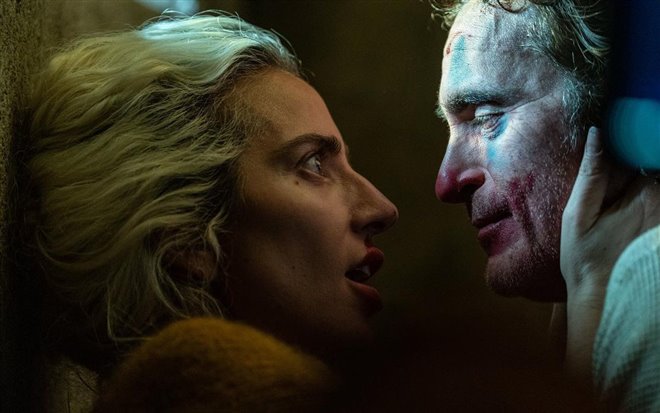
Joker: Folie à Deux is now playing exclusively in theatres.
 The Joy of Movies
An excellent review. Joker Folie a Deux is a movie that I am excited to see soon. Despite the negative reviews it has got, I am very much looking forward to seeing this film. I was a big fan of the first Joker which raised the bar for the comic-book genre. I’m curious to see how a sequel would turn out.
Here’s my thoughts on the first Joker:
LikeLike