
By John Corrado
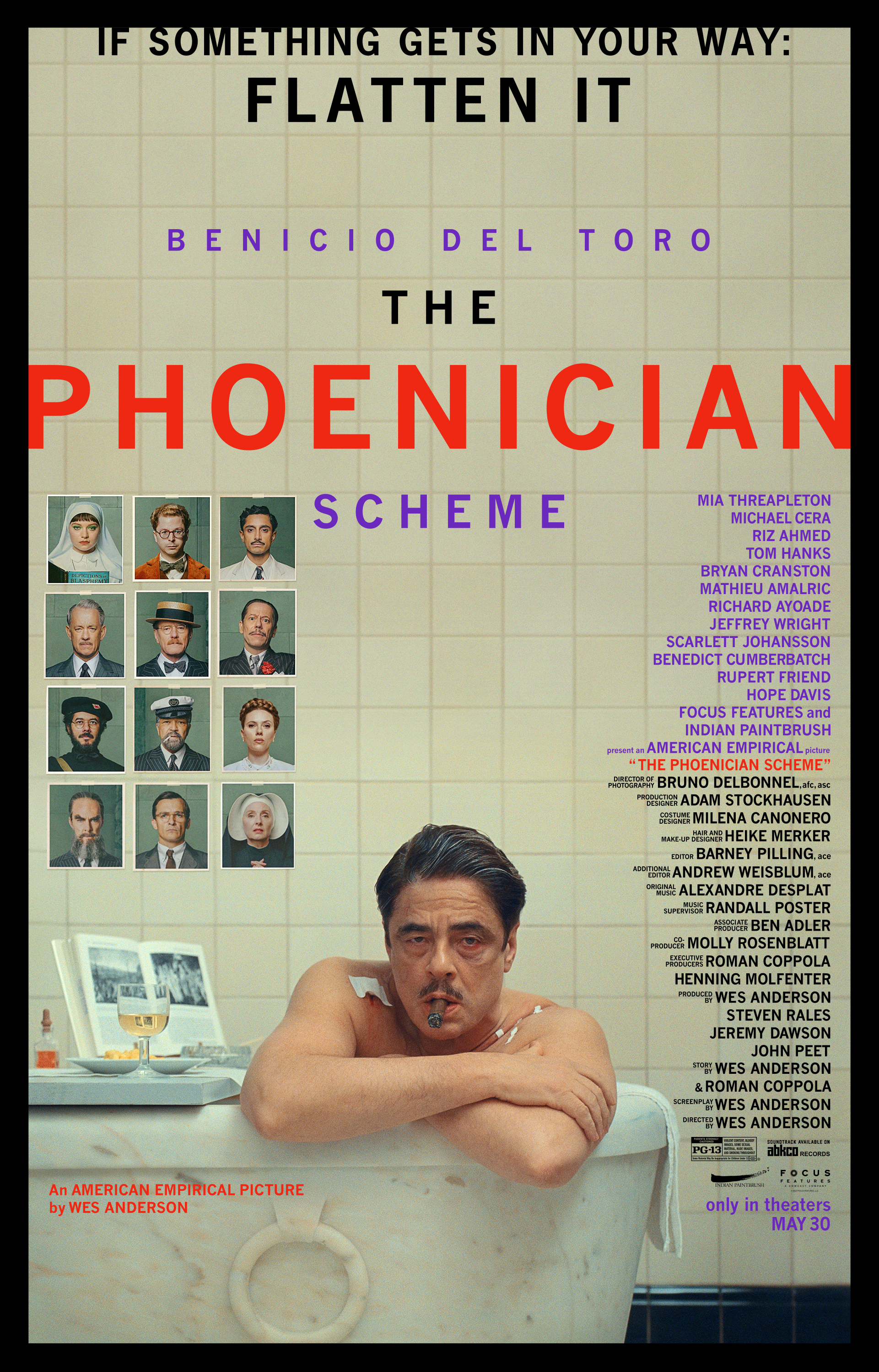 The Phoenician Scheme is Wes Anderson’s twelfth feature film, and by this point, you either vibe with his style or you don’t.
Anderson’s latest is another immaculately designed work that doesn’t find him straying from his signature style, but rather doubling down on it; the panning camera moves, the intricate, dollhouse-like sets, and high attention to detail are all part of this world.
Case in point, the opening credits sequence of The Phoenician Scheme is shot from above, as an injured Zsa-Zsa Korda (Benicio Del Toro) sits in the bathtub. We observe nurses coming in and out of the bathroom in slow-motion to serve him food and tend to his wounds, or put a bottle of champagne on ice in the bidet.
Every item is placed as if we are looking at a floor plan. It’s not only an example of the Andersonian aesthetic that the filmmaker has perfected by this point, but also an example of the absurdity, the underlying pathos, and the quirky, dry humour all existing within a single frame that is equally a signature of his work.
Korda, the main character and mastermind behind the titular “Phoenician scheme,” is a notorious, corrupt businessman who has suffered his latest assassination attempt after being involved in a plane crash. In light of this, he decides to appoint his only daughter Liesl (Mia Threapleton), a young nun who plans to give her life to the Lord, as the sole heir to his estate, over his nine various sons.
The increasingly convoluted plot involves Korda trying to secure backers for his latest business deal, a massive infrastructure project. But this is really an excuse for Anderson to move his characters through a series of carefully crafted worlds, while introducing a number of eccentric characters played by Anderson regulars, who by this point are like a theatre troupe. Korda’s business partners are played by a rogue’s gallery of recognizable faces; Mathieu Amalric, Tom Hanks, Bryan Cranston, and Jeffrey Wright. There’s also Scarlett Johansson as Cousin Hilda, and Benedict Cumberbatch as Uncle Nubar.
These interludes are often highly amusing on their own (such as a basketball game between Hanks, Cranston, and a young prince, played by Riz Ahmed), and The Phoenician Scheme is one of Anderson’s funniest films. But he also weaves in some deeper, more poignant themes about religious repentance, and struggling to repair a broken father-daughter relationship.
Korda joins a long line of Anderson’s memorable leading men like Gene Hackman’s Royal Tenenbaum, Bill Murray’s Steve Zissou, Ralph Fiennes’ M. Gustave (or even that dapper canid, Mr. Fox, voiced by George Clooney). Del Toro is excellent in the role, adding a hint of tragedy to his portrayal of a man who doesn’t know how to connect to the world – or even his own daughter – beyond jostling for power and control. Threapleton, daughter of actress Kate Winslet, perfectly handles every deadpan line delivery, making her a natural fit for Anderson’s very specific dialogue.
Another new addition to the ensemble is Michael Cera, who plays an insect-obsessed tutor named Bjorn, hired by Korda to teach him about the natural world. He just about steals the entire movie. Cera is a delight, and such a natural addition to the Wes Anderson stock company, that it’s a wonder he is only joining now and the two have never worked together before. Richard Ayoyade, who previously appeared in two of Anderson’s shorts and whose own movies could be described as Andersonian in style, also amusingly appears as the leader of a rogue communist militia group.
Anderson is also working with cinematographer Bruno Delbonell for the first time, instead of his usual go-to Robert Yeoman. But none of the director’s distinctive style has been lost working with his new collaborator. We still get his signature pans over meticulously designed sets and props, as well as a few new camera moves that feel like the filmmaker adding to his arsenal.
This is stylistically similar to his series of Netflix short films (including his Oscar-winning The Wonderful Story of Henry Sugar), which found him leaning in to the stage-like design and presentation of his work. The heightened reality of Anderson’s films also now gives way to fantastical, gorgeously shot black-and-white dream sequences, in which Korda goes before a heavenly court (where Willem Dafoe and Bill Murray appear).
If Anderson’s previous film Asteroid City served as a masterful, emotionally cathartic deconstruction of his style and the meaning beneath the surface of the artifice, The Phoenician Scheme feels like him fully embracing all these quirks. Anderson’s worlds might feel like dioramas, but this is a feature, not a bug; he moves his characters about in a way that allows us to observe their relationships, as odd or offbeat as they may be.
Anderson’s last few movies (Asteroid City, The French Dispatch, even Isle of Dogs) have served as a sort of litmus test between the more casual viewers and those still fully committed to his style. It’s highly unlikely that The Phoenician Scheme will bring in any new fans. But those of us who are still very much onboard with Anderson’s unique voice and cinematic aesthetic, will find many delights amidst the comic interludes and wonderful performances of The Phoenician Scheme. I’ve seen it twice now, and the film grew even richer for me on a second viewing.
Film Rating: ★★★½ (out of 4)


