
By John Corrado
In his mixing of paranoid espionage thriller and absurdist dark comedy, Brazilian filmmaker Kleber Mendonça Filho delivers a culturally specific portrait of his country in the late 1970s in The Secret Agent, seen through the eyes of a man on the run during the waning days of the military dictatorship.
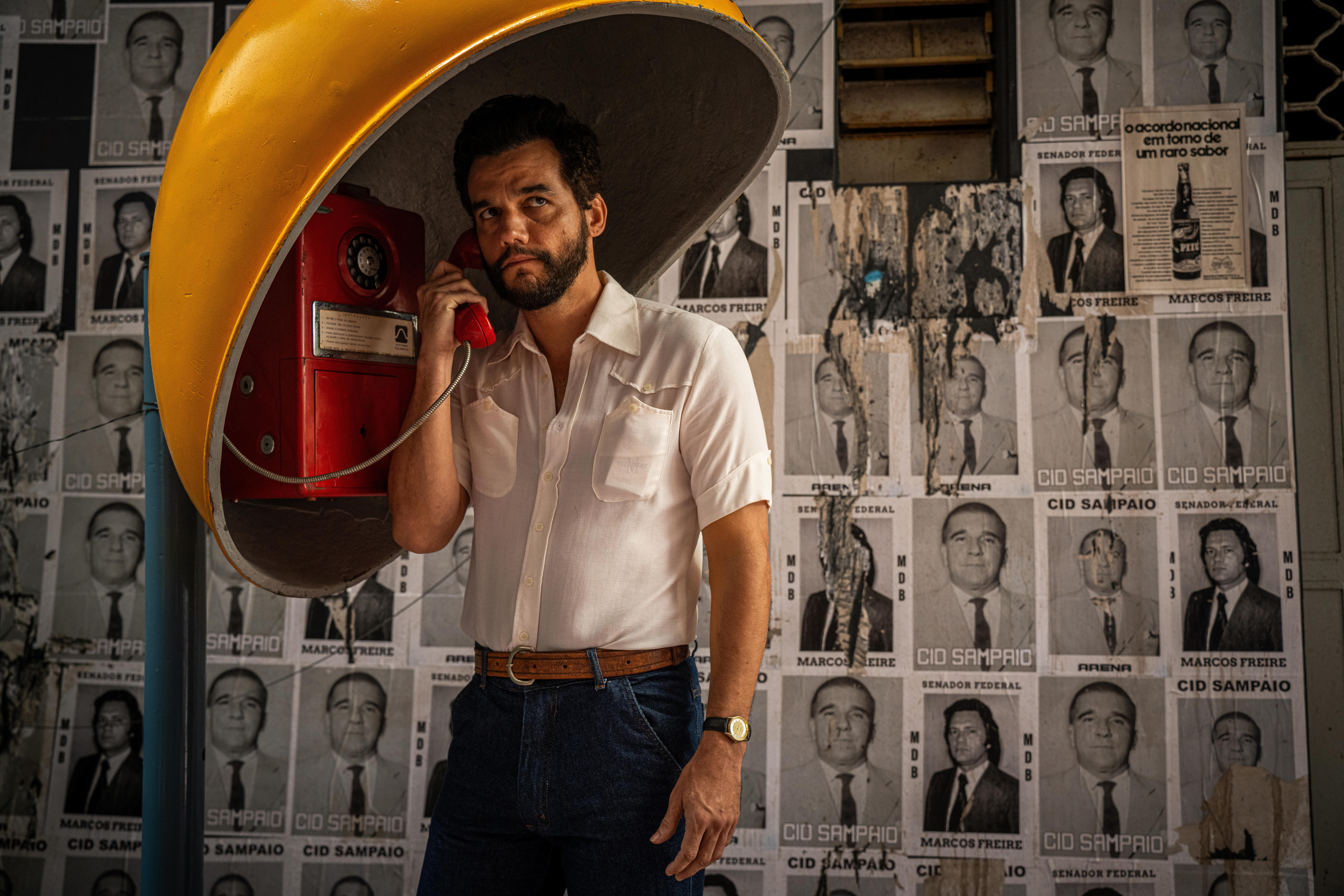
The man is Marcelo (Wagner Moura), a technology researcher, who we first meet in the film pulling into a gas station to fill up his VW. There is a dead body lying on the ground of a man who tried to rob the place and got shot by the shop’s attendant. But the cops are too busy with ongoing Carnival celebrations to notice, so the corpse lays there to rot in the dirt.
It’s this sort of darkly comic touch that fuels Mendonça Filho’s vision, one of a country rife with casual corruption and death, so much so that many have chosen to ignore it. The year is 1977, and Marcelo, having gone astray of authorities pertaining to his work at a university, is travelling to take refuge in the city of Recife, where his young son (Enzo Nunes) lives. Marcelo is given cover by Dona Sebastiana (Tânia Maria), who brings him into her tight-knit community of political dissidents.
The film’s complicated, interwoven plot – including a modern day through-line – and whopping 158 minute running time do require attention and patience. The script meanders, and gets convoluted. But it’s all in favour of offering a glimpse into the surreality of living through the final stages of a military dictatorship. The storytelling, with its forays into absurdity, is carried through by confident editing choices, and Evgenia Alexandrova’s classical cinematography.
Not only does Mendonça Filho shoot on Panavision lenses and vintage equipment to mimic the look of a 1970s film, he also evokes classic cinema of the era through his ample references. The release of Steven Spielberg’s Jaws is a running theme, with an old movie theatre that Marcelo’s father-in-law (Carlos Francisco) operates also providing one of the main settings.
This inextricably ties The Secret Agent back to Mendonça Filho’s previous film Pictures of Ghosts, a documentary about the old movie theatres of Recife that he grew up visiting. Despite being set during such a dark time period, there is a nostalgic quality to The Secret Agent that comes from the filmmaker having grown up in the same place that his film is set.
Mendonça Filho’s filmmaking feels most energized in a violent, last act chase sequence that is crafted with precision and delivers classic suspense, as bad guys close in and run through the local streets and shops. What pulls it all together is Moura, delivering a compelling, weathered movie star performance as we watch his character go from bemused to grieving to terrified. It allows the film to find some mournful notes amidst the absurdism.
 The Joy of Movies