By John Corrado
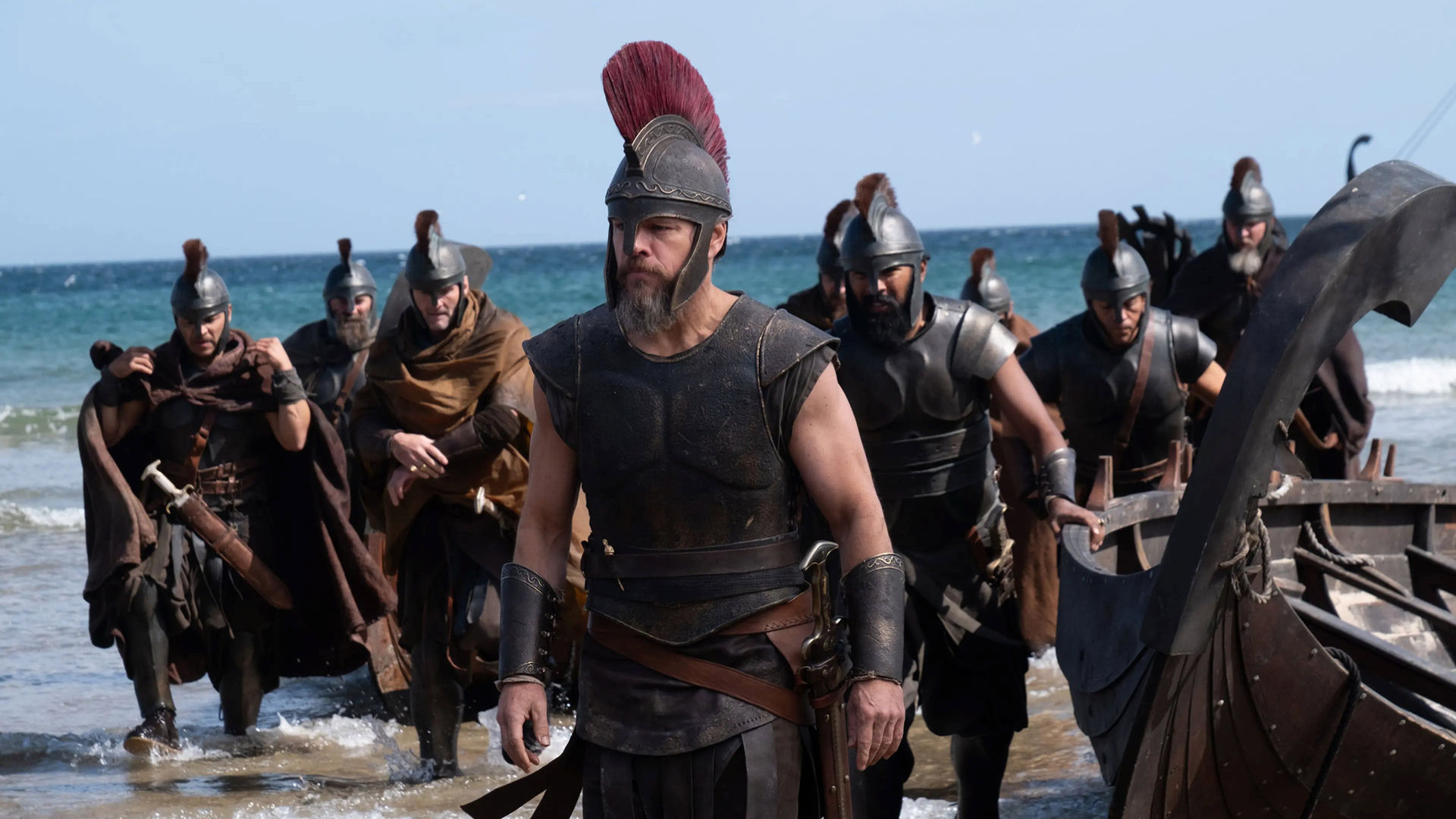
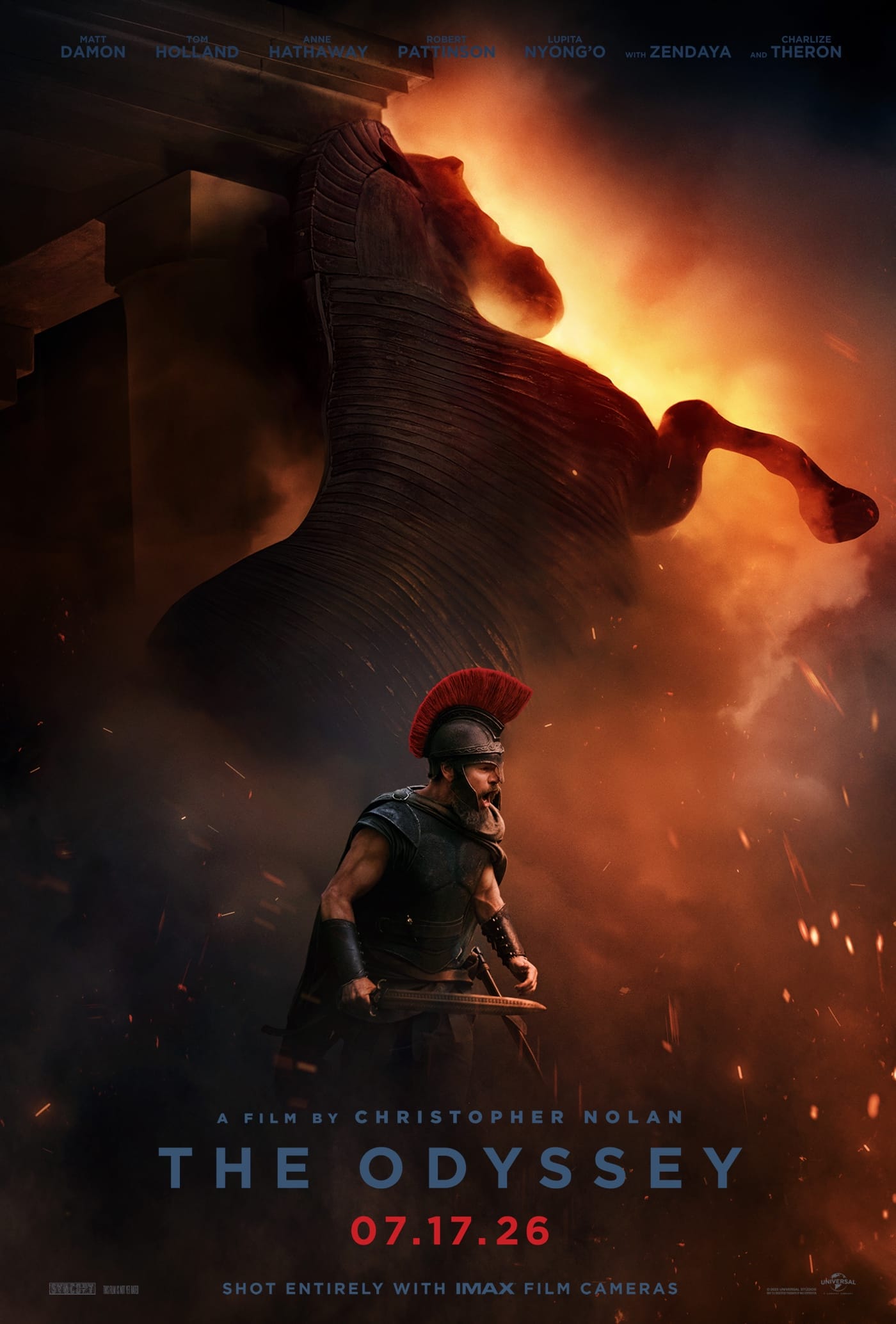 Christopher Nolan’s The Odyssey opens with glimpses of the Trojan Horse, half-submerged in water and being pulled onto the beach by unsuspecting Trojan guards who view it as a gift.
We’ve all heard the story, or “song,” of how Greek soldiers hid inside this giant wooden horse to sneak inside the city of Troy, and win the Trojan War. Here, the story is being told – “sung” – by Phemius (Travis Scott), a bard regaling his captive audience with the tale of heroism and bravery.
The Trojan Horse itself, which Nolan had built practically for the film in the form of a forty foot replica, serves as a recurring motif, and we will return to this sequence throughout the movie. Later, Jon Bernthal’s Menelaus, the Greek king of Sparta, asks another character if they’ve heard what it was like inside the horse, acknowledging that everyone has already heard versions of this near-mythic tale.
At first, Nolan holds back on showing the full storming of the city of Troy, as if teasing it out for the full reveal. Nolan does this throughout The Odyssey, setting something up and then making us weight for the payoff. It’s a clever structure that allows him to pack a lot more into the roughly three hour film, which all-told spans two decades and offers an epic adaptation of Homer’s The Odyssey, an ancient text written thousands of years ago. And when we do finally get to the full sequence, the cumulative impact of it is even more powerful.
This is grand scale filmmaking on every level, and it feels like a companion piece to Nolan’s Oscar-winning 2023 film Oppenheimer in a lot of ways. Structurally, the film shares similarities in the ways that it plays with time, cutting between flashbacks and the main timeline. So, too, in its themes about men grappling with the full weight of their greatest achievements; in Oppenheimer’s case, the invention of the atomic bomb and bombing of Japan, for The Odyssey‘s hero Odysseus (Matt Damon), the storming and burning of Troy. What was lost to win a war? It’s a question that both men must ask.
In the main timeline, Odysseus’s wife Penelope (Anne Hathaway) waits for her husband to come home a decade after the war, and return to his rightful place on the throne as King of Ithaca, while their son Telemachus (Tom Holland) seeks closure about his father. They hold out hope for his return. Equally convinced that the king is alive is Eumaeus (John Leguizamo, a standout of the stacked ensemble cast), Odysseus’s blind servant who patiently awaits his master’s return.
Everyone else believes that Odysseus died in battle. Dozens of male suitors crowd the castle’s halls, trying to gain power by taking the queen’s hand in marriage. Among the most conniving is Antinous (Robert Pattinson), who views Telemachus as a threat. Meanwhile, we see Odysseus trapped on the island Ogygia with temptress Calypso (Charlize Theron), and facing visions of the god Athena (Zendaya).
The other story strands are split between timelines. There are flashbacks to the various trials and tribulations that him and his men faced on their journey to travel home; a Cyclops, Sirens, a giant whirlpool, and, in a sequence of surprising body horror, the witch Circe (a mesmerizing Samantha Morton, who makes the most of her limited screen time). There are many stormy days and nights on the ship in the middle of the ocean, which are thrillingly captured on screen, and a terrifying trip into the underworld of Hades.
Nolan once again utilizes this non-linear story structure to help build suspense, punctuated by these striking set-pieces. Nolan is realizing a massive vision, with each one of these sequences serving as its own showstopper. Seeing how Nolan pulled this off with practical, in-camera effects makes these set-pieces even more dazzling on a technical level. In an age of many green screen blockbusters, there is a gritty, tactile quality to this film, which is wholly impressive considering the gigantic scope of it.
Hoyte van Hoytema’s 70mm cinematography, Jennifer Lame’s editing, and Ludwig Göransson’s score all add to the immersive experience. Much has been made about the fact that this is the first movie shot entirely on IMAX film cameras in the 1.43:1 aspect ratio, with a new, lighter camera having been designed for the film, and a special enclosure built to muffle the noise of it, allowing closeup dialogue scenes to be filmed in the format. The grandeur of van Hoytema’s images is undeniably impressive, and so too is the intentionality behind every framing choice, such as low-angles looking up at the massive Trojan Horse.
Like she did in Oppenheimer, Lame’s precise editing is what gives The Odyssey its unique rhythm and structure, capturing the rises, falls, and crescendos of the story. The match cuts and quick cutaways help build thematic cohesion between the different story threads. Göransson provides another powerful, eclectic score, mixing in elements like the pluck of a bow string to powerful effect.
The film has faced some controversy for its use of more modernized language such as “dad” and the diverse casting of actors like Lupita Nyong’o (as Helen of Troy) and Elliot Page (as soldier Sinon, a key player in the Trojan Horse chapter) in a few supporting roles. But Nolan is simply embracing a theatrical tradition of having different people take on and reimagine these fictitious characters, not unlike what has been done with Shakespeare over the years. The at times plainer dialogue is easy to overlook as a stylistic choice to bring the story to a modern audience.
Nolan, who also wrote the screenplay, is using Homer’s text as the basis for his thematically rich storytelling. A key theme is the breakdown of “Zeus’s Law,” which states that strangers should be treated with respect, because they might be gods in disguise walking among us. We see how this is challenged and tested throughout the film. It’s in the last act that Nolan really finds the emotion in the material, aided by Damon’s performance.
Damon delivers some of his finest acting work here, powerfully exemplified in the moments when his Odysseus is screaming while tied to the ship’s mast so that he is able to hear the song of the Sirens, while also resisting the temptation to join them. He plays Odysseus as a warrior left haunted after the end of the war, not unlike Cillian Murphy’s J. Robert Oppenheimer, and a moving monologue he delivers brings these themes to the forefront in a surprisingly mournful way.
It’s hard not to write about The Odyssey without simply describing the experience of watching it and seeing the many spectacular sights and sounds on display. It’s thrilling to see these images tower over us in IMAX. The film is at times overwhelming and even exhausting, but altogether a stunning achievement that will likely only grow in richness on subsequent viewings.
The point of Nolan’s film is to make us feel like we have gone on an epic journey, and we do feel like that way by the end of the nearly three-hour running time. It’s hard to deny this as a definitive big screen experience, no matter what format you see it in.