By John Corrado
 Directed by Kent Jones, the film Late Fame mainly exists to give a formidable late career role to Willem Dafoe, an actor whose own current standing among young cinephiles could be seen as being mirrored in the film’s narrative.
Dafoe stars in the film as Ed Saxberger, a poet living in New York City who got published in his younger years but never really made it, and has spent the past nearly four decades working in a post office, revelling in obscurity.
That is, until his out-of-print book Way Past Go is rediscovered by Meyers (Edmund Donovan), a young writer who leads a group of other aspiring artists. The Enthusiasm Society is what they call themselves, and Saxberger – they prefer to only use last names to address each other – is their idol.
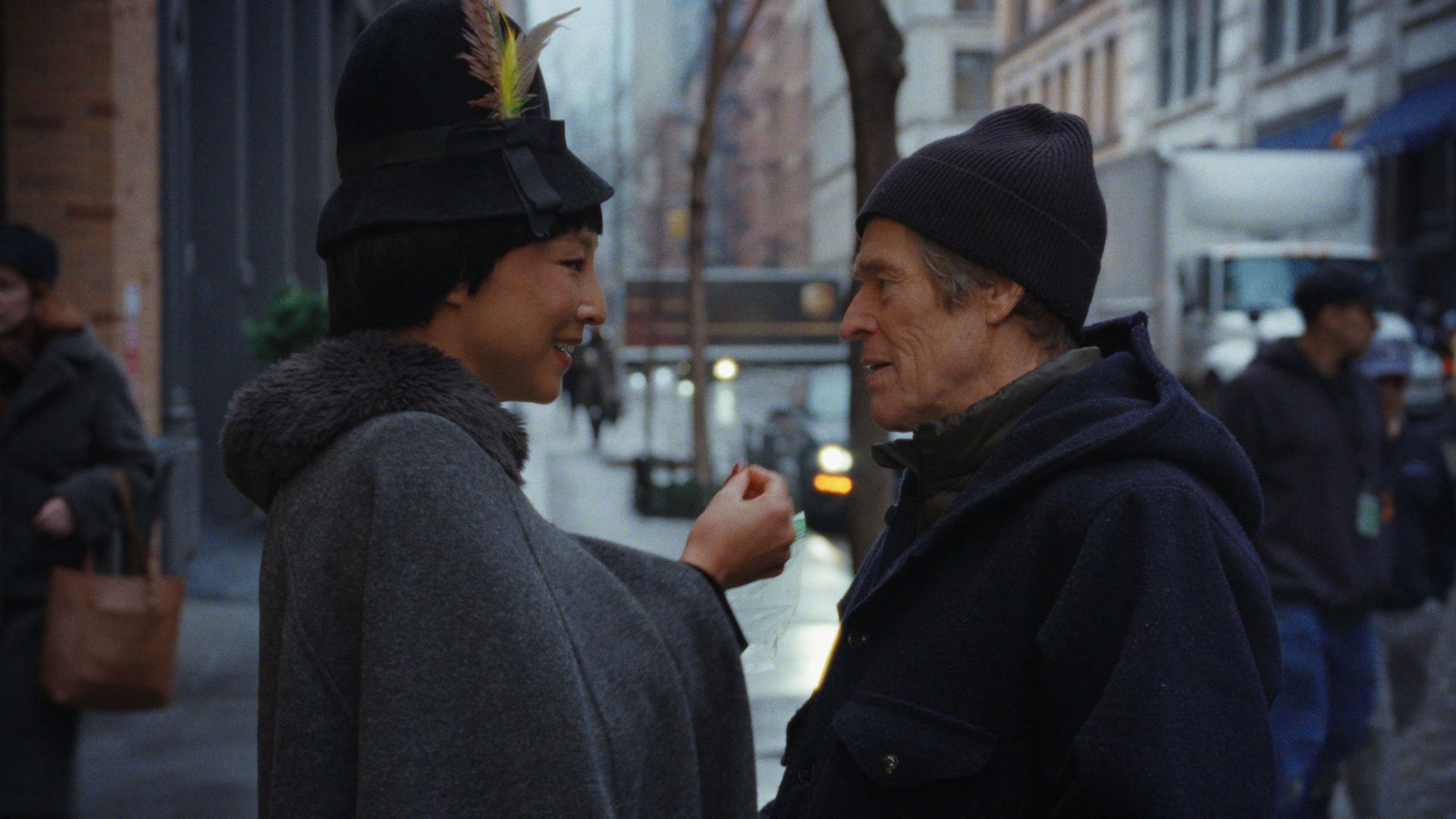
Much of the film unfolds around the older Saxberger trying to navigate his place in this group of young people who revere him, as well as his newfound artistic recognition as a forgotten literary genius. The group’s matriarchal figure is Gloria (Greta Lee), a slightly older stage actress who behaves like a 1920s flapper, and turns on the charm on to seduce Saxberger, adding another complication.
It’s a low-key film, but one rich with big ideas on the nature of art, that becomes something a little thornier as a character study. The screenplay by Samy Burch (May December, Coyote vs. Acme) revels in constantly interrogating the authenticity of the artist. Who has more authenticity, the film is asking; these kids who gather in high-end coffee shops crowing about their work and connections, or the one who wrote his poems from an honest place and then faded away into a working class life?
Despite his lack of recent output, Saxberger has far more credibility in the role of starving artist than any of these rich, coddled kids will ever know, the film suggests. In effect, Meyers and his group are sort of posers and hypocrites, and seeing them be subtly exposed as such adds an element of amusement to the film. The film itself is adapted from a novella by Austrian playwright Arthur Schnitzler that was written in 1895 and published after his death, which Burch has seamlessly brought into modern day New York.
An actor of Dafoe’s calibre is able to ground this material, his presence carrying an understated gravitas that makes us believe he is viewed as a god-like figure by a group of young people who have just rediscovered his work and want to go directly to the well for inspiration. Dafoe is able to bring so much texture to a role like this through every glance and reaction shot, complimenting and enriching what is already on the page.
Lee is playing an actress who is necessarily a bit of an enigma, a role that requires her to show a lot of range, turning Gloria into a fascinating and somewhat tragic character who herself is desperate to retain youthful glory, hanging out with students probably a decade her junior. Lee’s performance nicely compliments Dafoe’s work. There is also a fascinating push and pull between Dafoe and Donovan in their scenes together as Saxberger and Meyers.
There are hints of Woody Allen or early Noah Baumbach. The film has a strong narrative through-line, but still manages to have a somewhat loose, ambling quality to it that makes it feel like we are just getting caught up hanging out with these characters. The film’s strong performances, and the sharp, compelling writing are what make Late Fame an engaging and thoughtful treat to watch.