
By John Corrado
 Before David Fincher’s The Social Network was released in 2010, there was a lot of talk about whether or not we actually needed a movie about Facebook and its founder Mark Zuckerberg. It turned out to not only be one of the most prescient films of that decade, but one of the best and most defining as well.
It was a precise, finely tuned tech thriller about the social media giant – still in its relative infancy connecting people, compared to what it is now – that hummed along thanks to the perfect marriage between Fincher’s icy direction, Aaron Sorkin’s Oscar-winning screenplay, an Oscar-winning score by Trent Reznor and Atticus Ross, and Jesse Eisenberg’s pitch-perfect portrayal of Zuckerberg.
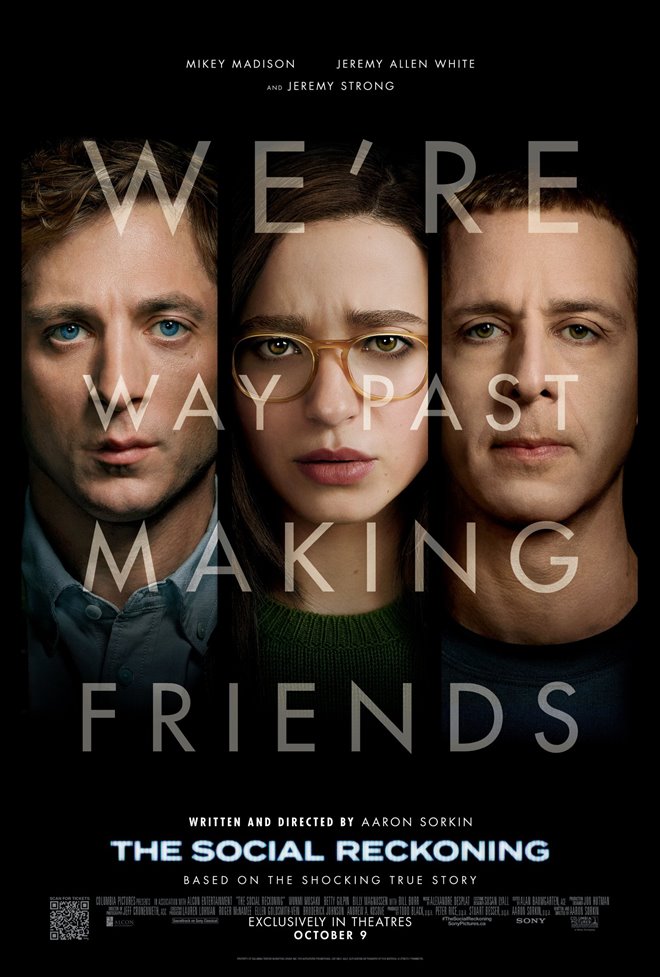
Now we have a “spiritual sequel” to that film with The Social Reckoning, which only has one of those ingredients – Aaron Sorkin – this time around. Sorkin is directing the film himself from his own screenplay, with Fincher uninterested in returning, and Jeremy Strong taking over the role of Zuckerberg. The result is a film that has sparked similar conversations around if it was needed, but is unable to fully justify itself in the same way as its predecessor.
It’s not that a lot hasn’t happened with Facebook in the sixteen years since the first film, or that The Social Reckoning isn’t fairly entertaining to watch on its own terms. Because it has, and it is. But it was always going to challenging to make a sequel to The Social Network without it feeling like a lesser copy, especially when key figures behind why that film worked so well aren’t returning. As such, the biggest thing hurting The Social Reckoning are comparisons to that modern classic.
The main focus this time around is actually Frances Haugen (Mikey Madison), a Facebook engineer turned whistleblower, leaking information to Wall Street Journal tech reporter Jeff Horwitz (Jeremy Allen White). Frances has evidence that changes to Facebook’s algorithm, which in theory were put in place to boost personal posts, actually ended up amplifying divisive and polarizing content instead.
Strong’s Zuckerberg is more of a supporting presence, with the film showing him as he prepares to testify in front of congress, with crisis specialist Raya (Wunmi Mosaku) coaching him, and (fictional) former investor Charlie Garrigan (Bill Burr) watching from the sidelines. Strong’s eery impersonation offers a different and much colder read on Mark Zuckerberg than Eisenberg, who delivered more of a fascinatingly aloof characterization than an impersonation. Strong, a notorious method actor, is more focused on the technicals of copying his voice and mannerisms.
The narrative jumps back and forth between these two storylines, a timeline bar appearing onscreen between scenes to tell us what year we are in (it roughly spans from 2019 to 2021). Frances is driven by the question of how one of her friends, a progressive in 2016, became part of the “new right” milieu by 2020? She blames Facebook, and alleges that the platform not only isn’t doing enough to remove “misinformation,” but amplifying that content as well, leading to increased political polarization in the country.
In many ways, Sorkin is starting with his thesis that radicalization on Facebook led to the January 6th storming of the Capitol, and working backwards to prove it. Sorkin even recreates flashes of the riot to be shown throughout (scenes that must’ve been surreal but fun for the background actors to recreate on the film’s Vancouver set). This makes Reckoning feel a lot more like a message movie, something that Fincher’s more detached style helped Network avoid. The film often feels heavy-handed as a result.
Despite his pivot to directing, Sorkin has always been a stronger writer than filmmaker, and he benefits from having a stylist such as Fincher (or Danny Boyle with 2015’s excellent Steve Jobs) behind the camera. Sorkin’s direction lacks Fincher’s precision. As such, Reckoning feels a lot less cinematic than Network, with an aesthetic that borders on feeling more like a high-end TV production. But Sorkin has a particular skillset as a screenwriter that is able to shine through the more flat direction, and his signature snappy dialogue is still pretty entertaining.
The film is elevated by good performances from Madison and White. Madison, in her first big role since winning the Oscar for Anora, does solid work here, even if Sorkin falls into the “attractive nerd” stereotype in portraying the real life Haugen. White credibly takes on the role of a tech reporter more interested in social ramifications of it than technology itself. The two of them have a lot of chemistry in their scenes together as they negotiate the exchange of information, with her acting as his source for the article he is writing.
As a sequel, The Social Reckoning is like a member of a once-popular band trying to make a comeback with a solo record. It hits some of the right notes, and plays a few of the greatest hits, but can’t help but feel like a watered down version of what came before. Sorkin delivers some of the expected verbal fireworks, especially in a few solid exchanges between Strong and Burr, while Fincher’s direction is missed.
It’s uneven, and obviously nowhere near as good as its predecessor. But, taken on its own as an investigative journalism thriller about exposing the downstream effects of Facebook, The Social Reckoning can be enjoyable to watch. It just suffers by comparison to a much better film.