By John Corrado
 Teenage Sex and Death at Camp Miasma, the third film from director Jane Schoenbrun, is a tribute to 1980s slasher movies channeled through a meta, queer lens.
In this way, Camp Miasma serves as an interesting companion piece to Schoenbrun’s haunting 2023 sophomore film I Saw the TV Glow, which also operated around its own invented mythology of IP that only existed within that world.
Both films are about how we consume media, and how it shapes our perception of ourselves and the world. In I Saw the TV Glow, it was a fictional YA television series. In Camp Miasma, it’s a series of slasher movies modelled after Friday the 13th or, perhaps more precisely, the campy queer classic Sleepaway Camp.
The result is a film with layers of commentary and meaning, some of which can only be interpreted as a glimpse inside Schoenbrun’s own mind, but one that is constantly engaging to watch as it keeps reinventing itself. It centres around Kris Williams (Hannah Einbinder), a young, queer filmmaker who has been hired to direct a reboot of the Camp Miasma franchise, a series of very bloody summer camp slashers following a masked killer known as Little Death (played by I Saw the TV Glow‘s Jack Haven).
Kris, an avowed Camp Miasma fanatic whose claim to fame is a critically acclaimed horror film that reimagined Psycho “from the perspective of the shower curtain,” has been brought onboard to craft an “elevated” reboot tailored for modern sensibilities. Her job as a queer filmmaker is to paper over how the series historically handled themes that have now gotten it slapped with the “problematic” label.
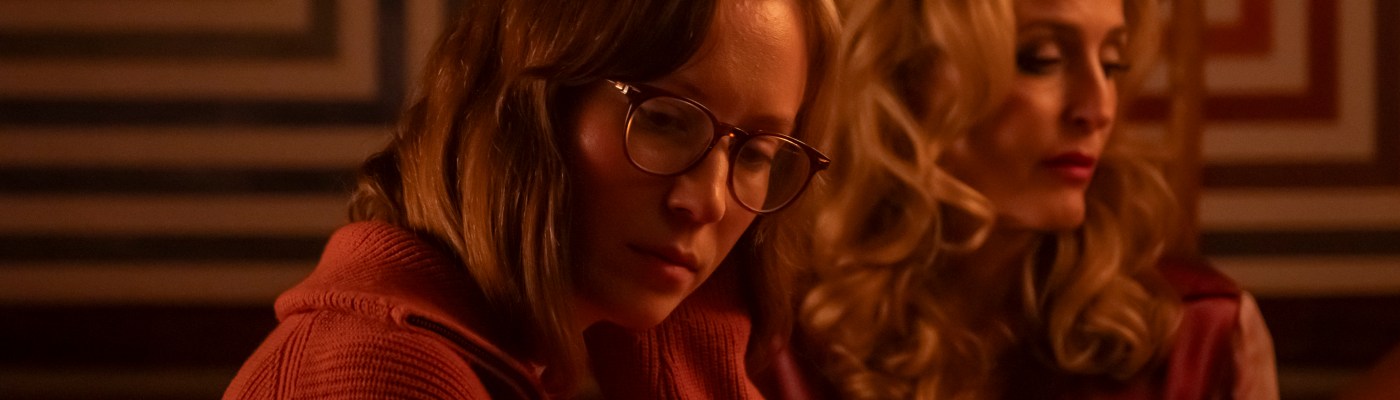
The film opens with Kris travelling to meet actress Billy Preston (Gillian Anderson), who played the original “final girl” in the series, and is now a washed up former star who gave up acting and turned down opportunities to reprise her role after the first film. Billy instead became a recluse, living in the middle of nowhere. This premise itself is the perfect setup for a horror movie, which the film fully acknowledges, but Schoenbrun is constantly subverting these expectations, with a story that keeps folding in on itself.
For much of its running time, Camp Miasma is essentially a two-hander chamber piece between these two characters. But Schoenbrun keeps their film always involving to watch, as new meta aspects to the storytelling emerge, and the narrative’s themes – not only about horror movies but also about sexuality, queerness, and gender identity – continue to deepen.
In this way, Camp Miasma presents a much more interesting approach to actually engaging with art that is written off as “problematic,” especially when that work has had a profound effect on you for other, perhaps contradictory reasons. While watching the titular slasher, Kris announces that the next part is “transphobic,” and Billy promptly shushes her. Kris’s reading of the film is academic, but Billy is reminding her to just feel it, and experience it on a more emotional, sensory level.
In addition to exploring the complicated legacy of the fictional Camp Miasma series, and the impact that it had on Kris who watched it way too young, the film also morphs into an exploration of sex when you don’t feel comfortable in your own body. Let alone connected enough to it to share it with another person. Even the killer’s nickname, Little Death, doubles as an idiom used to refer to the experience of orgasm, meaning that can be easily inferred by the audience.
It sounds heavy, and sometimes is, but Teenage Sex and Death at Camp Miasma also has a surprising sense of playfulness to it; it’s a fun movie in a lot of places, in addition to being an intriguing and thought-provoking one. The way that Schoenbrun plays with genre, and stages some over-the-top gory interludes, provides a series of constant delights for horror movie fans.
On a purely cinematic level, Camp Miasma is also simply a compelling showcase for Schoenbrun as a maximum stylist, one with a clear directorial voice. This is perhaps best exemplified in an incredible, show-stopping one-take sequence brilliantly choreographed to the Counting Crows song “A Long December.” This mesmerizing sequence, which offers one of the most inspired uses of music in recent memory, perfectly encapsulates the film’s almost dreamlike tone.
The cinematography by Eric Yue offers some hauntingly beautiful imagery, including the use of painted backdrops. What’s more impressive is that Schoenbrun basically shot two movies; the main narrative, and the film-within-a-film, which has to exist as a credible relic of slasher cinema that gained a following in this world, and inspired at least half-a-dozen sequels and spinoffs. For these scenes, Schoenbrun convincingly apes the aesthetic of a low-budget ‘80s slasher movie.
The film is also helped greatly by the performances of both Einbinder and Anderson, who share some electrifying chemistry together. Einbinder is very good as a young woman whose slightly quirked up personality hides insecurity around her sense of self. Anderson steals the screen as a reclusive older kook who keeps us watching closely to see if she is actually crazy; a sort of Norma Desmond in Sunset Boulevard (who is name-dropped early on). It’s an endlessly watchable supporting performance.
The film has a self-awareness to it, with moments that feel tongue-in-cheek, but Schoenbrun’s work is also capable of feeling strangely mournful at times as well. In this way, the film’s tone is nearly indescribable; it’s bloody, sexy, funny, frightening, strangely moving, and damn near enchanting. In short, there’s nothing else quite like Teenage Sex and Death at Camp Miasma. It’s a singular work, one that is hard to shake afterwards, and should be celebrated as such.

 The Joy of Movies