By John Corrado
The latest from Japanese filmmaker Ryûsuke Hamaguchi, All of a Sudden is primarily a film about the different ways we care for each other, weaving themes about the bureaucratic power structure of a nursing home into a character drama.
It’s an ambitious undertaking, even more so when you account for the fact that the film clocks in at an epic 196 minutes, with Hamaguchi employing a similar style of long, dialogue-driven scenes that he perfected in his Oscar-winning 2021 masterwork Drive My Car. And the complexities of this film carry through to questions around how successful it is at everything it tries to do.
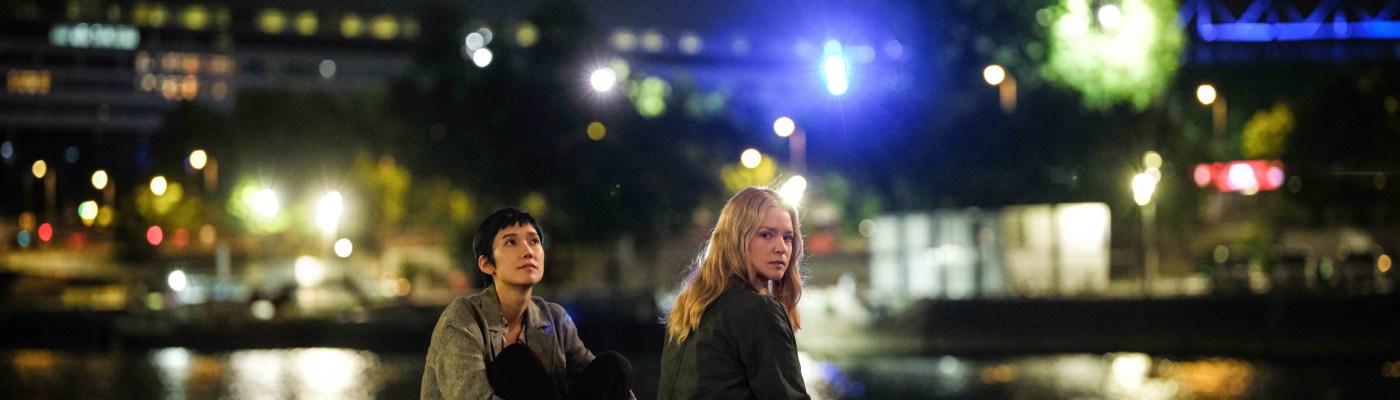
This is also Hamaguchi’s first film set in Paris, switching back and forth between French and Japanese. The story centres around Marie-Lou (Virginie Efira), the director of a French nursing home for residents with dementia, and the friendship that forms between her and Mari (Tao Okamoto), a Japanese theatre director facing a terminal illness.
The two meet through Tomoki (Kodai Kurosaki), the autistic grandson of Japanese actor Gorō Kiyomiya (Kyōzō Nagatsuka), who is starring in Mari’s play. Marie-Lou sees Tomoki eloping and running alongside her tram, and gets off to wait with him in the park. When Gorō and Mari come to retrieve him, she invites Marie-Lou to the play.
From here, All of a Sudden basically turns into an extended conversation between the two women. The film’s midsection is essentially a variation on the Before trilogy, with Marie-Lou and Mari walking and talking. The completely naturalistic performances of Efira and Okamoto help the film come alive, despite dialogue that can occasionally feel a bit stiff, trying to get ideas across instead of having the flow of an actual conversation.
This eventually leads to a long conversation critiquing capitalism, with one character pushing back slightly in defence of it. There can be an intriguing way to how Hamaguchi has his characters present ideas and then gently debate them, but All of a Sudden can’t necessarily escape having a slight air of academic preachiness to it as well. This is best exemplified in the film’s use of a literal whiteboard to get a point across, a somewhat daring move on a narrative level.
Herein lies one of the challenges of All of a Sudden, a film that can feel like it exists more as a way for Hamaguchi to share his own thesis on caregiving and capitalism, rather than a traditional narrative. If these extended conversations can reveal little moments of humanity between the characters, it’s also a conceit that was far more successful in the superior Drive My Car.
A lot of the film rides on how credible we find his thesis and how it’s presented. For example, Marie-Lou specializes in a caregiving practise for dementia patients called “Humanitude,” and wants all of the staff to be trained in this technique. But Hamaguchi doesn’t really grapple with elements of the Humanitude approach that feel slightly infantalizing, or might not work for every person, such as the focus on light touch and direct eye contact, or the massaging of each other’s feet that becomes a big part of the film.
Within his portrait of class imbalances, there is also some unease around how Hamaguchi paints working class nurse Sophie (Marie Bunel) as somewhat of a villain, doubtful of the “Humanitude” approach and the increased demands it will put on already overworked and underpaid staff. When Marie-Lou encourages staff to move into the apartments in the basement of the home, and the prospect of how this will impact work-life balance is brought up, she curtly responds that some people don’t want that balance.
Furthermore, there are uncomfortable questions around why Hamaguchi didn’t authentically cast an autistic actor in the role of the non-speaking Tomoki. By casting a neurotypical actor (which, by all accounts, Kurosaki is in real life), instead of someone who is actually on the spectrum, it feels like Hamaguchi is defying his own best practises that he has his characters preach within the film.
Tomoki’s character basically exists as a plot device to bring the two characters together in a sort of “meet cute” moment that feels more contrived the longer you think about it, and he largely exists as a passive figure in the background. Even if his heart is largely in the right place, Hamaguchi’s arguably tone deaf handling of the character provides a bit of a sour note in the film.
And, by casting a non-autistic actor doing what is essentially an impersonation, however convincing it may be, Hamaguchi undercuts his own main argument about inclusivity and treating people who are different with respect. Why not create a safe environment on-set to work with an autistic actor, like how Tomoki wanders in and out of his grandfather’s play in the film?
If these elements of All of a Sudden can be heavily (and, I would argue, rightly) critiqued, a lot of the power of Hamaguchi’s film comes from how he simply lets us live in this world for a few hours. The running time is long, yes, but that is perhaps the only deterrent to this being a largely accessible crowdpleaser, with emotional beats that can border on surprisingly saccharine in the last act but are mostly effective while watching it.
There are a lot of moments when the film works thanks to the very fine performances of the two leads, and the conversations it evokes are frequently engaging. But, on a final note, watching All of a Sudden after Drive My Car feels a bit like Terrence Malick following up The Tree of Life with To the Wonder. It’s a very good movie, to be sure, but one that can’t escape feeling a bit like a slightly lesser copy of something that Hamaguchi already mastered and did better.