By John Corrado
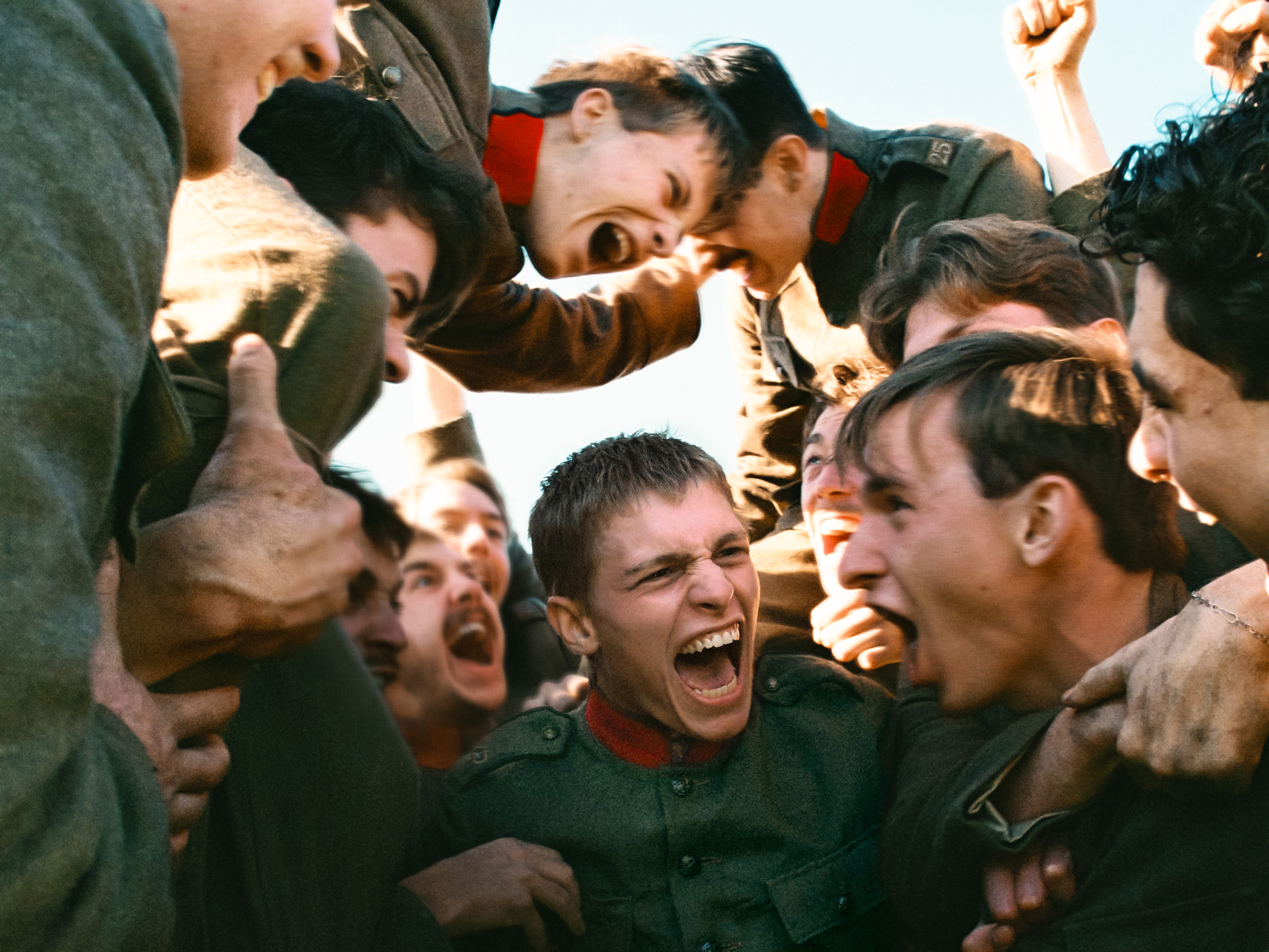
In Coward, his third and most ambitious feature yet, Belgian filmmaker Lukas Dhont (Girl, Close) takes us back to World War I. Dhont’s works all explore gender identity and burgeoning sexuality, and those themes get fine-tuned here as he explores the homoerotic tensions between young Belgian soldiers who arrive on the front lines in 1916.
The film is a love story between two very different soldiers; Pierre (Emmanuel Macchia), a rugged young lad from the country, and Francis (Valentin Campagne), a charismatic and more effeminate young man whose family has a tailor shop. Francis is part of a group who stage impromptu theatre performances on base. These “rejects,” as they are called by the other soldiers, perform shows to entertain the troops, with Francis often taking on female roles and performing in drag.
Dhont has crafted a film that offers a snapshot of life during the war, capturing the moments of humanity emerging just off the battlefield, including forbidden glances shared between the young men. This makes the film’s tense moments when the carnage of the First World War breaks through more harrowing.
It’s all beautifully shot by cinematographer and Dhont’s frequent collaborator Frank van den Eeden, whose images have a grace to them and a richness of colour. Equally impressive is the film’s sound design, making use of loud and quiet moments to immerse us in the world of these soldiers. There is a musical element to the film as well, not only through the song-and-dance performances Francis and his troupe put on, but also the rousing sing-a-longs of old war tunes (including one that thrillingly opens the film) that provide moments of camaraderie for the young recruits.
At the centre of Coward are a pair of tender, sensitive performances from Macchia and Campagne, who develop powerful if at times unspoken chemistry together. They are backed up by a cast of young actors who all do an excellent job of fleshing out this world, right down to the smallest background roles, credibly portraying a troop of young soldiers having their sense of idealism around fighting for their country met with the reality of war.