By John Corrado
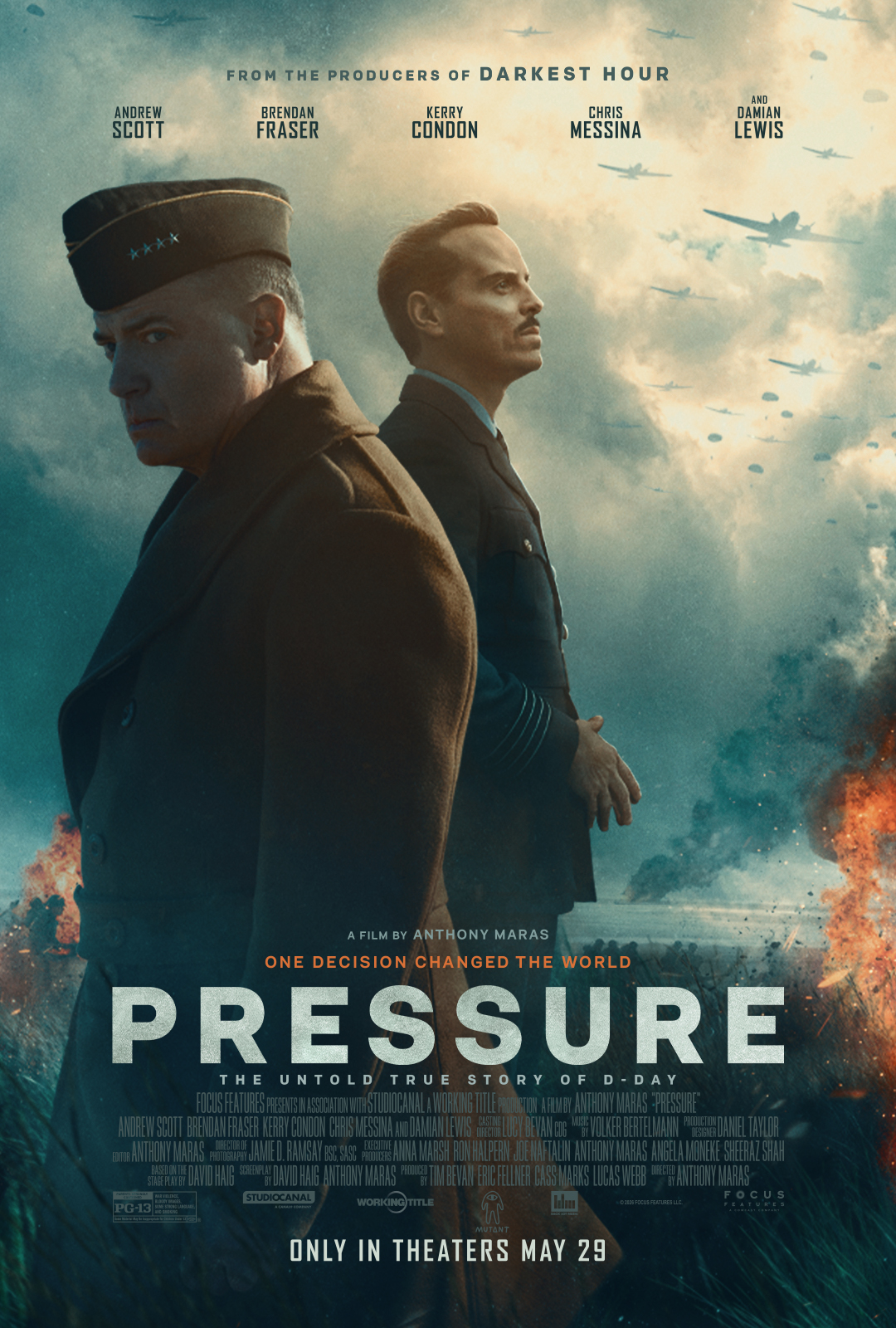 In the fantastic new World War II movie Pressure, Australian director Anthony Maras (Hotel Mumbai) finds a fresh angle to explore the events surrounding D-Day, by focusing specifically on the weather forecasts required to pull off the attack.
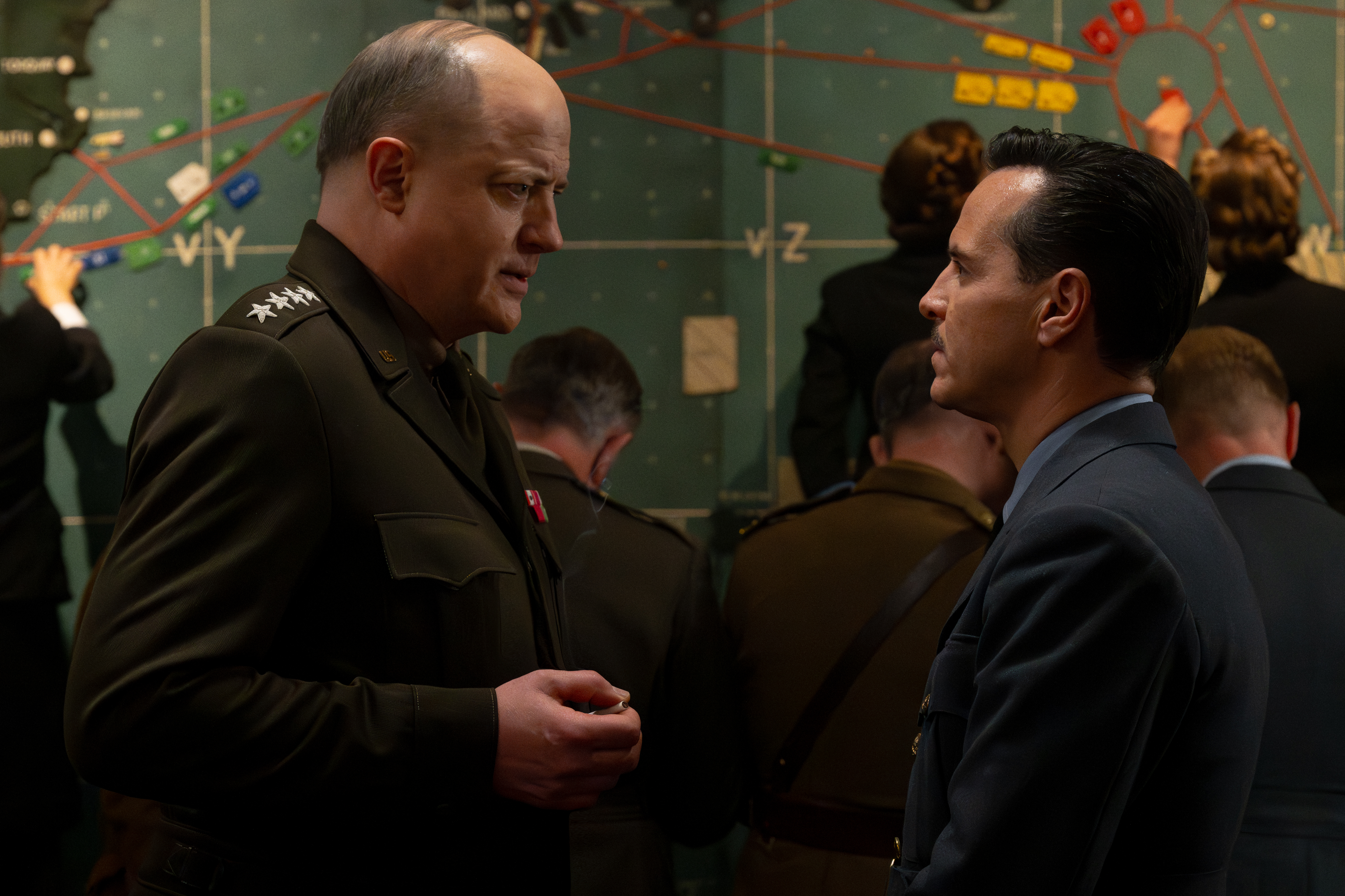
It’s a surprisingly gripping setup for this film, which Maras co-wrote with David Haig. Based on Haig’s 2014 stage play of the same name, a lot of Pressure unfolds in meeting rooms involving tense conversations between men in uniform hovering over maps and data, and it’s pretty riveting stuff, made all the more so thanks to a cast of actors who are all delivering a masterclass.
As such, Pressure offers a compelling snapshot of the logistics around one of the most consequential battles of the war, and the ingenuity of the Allied forces to pull it off. The film is set in the 72 hours leading up to D-Day in 1944, a tense three days when General Dwight D. Eisenhower (Brendan Fraser), stationed at Southwick House in England, must rely on the expertise of Group Captain James Stagg (Andrew Scott).
Stagg is the brilliant but somewhat aloof Scottish meteorologist who has been assigned to provide the definitive weather forecast for the attack. Stagg’s forecast will ensure whether or not their men can be safely sent to land on the beaches of Normandy for the largest seaborne invasion in history, which will determine the direction of the war.
Scott’s Stagg is presented as the film’s protagonist, with much of the tension involving his clashes with the American weatherman Irving P. Krick (Chris Messina). Krick, who mainly comes across like an arrogant prick for lack of a better word, would rather rely on historical data and weather patterns from these dates in the past. Stagg argues that this is irrelevant for current forecasts; he knows that the weather in Northern Europe is volatile, and sees the conditions forming for a storm coming on June 5th, the planned date of attack.
If they hold off the attack, the Germans will get wise to their plans and have time to prepare. But, if they send their men into a storm, and the tide is too high, they will be washed away. The weight of these decisions weigh heavily upon Stagg. Eisenhower wants absolute certainty, but Stagg reminds him that he can’t offer that, only his best calculations based on all available data. Eisenhower grows frustrated, Krick even more so. But Eisenhower’s assistant, Kay Summersby (Kerry Condon), a calming presence throughout the film, reminds the American general that Churchill himself believes Stagg is a genius.
This push and pull provides the main source of tension throughout Pressure, with Maras, who also edited the film, doing an excellent job of introducing the stakes and then raising them in a way that allows his film to build suspense and, well, pressure. What keeps his film so engaging to watch, aside from a carefully written and brilliantly structured screenplay that balances delivering information and developing dramatic arcs, are the performances.
Scott turns Stagg into a compelling central figure, portraying him as someone likely on the autism spectrum who doesn’t suffer fools gladly, and rubs many the wrong way because of his no-nonsense approach. A lot of this is internal, allowing Scott to carefully peel back emotional layers throughout the film, and making the moments when he does erupt with a monologue all the more gripping. It’s great work from him.
The clashes with Messina’s Krick present a battle of wills, personality, and intellect. For his part, Messina brings a facade of cockiness to Krick, but one that also shows some cracks. Fraser brings a toughness but also world-weariness to his portrayal of Eisenhower that is fascinating to watch, even if his physical resemblance to the historical figure might not be an exact match. Fraser portrays him as a man who has barely slept in days, his eyes showing a resolve in his acknowledgement that the weight of the free world rests on his shoulders.
In addition to being a worthy instalment into the pantheon of World War II movies (the ending of Pressure could lead right into the start of Steven Spielberg’s Saving Private Ryan), Pressure also delivers something else; the deep satisfaction of seeing smart people be proven right. As much as it is a story about weather reports, this is also a story about human choices, and the weight of them to impact the direction of human history.
At just a hundred minutes, the film is lean and paced like a thriller, with a score by Oscar-winning All Quiet on the Western Front composer Volker Bertelmann that is pounding and intense when it needs to be. The film’s final moments, when Maras finally releases a pressure valve, are beautifully played by Scott in a way that allows them to hit even harder on an emotional level.
Film Rating: ★★★½ (out of 4)