By John Corrado
 The name John Carney has become synonymous with a certain type of music drama. Ever since his debut film Once broke out in 2007, carried along by it’s Oscar-winning song “Falling Slowly,” the Irish filmmaker has carved out a nice little niche for himself crafting a series of very good films – Begin Again, Sing Street, Flora & Son – about musicians trying to make it big or finding unexpected success.
This brings us to Carney’s latest, Power Ballad, which seems, at least on paper, like his most commercial play, headlined by Paul Rudd and Nick Jonas in the starring roles. But the scrappy heart that exists behind all of Carney’s films still beats here, and it’s hard not to leave this film feeling completely satisfied. It’s a delight.
When Carney’s Begin Again premiered at TIFF back in 2013, it was under the title Can a Song Save Your Life? That got changed to the more generic Begin Again when Harvey Weinstein bought the film, and released it six months later. But “can a song save your life?” is really the question at the centre of all of Carney’s films, and Power Ballad continues this theme, as it follows a wedding singer having his life changed and nearly ruined by one.
Rick Power (Rudd) is a failed former rock star from America who now lives in Ireland with his wife Rachel (Marcella Plunkett) and teenaged daughter Aja (Beth Fallon). He performs as part of The Bride & Groove, a wedding band based out of Dublin that specializes in playing all the hits that people want to hear in the background at their reception. Sometimes he slips in one of his original tunes at the end of their sets, but the crowd isn’t interested in hearing it.
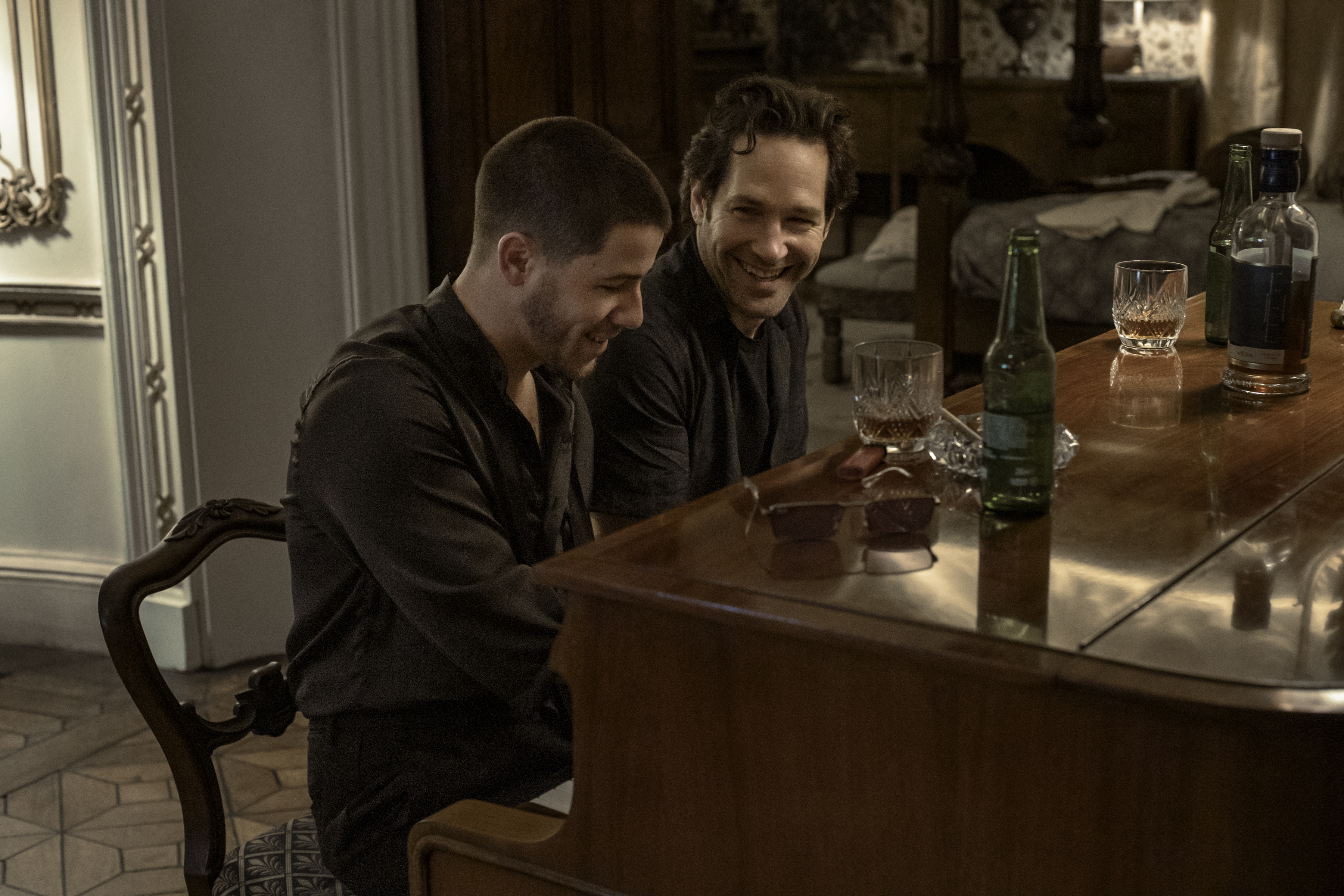
Rick’s life changes unexpectedly one night following a wedding gig that leads to him hanging out with Danny Wilson (Nick Jonas), a former boy band star turned solo artist who is friends with the couple getting married. They drink, and spend the night messing around on piano and guitar, sharing songs they’ve been working on and giving each other notes. Rick plays him a song he’s been trying to perfect for years but never recorded; a bittersweet if incomplete tune called “How to Write a Song Without You.”
Lo and behold, six months later, Rick hears his own song on the radio at the mall, with Danny recording “How to Write a Song Without You” and passing it off as his own. It provides a comeback hit for Danny, while Rick grows increasingly frustrated by his seemingly stalled out life, and being denied the life-changing opportunity that a credit on the track would’ve given him.
The crux of Carney’s film lies in exploring how both men react to this messy situation. Rick mainly just wants recognition for his song, while Danny leaves things to his ice cold manager Mac (Jack Reynor, reuniting with Carney following 2016’s Sing Street). It’s an engaging setup for a film, one that lets Carney explore the fallout and how it impacts both of their lives, crucially allowing the filmmaker to show the contrast between their vastly different lifestyles in a heartfelt way.
Rudd’s charming portrayal does a lot of the heavy lifting. Even if the comedy can go a bit broad at times, Rudd keeps it grounded, delivering some of his finest tragicomic work. Jonas does a good job as the former boy band star desperate for credibility as an actual artist, revealing more depth to his character in scenes with Rudd that he hides onstage. The middle sequence when it is just a hangout movie between the two of them is delightful, and makes the eventual betrayal sting even harder.
Something that Carney does so well in all of his films is showing the songwriting process and how a tune comes together, and the entirety of Power Ballad hinges on this. We have to believe that “How to Write a Song Without You” is both a song that Rick could’ve written, and one that turns into a major hit when Danny sings it. And like the centrepiece songs in previous Carney movies, the tune is good enough to work as both inside (and outside) the confines of the film.
Carney knows how to craft an immensely enjoyable film. Sure, some of the notes in Power Ballad might be familiar, with Carney exploring similar themes as his previous films (we even see a street musician performing “Falling Slowly” in a sly nod to his own earlier work). But he knows how to play these notes extremely well, and find new variations on them.
As such, Power Ballad plays out in incredibly satisfying fashion, as it builds to a beautifully done crescendo that delivers exactly what we want, and sends us off on a wonderful high note.
Film Rating: ★★★½ (out of 4)